 PlaceTube
CUBA: 60 Years of Isolation Created Something Nobody Expected | 4K Travel Documentary
Open in PlaceTube Watch on YouTube
Places in this video
- Moncada Barracks ▶ 0:10
The presenter describes the yellow walls of the Moncada Barracks, where Castro ordered the bullet holes from the 1953 attack reopened after 1959 as a visible record of the revolution's near failure.
- Malecón ▶ 1:53
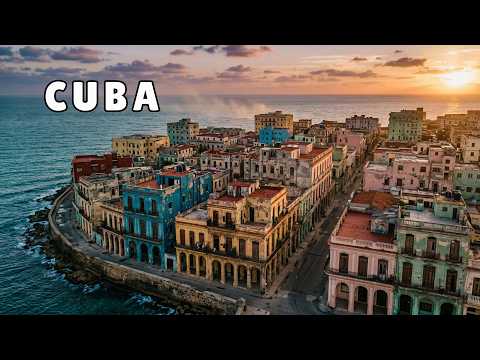
The 8 km seawall promenade along Havana's northern coast is shown as a living room for the city, filling at dusk with families, fishermen, domino players and couples watching the Atlantic crash against the stone.
- Old Havana ▶ 3:24
Walking in from the Malecón, the presenter describes narrow streets, Spanish colonial facades, iron balconies with drying laundry and cathedral squares where musicians play.
- Havana Cathedral ▶ 3:55
The cathedral has stood in its square since 1777; the presenter points out its asymmetrical towers, one wider than the other, a construction flaw that became a feature, and the morning light filling the square.
- Fusterlandia ▶ 5:06
On Havana's western edge, artist José Fuster's home, neighbors' houses and the whole street are covered in hand-laid ceramic mosaic of suns, fish and revolutionary figures.
- Viñales Valley ▶ 7:07
The presenter describes the limestone mogotes rising 200 m from the flat valley floor in Pinar del Río province, formed by 200 million years of erosion, and the fertile red soil where tobacco is grown.
- Viñales tobacco drying houses ▶ 9:00
Long wooden drying houses with ventilated walls hold tobacco leaves darkening from green to brown over eight weeks, in a particular quality of silence and intensifying smell.
- Cueva del Indio ▶ 9:37
Inside the limestone the temperature drops 10 degrees in 20 steps; the cave sheltered Taíno and runaway slaves, and hundreds of bats pour from its mouth at dusk.
- Jardines de la Reina ▶ 11:09
Columbus named this archipelago in 1494; the 2,000 sq km marine reserve has no permanent population and strictly regulated access, and its coral reefs are among the healthiest left in the Caribbean because the embargo removed pressure to develop.
- Playa Ancón ▶ 14:10
North of the reserve, 4 km of white sand against turquoise water where snorkeling begins in knee-deep water over the same abundance in shallower form.
- Trinidad ▶ 15:24
The presenter walks the original 16th- and 17th-century cobblestones, describing how sugar wealth built terracotta and ochre palaces around the Plaza Mayor and how poverty preserved the colonial streetscape.
- Church of the Holy Trinity ▶ 17:09
The church's neoclassical facade, worn to a pale yellow no paint manufacturer has replicated, rises above the north side of the Plaza Mayor.
- Plaza Mayor ▶ 17:09
At noon the light is flat and white, iron railings are painted cream, and the Church of the Holy Trinity rises above the north side; by late afternoon musicians fill the square with son cubano.
- Manaca Iznaga Tower ▶ 18:41
The 45 m tower built in 1816 in the sugar valley 5 km from Trinidad; its bell marked the working day across the cane fields, and the presenter stands at its base in the silence.
- Santiago de Cuba ▶ 20:02
The presenter describes Santiago as louder than Havana, with deeper African roots in its son, trova and Afro-Cuban ceremony, closer to Haiti and Jamaica than to Havana.
- Santa Ifigenia Cemetery ▶ 22:05
The cemetery on the city's western edge holds José Martí's mausoleum, designed so it receives direct sunlight for exactly two hours each day, with the Cuban flag moving above it.
- Calle Heredia ▶ 23:01
On Calle Heredia, in the squares and bar doorways, musicians play son cubano in amber afternoon light that smells of coffee and tobacco.
- Baracoa ▶ 24:34
Cuba's oldest city, founded in 1511, sits at the eastern tip surrounded on three sides by the Sierra del Purial and on the fourth by the sea, long accessible only by boat.
- Baracoa Cathedral ▶ 25:10
A wooden cross in the local cathedral is believed to have been left by Columbus himself; carbon dating suggests the wood is the right age, and it is kept under glass.
- Bahía de Miel ▶ 25:57
The Bay of Honey, named either for the bees in the coastal forest or the sweetness of the water where rivers meet the sea; fishing boats are pulled up on the beach below the seawall each evening.
- Sierra del Purial ▶ 26:44
The mountains behind Baracoa hold Cuba's largest remaining primary forest, never cleared because the terrain was too steep to farm and too remote to log, with cloud forest, tree ferns and orchids.
Cities in these videos
Santiago de Cuba · Havana · Viñales · Jardines de la Reina · Trinidad · Baracoa