 PlaceTube
Secrets of the Peloponnese: The Ruins That Shaped Ancient Greece
Open in PlaceTube Watch on YouTube
Places in this video
- Acrocorinth ▶ 1:43
A natural fortress overlooking the Isthmus of Corinth, occupied from the 6th century BC to the 19th century by Corinthians, Romans, Byzantines, Franks, Venetians and Ottomans.
- Ancient Corinth ▶ 2:18
One of the greatest cities of Ancient Greece, at the foot of the Acrocorinth, with its Temple of Apollo, the Pirene fountain and the Lechaion Road leading to the Agora.
- Temple of Apollo ▶ 2:34
One of the first Doric temples in continental Greece, dating to 540 BC, with seven monolithic columns still standing over seven meters high.
- Pirene Fountain ▶ 3:38
A fountain dating back to the 6th century BC with six stone arches and underground reservoirs, later embellished with a colonnade and basin by Herodes Atticus.
- Lechaion Road ▶ 4:12
A wide limestone road flanked by shops and temples on raised walkways that linked the port to the city and led to the Agora.
- Sanctuary of Asklepios at Epidaurus ▶ 5:24
The most famous site of Greek medicine, home to the best-known doctors, where athletic and theatrical events were held in honor of the gods.
- Theater of Epidaurus ▶ 5:40
The best-preserved ancient theater, built around 330 BC, seating up to 12,000 spectators and famous for its remarkable acoustics; it hosts the annual Festival of Epidaurus since 1955.
- Poros ▶ 7:43
A Greek island near Argolis with about 3,500 inhabitants, known for its hill overlooking the port, neoclassical houses and narrow streets.
- Poros Bell Tower ▶ 8:03
The most remarkable monument of Poros, a bell tower topped with a blue dome, built in 1927.
- Palamidi ▶ 9:40
A Venetian fortress on a hill 216 meters high above Nafplio, built between 1686 and 1715, with eight bastions and a magnificent view over the Argolic Gulf.
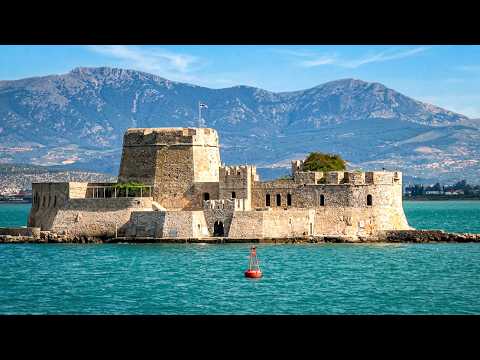
- Bourtzi ▶ 12:27
A fort guarding the entrance to Nafplio's port, completed by the Venetians in 1473, later a prison and a hotel, now a tourist attraction that occasionally hosts a music festival.
- Nafplio Old Town ▶ 13:07
The charming old town of Nafplio, capital of Argolid, with narrow streets full of bougainvilleas and tavernas serving mezedes with ouzo.
- Tiryns ▶ 14:43
An ancient Mycenaean city with a palace dating to 2000 BC, cyclopean walls and a beehive-shaped royal tomb.
- Mycenae ▶ 15:37
The Mycenaean site with grave circles of royal sepulchers, the Lion Gate, the royal palace on the citadel and the Treasury of Atreus tholos tomb.
- Lion Gate ▶ 17:07
The main entrance of Mycenae, with an enormous lintel topped by a relieving triangle carved with two lionesses flanking a central pillar, dating to 1250 BC.
- Treasury of Atreus ▶ 19:36
The best-preserved and most spectacular tholos tomb, also called the tomb of Agamemnon, with a 13.5-meter-high dome that was the biggest in the world for over a thousand years.
- Sparta ▶ 20:40
The ancient territory of the city-state of Sparta, one of the most powerful cities of Ancient Greece, which won the Peloponnesian War against Athens.
- Mystras ▶ 22:05
A Byzantine city founded after a fortress was built in 1249, later the second biggest city of the empire, now a UNESCO-listed archaeological site with churches, monasteries and a palace.
- Metropolis of Mystras ▶ 23:53
The church of the metropolis in the lower city, built in the late 13th century by Nicephorus, with Byzantine domes and frescoes from the 13th and 14th centuries.
- Church of Saint Demetrius ▶ 25:13
A basilica divided into three naves by columns, with a traditional Byzantine altar and paintings from the late 13th and early 14th centuries.
- Evangelistria Church ▶ 26:29
A cross-plan church probably built in the late 14th or early 15th century, apparently never converted into a mosque by the Turks.
- Monastery of Pantanassa ▶ 27:02
The best-preserved building of Mystras and the only one still occupied, by a half dozen nuns; founded in 1424, it shows Frankish influence in its bell tower and Gothic windows.
- Palace of Mystras ▶ 30:15
The palace of the region's leaders, an L-shaped complex with a throne room 36 meters by ten meters, heated by eight chimneys.
- Church of Saint Sophia ▶ 30:32
A church built around 1350 by the first Byzantine leader of the Peloponnese to recall Constantinople's Hagia Sophia, later converted into a mosque during the Ottoman occupation.
- Monastery of Peribleptos ▶ 33:33
A 14th-century monastery built on the face of a cliff in the prolongation of a cave, with a well-preserved katholikon covered in frescoes depicting Christ, the apostles and the Virgin Mary.
- Hydra ▶ 36:35
A beautiful island near the eastern Peloponnese coast, cosmopolitan and popular with celebrities and artists, with a picturesque capital of narrow streets and red-tile-roofed houses and no motorized traffic.
- Olympia ▶ 38:42
A religious sanctuary dedicated to Zeus in the western Peloponnese, in a sacred grove of wild olive trees, where the Olympic Games were celebrated since 776 BC.
- Philippeion ▶ 39:26
A round building with ionic columns erected by order of Philip II of Macedonia in 338 BC, containing statues of his family and commemorating a military victory.
- Heraion of Olympia ▶ 40:18
A temple devoted to Hera, probably the first known Doric edifice in the Peloponnese, dating to about 600 BC, where the Olympic torch is lit.
- Stadium of Olympia ▶ 41:47
The stadium created in the Classical period, with a monumental entrance, a starting line of stones and room for 45,000 spectators who had no seats.
- Temple of Zeus at Olympia ▶ 43:01
A colossal 64-meter Doric temple built around 450 BC that contained the golden ivory statue of Zeus, one of the seven ancient wonders of the world.
- Workshop of Phidias ▶ 44:11
The building identified as the workshop where Phidias created the gold and ivory statue of Zeus, later built over by a Byzantine church.
- Palaestra of Olympia ▶ 44:57
A small training gym where athletes trained in wrestling and jumping, with porticos and rooms where they rubbed themselves with olive oil or powder and ash.
- Archaeological Museum of Olympia ▶ 45:15
The museum housing the vestiges of Olympia, including the famous pediments of the Temple of Zeus, the Nike of Paionios and Roman statues.
Cities in these videos
Corinth · Epidaurus · Poros · Nafplio · Tiryns · Mycenae · Sparta · Mystras · Hydra · Olympia