 PlaceTube
DRESDEN, Germany - Old Town, Elbe & Neustadt Walking Tour - 4K HDR
Open in PlaceTube Watch on YouTube
Places in this video
- Postplatz ▶ 0:55
The walk begins at Postplatz, one of Dresden's main tram intersections, which was once the site of a fortified city gate and got its name in 1865 from the nearby main post office.
- Zwinger ▶ 1:48
The presenter explores the Baroque Zwinger, built from 1711 for Augustus the Strong as a place for royal celebrations and orange trees, and notes its Crown Gate, fountains and gardens reopened after restoration in 2025.
- Old Masters Picture Gallery ▶ 4:05
Inside the Semper building in the Zwinger, around 700 paintings are displayed, with Raphael's Sistine Madonna as the star alongside works by Rembrandt, Vermeer and Canaletto.
- Theaterplatz ▶ 5:12
The square is surrounded by the Semper Opera House, the Catholic Cathedral and the Royal Palace, and takes its name from the former Royal Court Theatre.
- Semper Opera House ▶ 6:54
The opera house opened in 1878, was destroyed in the 1945 bombing and reopened exactly 40 years later in 1985 with Weber's Der Freischütz.
- Cathedral of the Holy Trinity ▶ 7:53
Built between 1739 and 1755 for Saxony's Catholic royal family, the cathedral has an 86-metre tower, 78 sandstone figures and a royal crypt containing the heart of Augustus the Strong.
- Hausmann Tower ▶ 9:25
The tower rises just over 100 metres above the old town, with its oldest sections dating to around 1400, and visitors can climb it for views across the city and the Elbe.
- Procession of Princes ▶ 11:27
The 102-metre mural along Augustus Street is made of around 23,000 Meissen porcelain tiles and depicts Saxony's Wettin rulers on horseback through nearly 800 years of history.
- Stableyard ▶ 13:02
Completed in 1591 for Elector Christian I, this courtyard hosted knightly tournaments and is considered the world's oldest surviving courtly tournament ground in its original design.
- Augustus Street ▶ 13:56
The street links Palace Square with the Neumarkt, dates back to the 16th century and runs beside the Long Corridor, whose walls carry the Procession of Princes.
- Neumarkt ▶ 14:28
The New Market square was almost entirely destroyed in 1945 and has been rebuilt block by block since reunification, with historic-looking façades in front of modern buildings.
- Frauenkirche ▶ 15:04
The Church of Our Lady was completed in 1743, collapsed after the 1945 bombing, and was rebuilt with donations from around the world and reopened in 2005; its 91-metre dome has a viewing platform.
- Transport Museum ▶ 15:44
Occupying the Renaissance Johanneum, the museum has displayed the history of trains, automobiles, ships and aircraft, including historic vehicles and model railways, since 1956.
- Rampische Street ▶ 17:36
The presenter walks through this favourite area for visitors while discussing Dresden's tourism figures and overnight stays.
- Kurländer Palace ▶ 18:38
Built in 1728 and 1729 for Count Wackerbarth, the palace later housed medical institutions, survived as a war ruin and was reconstructed between 2006 and 2008.
- Georg Treu Square ▶ 20:21
The small green square is named after an archaeologist and features a grieving bronze figure inscribed "Dresden warns", recalling the destruction of 1945.
- Brühl's Terrace ▶ 20:56
The elevated walkway stretches roughly 500 metres along the former fortress walls, was opened to the public in 1814 and is nicknamed the Balcony of Europe.
- Albertinum ▶ 21:29
Built as a weapons store in the 1560s and converted into a museum in the 1880s, it now houses paintings by Caspar David Friedrich and sculptures by Rodin, with a flood-protection structure added after 2002.
- Dolphin Fountain ▶ 22:10
The fountain dates from 1750 and shows a winged child riding a dolphin above a 14-metre-wide pool; the original sculpture is kept at Rammenau Castle.
- Dresden Fortress Museum ▶ 23:39
The museum takes visitors through underground passages, cannon chambers and a brick city gate more than 450 years old, with the Fortress Xperience exhibition using projections and sound.
- Academy of Fine Arts ▶ 23:58
Built between 1887 and 1893 to designs by Constantin Lipsius, its folded glass dome is nicknamed the Lemon Squeezer and topped by a 4.8-metre gilded figure of Fame.
- Münzgasse ▶ 25:05
The pedestrian street, once called Great Fishermen's Lane, is now filled with restaurants and outdoor tables leading towards the Frauenkirche.
- Earth and Planets sculpture ▶ 25:46
The bronze globe was created in 1988 by Vinzenz Wanitschke, with seven plaques recalling Dresden's fortress bastions named after planets in 1721.
- Sekundogenitur ▶ 26:39
The small palace was built in 1896 and 1897 for Prince Johann Georg, burned out in 1945 and was later reconstructed as part of the Hilton hotel complex.
- Radeberger Spezialausschank ▶ 27:33
In the former bridge keeper's house beside the Elbe, Radeberger Pilsner is served directly from large copper tanks, along with unfiltered Zwickel available on draft only here.
- Royal Palace ▶ 29:16
Home to Saxony's rulers for centuries, the palace now houses major museums including the Green Vault with its royal jewellery and the Dresden Green Diamond.
- Augustus Bridge ▶ 29:51
The 390-metre bridge opened in 1910, replacing an older stone bridge, and is used by trams, cyclists and pedestrians but not ordinary cars.
- Neustadt ▶ 31:54
The New Town, once called Altendresden, was rebuilt with broad streets and Baroque houses after an 1685 fire, while the Outer Neustadt has 19th-century streets full of shops, bars and street art.
- Augustus Garden ▶ 33:20
The large riverside beer garden overlooks Dresden's historic skyline and offers outdoor tables, grilled food and Saxon beer near the Augustus Bridge.
- Neustadt Market ▶ 33:35
The square marks the entrance to the Baroque quarter and is home to the Golden Horseman; its present layout was largely created between 1974 and 1979 under East German rule.
- Elbe Cycle Route ▶ 34:16
The long-distance route follows the Elbe for about 1,270 kilometres from the Czech mountains to the North Sea, with mostly flat paths popular around Dresden.
- Canaletto View ▶ 36:45
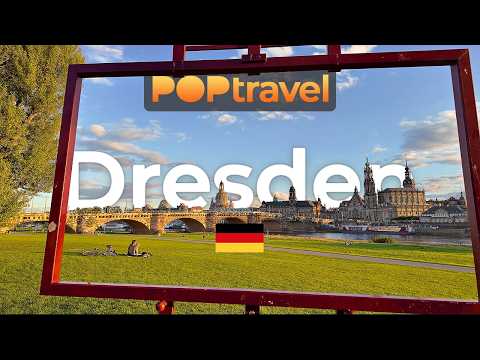
From this bank of the Elbe, a special viewing frame lets visitors compare Bernardo Bellotto's 1748 painting with today's skyline of the Frauenkirche, cathedral and Royal Palace.
- Three Graces Fountain ▶ 38:12
Created in 1983 and 1984 by Vinzenz Wanitschke, the fountain features three seated women around a sandstone basin and was repaired after the 2002 flood.
- Bilderberg Bellevue Hotel ▶ 38:31
Opened in 1985 as an East German luxury hotel incorporating a Baroque building, it mainly welcomed Western visitors and was where Helmut Kohl met Hans Modrow in December 1989.
- Elbsegler beer garden ▶ 40:06
The seasonal beer garden belonging to the Bellevue Hotel sits beside the Elbe, where a glass of Radeberger Pilsner comes with a view of the old town.
- Blockhaus ▶ 40:38
The Baroque building was constructed from 1732 as a guardhouse for Neustadt and since 2024 has housed the Archive of the Avant-Gardes.
- Golden Rider ▶ 42:44
The gilded statue of Augustus the Strong in Roman armour was unveiled in 1736, faces east towards Poland, and was restored in 2003 with around 500 grams of gold leaf.
- Hauptstraße ▶ 43:57
The wide pedestrian avenue and its prefabricated apartment blocks were built mainly between 1974 and 1979, when it was called Liberation Street, and it is now a popular shopping street.
- Church of the Three Kings ▶ 46:22
Built between 1732 and 1739, the church has an 87.5-metre sandstone tower and a 12-metre stone relief from 1534 depicting the Dance of Death; it housed Saxony's state parliament from 1990 to 1993.
- Neustadt Market Hall ▶ 48:05
Opened in 1899, the hall measures 86 by 30 metres with a roof 17 metres above the floor; after war damage and use as a department store, it reopened in 2000 with shops and food stalls.
- Albertstraße ▶ 50:34
The 500-metre road was laid out in 1892 through former military grounds, named after King Albert of Saxony and later called Street of Unity under East German rule.
- Albertplatz ▶ 52:48
The square is home to the Erich Kästner Museum and two large fountains, Still Waters and Stormy Waves, created by Robert Diez and unveiled in 1894.
- Erich Kästner Museum ▶ 52:48
The museum occupies the former villa of Kästner's wealthy uncle at Albertplatz, recalling the writer born in Dresden in 1899, famous for Emil and the Detectives.
- Still Waters and Stormy Waves fountains ▶ 53:50
The two fountains by Robert Diez were unveiled in 1894, with 18-metre granite basins and bronze figures; the western one was removed after the war and returned in 1994.
- Alaunstraße ▶ 56:43
The heart of the Outer Neustadt became a centre for alternative culture after 1989, now filled with restaurants, small shops, street art and music venues.
- Louisenstraße ▶ 58:50
Along with Alaunstraße and Görlitzer Straße, this street forms Dresden's main nightlife district, with bars, clubs and the Louisengarten beer garden at number 43.
- Görlitzer Straße ▶ 1:03:41
The street received its present name in 1882, named after the Saxon city of Görlitz, and connects to the Kunsthofpassage courtyards.
- Kunsthofpassage ▶ 1:05:14
The project begun in 1997 connects Görlitzer Straße with Alaunstraße through five decorated courtyards, including the Courtyard of the Elements with its musical drainpipes and the Courtyard of Animals.
- Planwirtschaft ▶ 1:12:30
The pub on Louisenstraße is named after the planned economy and its décor recalls everyday life in East Germany, now operating as a private business.
- Königsbrücker Straße ▶ 1:14:54
At number 66 Erich Kästner was born in a small attic apartment in 1899, and his family later moved to number 48 where he spent much of his childhood.
- Pfund's Dairy ▶ 1:15:29
Founded in 1880, the dairy's tiled shop opened in 1892 and entered the Guinness Book of Records in 1997 for its interior decorations covering around 248 square metres; it also appeared as Mendl's in The Grand Budapest Hotel.
- Yenidze ▶ 1:17:51
The mosque-like building with a colourful dome and minaret opened in 1909 as a cigarette factory, with the minaret concealing the factory chimney and the dome now housing a restaurant.
- Antonstraße ▶ 1:19:51
Named after King Anton of Saxony, the street follows part of the former city fortifications and leads towards Dresden-Neustadt station past older houses and busy tram tracks.
- Dresden-Neustadt station ▶ 1:22:54
The grand sandstone station opened in 1901, with an Art Nouveau entrance hall and a steel-and-glass roof stretching 146 metres above eight platform tracks; the walk ends here.