 PlaceTube
Türkiye (1): Istanbul & the Northwest | See the World Ep 43
Open in PlaceTube Watch on YouTube
Places in this video
- Hagia Sophia ▶ 4:08
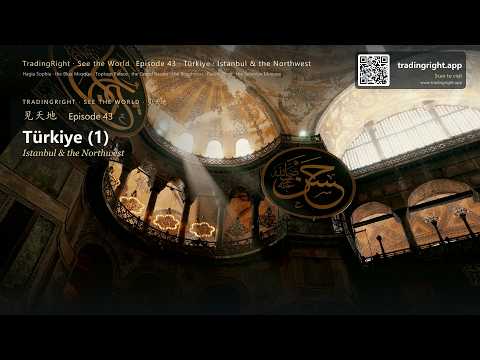
The journey begins in Istanbul's old city at Hagia Sophia, built by Justinian and completed in 537; its great dome was the largest church in the world for nearly a thousand years, and it has been a mosque, a museum and a mosque again.
- Sultan Ahmed Mosque (Blue Mosque) ▶ 4:58
Facing Hagia Sophia stands the Sultan Ahmed Mosque, completed in 1616 with six minarets and lined with more than twenty thousand İznik tiles, which is why it is called the Blue Mosque.
- Hippodrome of Constantinople ▶ 5:16
Beside the Blue Mosque lies the old Roman Hippodrome, where an Egyptian obelisk some three and a half thousand years old still stands.
- Basilica Cistern ▶ 5:32
Steps lead down into the dim Basilica Cistern, built in 532, where 336 columns stand in rows in the water like a sunken palace, and two columns rest on heads of Medusa.
- Topkapı Palace ▶ 6:07
Topkapı Palace stands where the Golden Horn, the Bosphorus and the Sea of Marmara meet; built by Mehmed the Second in 1459, it was the sultans' home for nearly four hundred years and shows the 86-carat Spoonmaker's Diamond.
- Grand Bazaar ▶ 6:44
The Grand Bazaar is a covered market begun in the fifteenth century, one of the oldest and largest in the world, with some four thousand shops crowding more than sixty lanes.
- Spice Bazaar ▶ 7:00
In the nearby Spice Bazaar, the scents of saffron, pepper and Turkish delight fill the arcades.
- Süleymaniye Mosque ▶ 7:15
The domes of the Süleymaniye Mosque look over the Golden Horn; designed by Sinan for Suleiman the Magnificent and completed in 1557, it was a complete complex with schools, a hospital, baths and a soup kitchen, and both ruler and architect are buried here.
- Galata Tower ▶ 7:48
Across the Galata Bridge, lined with anglers, the cone-topped Galata Tower rises; built by Genoese merchants in 1348, it is about sixty-seven metres tall and legend says a scholar once flew from its top on wooden wings.
- Dolmabahçe Palace ▶ 8:23
Dolmabahçe Palace stands on the water, completed in 1856 in a blend of European Baroque and neoclassical styles; its Ceremonial Hall holds a huge crystal chandelier, and Atatürk died here in 1938, with the clocks still set to 9:05.
- Bosphorus ▶ 8:44
By boat the film enters the Bosphorus, about thirty-one kilometres long and only about seven hundred metres wide at its narrowest, with Europe on one side and Asia on the other, lined with wooden waterside mansions, mosques and fishing villages.
- Rumeli Fortress ▶ 9:04
In 1452 Mehmed the Second built Rumeli Fortress in just a few months, ready for his assault on Constantinople the following year.
- Princes' Islands ▶ 9:20
A ferry ride southeast from Istanbul brings us to the Princes' Islands, nine islands where fallen princes and nobles were exiled in Byzantine times; private cars are banned, so people cycle or walk past old wooden mansions.
- Büyükada ▶ 9:58
From the hilltop of Büyükada, the largest of the Princes' Islands, the skyline of Istanbul shimmers far across the water.
- İznik ▶ 9:58
Across the Sea of Marmara lies İznik on its lake, ancient Nicaea, where the First Council of Nicaea met in 325 and drew up the Nicene Creed; its cobalt tiles adorned Istanbul's mosques and palaces.
- Bursa ▶ 10:32
At the foot of Mount Uludağ lies Bursa, taken by the Ottomans in 1326 and made the first capital of their empire, with its Grand Mosque, silk trade and the birthplace of İskender kebab.
- Grand Mosque of Bursa ▶ 10:52
Bursa's Grand Mosque, finished at the end of the fourteenth century, has twenty domes and walls covered in great works of calligraphy.
- Cumalıkızık ▶ 11:08
In 2014 Bursa and the nearby village of Cumalıkızık became a World Heritage Site as the birthplace of the Ottoman Empire.
- Assos ▶ 11:08
Southwest along the Aegean coast lies ancient Assos on a volcanic hilltop above the stone village of Behramkale, where Aristotle lived and taught in the fourth century BC.
- Temple of Athena at Assos ▶ 11:24
On the summit of Assos stands a temple of Athena from around the sixth century BC, with a few restored columns facing the sea wind and the Greek island of Lesbos across the strait.
- Troy ▶ 11:41
Near the mouth of the Dardanelles rises the mound of Hisarlık, the legendary Troy, where at least nine cities rose and fell; Heinrich Schliemann dug here in the 1870s, and a great wooden horse recalls the Trojan War.
- Gallipoli Peninsula ▶ 12:17
Across the Dardanelles lies the Gallipoli Peninsula, where the 1915-16 campaign of the First World War was fought; today it is a historical national park with the Çanakkale Martyrs' Memorial and cemeteries of many nations.
- Çanakkale Martyrs' Memorial ▶ 12:50
The Gallipoli peninsula is a historical national park with the Çanakkale Martyrs' Memorial and cemeteries of many nations on its hills and bays.
- Anzac Cove ▶ 12:50
Every April many Australians and New Zealanders gather at Anzac Cove for a dawn service of remembrance.
- Selimiye Mosque ▶ 13:05
In Edirne, once an Ottoman capital, stands the Selimiye Mosque, completed in 1575, which Sinan in his eighties called the finest work of his life; its dome rests on eight great piers and its four minarets rise more than seventy metres.