 PlaceTube
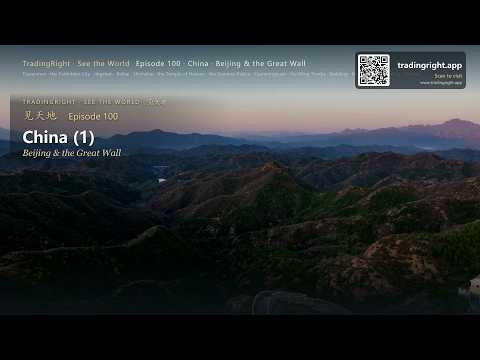
China (1): Beijing & the Great Wall | See the World Ep 100
Open in PlaceTube Watch on YouTube
Places in this video
- Tiananmen ▶ 3:56
The journey begins at Tiananmen, a gate of red walls and yellow tiles built in the early 1400s, the main entrance to the imperial city, with five marble bridges before it and a huge square to the south where a flag-raising ceremony is held each morning.
- Forbidden City ▶ 4:34
Through the Meridian Gate we enter the Forbidden City, completed in 1420, palace of the Ming and Qing emperors and one of the largest complexes of ancient wooden buildings on Earth, now the Palace Museum with more than 1.8 million objects.
- Hall of Supreme Harmony ▶ 4:52
The greatest hall of the Forbidden City saw coronations and imperial weddings, and ten guardian figures on its roof mark the highest rank.
- Jingshan Park ▶ 5:09
Opposite the palace's north gate rises Jingshan, a hill heaped up from earth dug for the moat, with five pavilions on its crest; from Wanchun Pavilion the golden roofs of the Forbidden City spread towards Tiananmen at dusk.
- Beihai Park ▶ 5:45
One of China's oldest imperial gardens, begun in the Liao and Jin era, with the White Dagoba on Jade Flower Island, the Nine-Dragon Screen on the north shore, and boats gliding through lotus on the lake in summer.
- White Dagoba ▶ 5:45
The White Dagoba stands on Jade Flower Island in Beihai Park, built in 1651 and about thirty-six metres high.
- Shichahai ▶ 6:17
Three linked lakes and the liveliest corner of old Beijing; a pedicab ride through the hutongs passes grey-brick courtyards and vermilion gates, and at night lights glow by the Silver Ingot Bridge with music from the bars along the shore.
- Drum and Bell Towers ▶ 6:36
Near Shichahai, the Drum and Bell Towers mark the north end of the central axis, and the bronze bell, about 63 tonnes, once told the hours.
- Lama Temple ▶ 6:36
Once the home of the Yongzheng Emperor as a prince and made a lamasery in 1744, its red-walled halls follow one courtyard after another; a Maitreya Buddha is carved from a single sandalwood trunk, eighteen metres above ground and eight below.
- Temple of Heaven ▶ 7:14
Completed in 1420, where emperors prayed to heaven for good harvests; the Hall of Prayer for Good Harvests rises about thirty-eight metres under a triple roof of blue tiles, and at dawn in the cypress groves people practise tai chi and sing opera.
- Central Business District ▶ 7:51
East of the old axis, the towers of the Central Business District trace the skyline of modern Beijing.
- CITIC Tower ▶ 7:51
About 528 metres high and shaped like an ancient vessel called a zun, it is the tallest building in the city.
- CCTV Headquarters ▶ 8:11
About 234 metres high, it joins two leaning towers with a bend in mid-air.
- 798 Art District ▶ 8:11
Further northeast, the red-brick factories of the 798 Art District are now full of galleries, sculpture and cafés.
- Olympic Park ▶ 8:29
The Olympic Park hosted the 2008 Summer and 2022 Winter Games, making Beijing the first city to host both; at night the Bird's Nest and the Water Cube glow red and blue.
- National Stadium (Bird's Nest) ▶ 8:29
The National Stadium is woven from a lattice of steel, like a giant bird's nest.
- Water Cube ▶ 8:49
Beside the Bird's Nest, the Water Cube, clad in blue bubbles, became the Ice Cube for curling in 2022.
- Old Summer Palace ▶ 9:07
Begun in 1709 and expanded over a century and a half into the garden of gardens; in 1860 British and French troops looted and burned it, leaving only broken columns and arches, and today the ruins of the Great Fountain stand quietly in the grass.
- Summer Palace ▶ 9:40
Around Longevity Hill and Kunming Lake, one of the best-preserved imperial gardens in China, with the Tower of Buddhist Incense, the 728-metre Long Corridor painted with more than fourteen thousand pictures, and the Seventeen-Arch Bridge lit at the winter solstice.
- Ming Tombs ▶ 10:02
Beneath Tianshou Mountain, thirteen Ming emperors lie at rest; along the Sacred Way stone lions, elephants, camels and officials have kept watch for centuries, and the vault of Dingling was excavated in the 1950s.
- Changling ▶ 10:20
The largest of the Ming Tombs, the tomb of the Yongle Emperor, its great hall held up by single trunks of golden nanmu.
- Badaling Great Wall ▶ 10:36
About seventy kilometres northwest, beyond the Juyongguan gorge, the Great Wall at Badaling was built in 1505, its walls about 7.8 metres high and wide enough on top for five horses abreast, rising and falling along the ridges; in 1957 it became the first section opened to visitors.
- Mutianyu Great Wall ▶ 11:12
Northeast in Huairou, the Great Wall at Mutianyu slips in and out of view among wooded hills, rebuilt in the Ming dynasty with more than twenty watchtowers close together; visitors can ride a cable car up and come back down by toboggan.
- Jinshanling Great Wall ▶ 11:49
Across the border in Hebei, built under the Ming general Qi Jiguang, it is dense with watchtowers of many designs and praised as the finest stretch of all, keeping much of its weathered original look; at dawn a sea of cloud rises from the valleys.
- Simatai Great Wall ▶ 12:07
At Gubeikou, the Simatai Great Wall climbs a steep ridge into the clouds; from Wangjing Tower, nearly a thousand metres up, it is said the lights of Beijing show on a clear night.
- Gubei Water Town ▶ 12:25
At the foot of Simatai, Gubei Water Town brings stone lanes, little bridges and canal-side houses, the feel of a southern water town, to the northern hills; as night falls, lights come on along the wall.