 PlaceTube
Domus Flavia
Rome, Italy · Videos: 10 · Map
Palace on the Palatine Hill in Rome, Italy
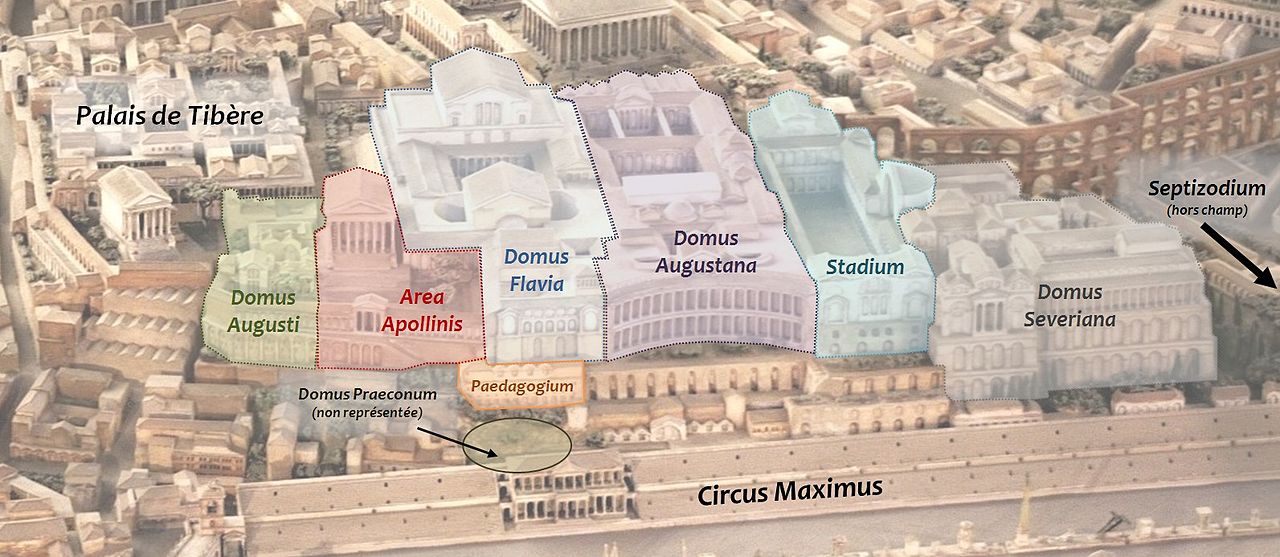
The Flavian Palace, commonly known as the Domus Flavia, forms part of the extensive Palace of Domitian on the Palatine Hill in Rome. It was completed in AD 92 by the emperor Domitian and is attributed to his architect Rabirius. The term Domus Flavia is a modern designation for the northwestern section of the palace, where most of the large public rooms used for official business, entertainment and ceremony were concentrated. Although Domitian was the last emperor of the Flavian dynasty, the palace continued to be used, with modifications, until the end of the Roman Empire. It is connected to…
What travel creators say
Emperor Domitian was stabbed to death in his bedroom here in 96 AD; the palace is open today on the Palatine Hill on the same ticket as the Colosseum and Forum.
The palace complex built by Emperor Domitian in the late 1st century AD, the center of power where he met advisors and held banquets, later damaged by fire and abandoned.
Completed in 92 AD by Domitian, this was the part of the palace with the large public rooms for official business, entertaining and ceremony.
The guide shows the public part of the imperial palace, where the emperor judged and received ambassadors, kings and senators, with a fountain and polychromatic marbles.
The major archaeological feature on the hill, built by Emperor Domitian in 96 AD and the largest home ever occupied by an emperor, complete with polished marble gardens so he could spot assassins.
Completed in 92 AD by Emperor Domitian, the northwestern section of the palace holding the large public rooms for entertaining and ceremony, centered on a peristyle with an octagonal fountain.
From videos in other languages
공식 의식과 알현이 열렸던 곳으로, 지금은 벽과 기둥의 흔적만 남아 2천 년의 세월을 느끼게 한다.
A Domitianus-palota maradványai a Palatinuson, patinás aranysárga falaikkal; a Septimius Severus-fürdő teraszáról áttekinthető az egész Circus Maximus.
El Palacio de Domiciano se dividía en tres secciones; la Domus Flavia era el ala pública del palacio.
Ruinas de las lujosas residencias imperiales, con frescos y mosaicos que reflejan el lujo de la época.