 PlaceTube
Roque de los Muchachos Observatory
La Palma, Spain · Videos: 23 · Map
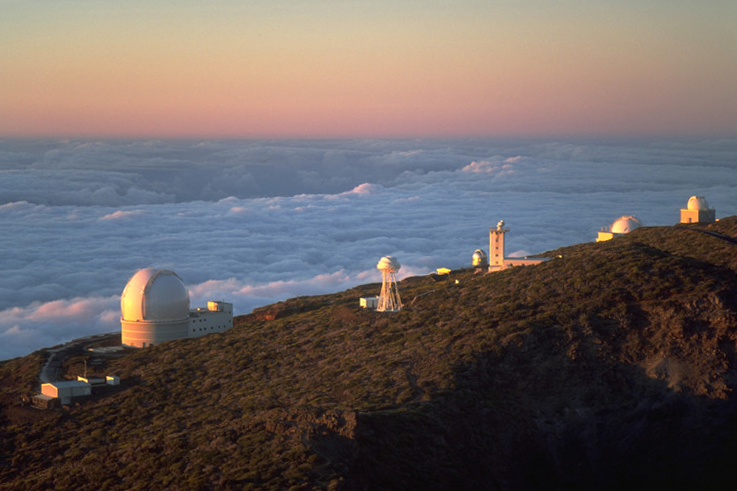
Astronomical observatory on La Palma, Canary Islands
Roque de los Muchachos Observatory is an astronomical observatory located in the municipality of Garafía on the island of La Palma in the Canary Islands, Spain. The observatory site is operated by the Instituto de Astrofísica de Canarias, based on nearby Tenerife. ORM is part of the European Northern Observatory.
What travel creators say
One of the world's premier astronomical observatories at 2,426 meters on the island's highest peak, home to some of the largest telescopes on Earth thanks to over 300 clear nights a year.
At 2,400 m the road ends at the roof of the island, where telescopes sit because La Palma was the first place to legally protect its night sky; the presenter points out the largest optical telescope, the LSTs hunting gamma rays, and the Galileo telescope.
At over 2,400 m, home to one of the world's most important observatories, where scientists study the night sky with almost no light pollution.
At 2,426 m on La Palma, the observatory hosts one of the world's largest telescope arrays and is described as the second-best stargazing spot in the northern hemisphere.
A famous observatory that takes advantage of La Palma's exceptionally clear skies, one of the best places in the world for astronomical observations, with guided tours.
Home to some of the world's most powerful telescopes, in a stargazer's paradise.
The second-best place to see stars in the Northern Hemisphere, home to Europe's biggest and most expensive telescopes such as the Herschel, Galileo and Isaac Newton telescopes.
Founded in 1969, the observatory is home to Europe's biggest telescopes, including the Galileo, William Herschel and Isaac Newton telescopes, and people come up to admire the exceptionally clear stars.
An observatory perched high above the clouds where you can marvel at the clarity of the night sky far from light pollution.
An astronomy observatory at the island's highest point, regarded as one of the best places in the world to view the stars.
From videos in other languages
En las inmediaciones aparecen las instalaciones del observatorio.
Nahe dem Gipfel analysieren zahlreiche große Observatorien Sterne, Licht und Sonne; einige sind im Rahmen einer Führung von innen zu besichtigen.
Obserwatorium astronomiczne na szczycie; dzięki wysokości i czystemu niebu to wyjątkowe miejsce do obserwacji gwiazd.
Complexe d'astrophysique installé en 1985 accueillant notamment le Grand Télescope optique infrarouge.
Neben Chile und Hawaii bieten die Kanaren die beste Möglichkeit, den Sternenhimmel zu beobachten, und daher sind Teleskope von verschiedenen Ländern hier positioniert.
Al llegar a la cumbre ven los telescopios del observatorio y comentan que allí vienen países de todo el mundo e incluso la NASA a investigar.
Complejo con los mejores telescopios del mundo que aprovechan el cielo limpio de la isla para estudiar el universo.
Gli osservatori astronomici tra i più fortunati del mondo, scelti per il cielo pulitissimo; qui c'è anche il Telescopio Nazionale Galileo, non visitabile liberamente, mentre l'osservatorio vicino si visita su prenotazione.
Se destaca por sus telescopios impresionantes y vistas panorámicas, una visita obligada para los amantes de la astronomía y la ciencia, con la posibilidad de disfrutar de una noche bajo las estrellas.
Estación astronómica desde la que se ven las estrellas de forma brutal, muy frecuentada por fotógrafos.
Observatorio Internacional de Astrofísica con más de 10 telescopios, incluido el mayor de Europa con más de 4 m de diámetro.
Uno de los complejos de telescopios más completos del mundo, en el techo de la isla, gracias a la estabilidad atmosférica y la ley de protección del cielo.
À plus de 2000 mètres d'altitude se trouve un observatoire qui fait partie des meilleurs lieux de la planète pour observer les étoiles, grâce à un ciel parmi les plus purs du monde protégé par une loi sur la pollution lumineuse.