 PlaceTube
Welland Canal
Welland, Canada · Videos: 24 · Map
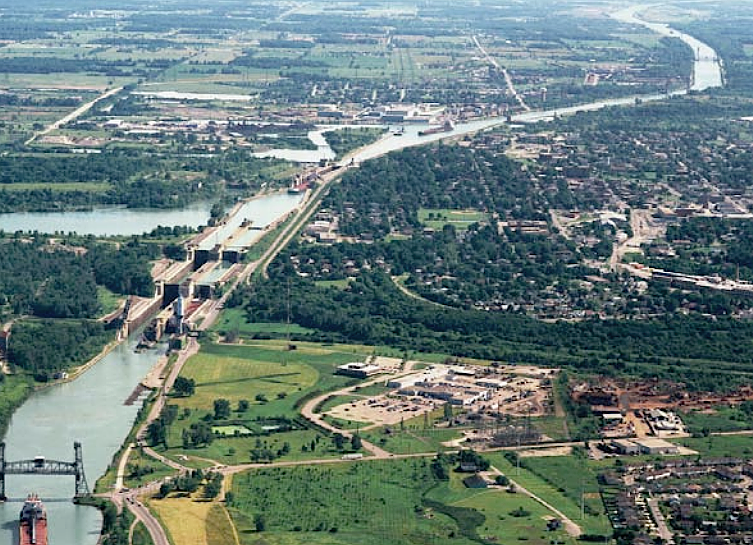
Ship canal in Ontario, Canada, connecting Lake Ontario and Lake Erie
The Welland Canal is a ship canal in Ontario, Canada, and part of the St. Lawrence Seaway and Great Lakes Waterway. The canal traverses the Niagara Peninsula between Port Weller on Lake Ontario and Port Colborne on Lake Erie, and was built because the Niagara River—the only natural waterway connecting the lakes—was unnavigable due to Niagara Falls. The Welland Canal enables ships to ascend and descend the Niagara Escarpment, and has followed four different routes since it opened.
What travel creators say
The presenter comes across the remnants of the second Welland Canal, built around 1845 and used until 1881, noting it was much smaller than the third canal.
He explores the abandoned Third Welland Canal, built in the 1870s, with canal doors and equipment still lying on the bottom.
The presenter says the ship passes through the Welland Canal, an engineering landmark linking Lake Ontario and Lake Erie.
One of the best viewing platforms to watch massive ships climb the eight-lock canal, with a memorial to fallen canal workers nearby.
Watch the bridge rise as huge ships pass through, especially on summer weekends.
The first Welland Canal was completed in the 1830s, overcoming the Niagara barrier and opening cost-effective trade routes between Lake Ontario and the lakes beyond.
Mentioned as a trail for outdoor enthusiasts in the area.
The Welland Canal, originally built in 1829, is described as a man-made wonder linking Lake Erie and Lake Ontario, letting ships bypass Niagara Falls.
Then you travel through the Welland Canal and the ships are indeed built so that they can just fit through that canal.
The canal lets ships bypass Niagara Falls by raising and lowering them through eight giant chambers, with each passage taking about 11 minutes.
The Welland Canal is shown as an engineering marvel where massive freighters pass through locks between Lake Erie and Lake Ontario.
The Welland Canal cuts across the Niagara Peninsula, lifting ships 327ft between Lake Ontario and Lake Erie through eight locks; at Lock 3 in the city, a viewing platform lets you stand eye-level with ships' bridges as 30,000 tons of steel rises on gravity alone.
An engineering marvel opened in 1829 that connects Lake Erie to Lake Ontario, bypassing Niagara Falls and serving as a lifeline of the St Lawrence Seaway, conceived by William Hamilton Merritt of St. Catharines.
The canal bridge that residents on this side of Port Weller must contend with, going up 7 to 10 times a day in peak season.
Connects Lake Erie to Lake Ontario and lets ships bypass the falls; at the midway point there's a great museum and viewing platform to watch ships go through the locks.
The Welland Canal path is popular with active residents in the North End.
The ship entered the Welland Canal at sunset and passed through eight locks to climb 326 feet from Lake Ontario to Lake Erie.
The presenter shows a time-lapse of the Pearl Mist transiting the Welland Canal, which connects Lake Ontario and Lake Erie and lets ships climb 326 feet through a series of locks.
The presenter introduces the Welland Canal, which connects Lake Erie to Lake Ontario, bypasses Niagara Falls and is part of the St. Lawrence Seaway, allowing large vessels to travel between the Great Lakes and the Atlantic.
The presenter notes that Port Colborne is the first place a ship passes through on the Welland Canal from Lake Erie to Lake Ontario, and later mentions the canal lock system takes about 11 hours to traverse.
They overlook the canal that starts at Lake Erie and funnels up to Lake Ontario, used for trade and boating; it's quiet in the off season.
He points out the entrance to the Welland Canal, which connects Lake Erie to Lake Ontario.
The presenter notes that visitors are surprised to see large vessels passing through the center of town, and suggests canal watching and walking along the canal.
From videos in other languages
Ils font du vélo le long du canal Welland, long de 42 km, qui relie le lac Ontario au lac Érié, contourne les chutes Niagara et compte plusieurs écluses, chefs-d'œuvre d'ingénierie.