 PlaceTube
How Did Families Survive Winter on St Kilda, Britain's Loneliest Island, With No Way Out?
Derink ·
Open in PlaceTube Watch on YouTube
Places in this video
- Village Bay ▶ 0:00
The presenter opens on the shore of Village Bay, where the last boat of the year leaves and the only village on St Kilda stood on the island's eastern shore.
- Hirta ▶ 0:53
Hirta is described as the largest island of the St Kilda archipelago, lying 65 km west-northwest of North Uist at the westernmost edge of the Outer Hebrides.
- Conachair ▶ 1:11
Conachair rises 430 metres above the sea, and its northern side ends in a 427-metre cliff, the highest sea cliff in the United Kingdom; a signal fire could be lit on its summit.
- Dùn ▶ 1:26
The little island of Dùn breaks some of the southwesterly weather before it reaches Village Bay.
- St Kilda pier and jetty ▶ 2:01
A small jetty built in 1877 was torn away by a storm within two years, and a proper pier was not finished until 1902, though the sea still decided who landed and when.
- Blackhouses ▶ 4:34
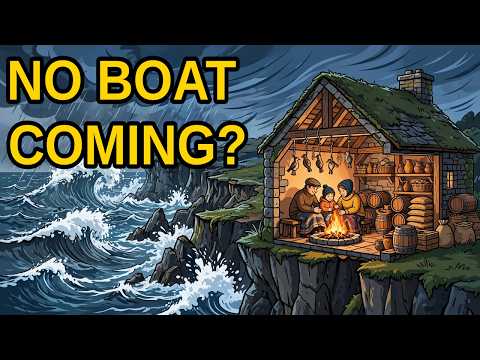
After the medieval village was abandoned in 1834, the islanders built thirty thick-walled blackhouses with turf roofs, central peat fires and no chimneys, where cattle shared the family's roof in winter.
- Tobar Childa ▶ 5:45
Water came from Tobar Childa, a well fed by two springs just outside the great Head Wall that ringed the village and its fields.
- Cleitean ▶ 6:24
More than 1,400 small domed stone storehouses called cleits cover the hillside; their stacked stones let the wind through but keep rain out, drying and preserving peat, grain, meat, eggs and hay for winter.
- Feather Store ▶ 9:19
A Feather Store built in 1819 held fulmar and gannet feathers, which the islanders paid as rent and which the British government bought for stuffing, until they could be shipped away and sold.
- Boreray ▶ 10:07
The islanders kept as many as two thousand hardy sheep on Hirta and Boreray.
- Soay ▶ 10:07
The wild little Soay sheep on the island of Soay belonged not to the islanders but to the laird and were left to fend for themselves.
- Stac Lee ▶ 11:18
Out on the great rock stacks, the fowlers built a small bothy, a shelter hut, on Stac Lee.
- Stac an Armin ▶ 11:18
Seventy-eight storage cleits were built on Stac an Armin, where three men and eight boys stranded during the 1720s smallpox epidemic survived until rescued in May 1728.
- Mistress Stone ▶ 11:52
On the rocks northwest of Ruival, a doorway-shaped opening called the Mistress Stone was where a young man had to stand on one foot over the drop to prove himself worthy of marriage.
- St Kilda mailboat ▶ 14:13
After John Sands was stranded in 1877, he tied a message to a lifebuoy and threw it into the sea; the islanders adopted the St Kilda mailboat, a hand-carved wooden boat on a sheepskin float carrying a letter in a bottle or tin.
- St Kilda church and school ▶ 15:24
Under the Reverend John Mackay the church filled three times every Sunday for two- to three-hour services, and in 1906 it was extended to hold the school where children learned English alongside Gaelic.