 PlaceTube
BARCELONA 🇪🇸 | Sagrada Família, Eixample & Old City | Walking Tour 4K
Open in PlaceTube Watch on YouTube
Places in this video
- Sagrada Família ▶ 1:40
The walk begins at Gaudí's legendary, still-unfinished basilica. The presenter points out the fruit mosaics on the towers, the Nativity Façade that Gaudí supervised himself, and notes that Gaudí is buried in the crypt.
- Eixample ▶ 6:05
The presenter walks into this famous district, explaining its unique grid pattern, chamfered corners, wide sidewalks, and division into the Left and Right Eixample.
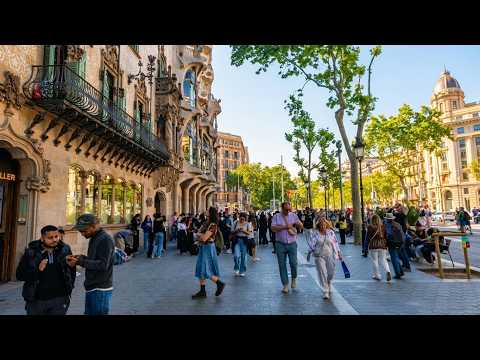
- Passeig de Gràcia ▶ 16:45
The walk follows this elegant avenue, the first street in the city with electric lights, known for its Luxury Mile, Modernista storefronts, and more Modernist buildings than any other street in the world.
- La Pedrera (Casa Milà) ▶ 36:15
The presenter points out Gaudí's wavy stone building nicknamed 'The Quarry,' describing its rooftop chimney park and the ventilation towers said to have inspired Star Wars Stormtrooper helmets.
- Rambla de Catalunya ▶ 39:17
A quick detour down this peaceful, shaded promenade, famous for its outdoor terraces and as a favorite spot for locals to have a merienda.
- Casa Batlló ▶ 49:15
The presenter admires the 'House of Bones' with its skull-shaped balconies and dragon-back roof, part of the Block of Discord, and explains the Sant Jordi legend behind its design.
- Casa Amatller ▶ 53:15
Standing right next to Casa Batlló, this building was designed by Puig i Cadafalch for a famous chocolatier, as part of the Block of Discord.
- El Corte Inglés ▶ 1:03:30
The presenter points out Spain's most famous department store at the corner, using it to explain that the first floor of a Barcelona building is called the 'Principal.'
- Plaça de Catalunya ▶ 1:05:43
The central hub where the old city meets the Eixample, called the 'Times Square' of Barcelona, with sculptures, illuminated fountains, and a labyrinth of train tunnels beneath it.
- Portal de l'Àngel ▶ 1:12:30
The walk heads down one of Spain's busiest shopping streets, passing the giant thermometer icon and noting the Christmas lights and the street's origin as a medieval city gate.
- Gothic Quarter ▶ 1:16:45
Stepping into the Ciutat Vella, the presenter explores the narrow streets built on Roman Barcino, pointing out Roman remains, hidden plazas, and the neighborhood's medieval atmosphere.
- El Petó de Joan Fontcuberta (Kiss Mosaic) ▶ 1:19:30
The presenter stops at the 'The World Begins with Every Kiss' mosaic in Plaça d'Isidre Nonell, made of 4,000 tiles featuring photos submitted by locals.
- Mercat Gòtic ▶ 1:24:30
An area in the old town that often hosts antique markets and local craftsmen.
- Barcelona Cathedral ▶ 1:26:30
The presenter visits this 13th-century Gothic cathedral dedicated to Saint Eulalia, noting the 13 white geese in the cloister, the gargoyles, and the Christ of Lepanto inside.
- Carrer del Bisbe ▶ 1:31:20
The presenter points out the Neo-Gothic bridge over this street, one of the most photographed spots in the city, though it was only built in 1928.
- Plaça de Sant Jaume ▶ 1:34:38
The political heart of Barcelona for over 2,000 years, flanked by the City Hall and the Palau de la Generalitat, seat of the Catalan government.
- Palau de la Generalitat de Catalunya ▶ 1:35:30
The presenter describes this medieval building as the seat of the Catalan government and one of the few medieval buildings still in use as a seat of power.
- El Call (Jewish Quarter) ▶ 1:38:30
The presenter walks through the old Jewish Quarter, once a city within a city, home to the Major Synagogue, one of the oldest in Europe.
- Plaça de Sant Felip Neri ▶ 1:39:30
Considered the most romantic and most tragic plaza in the city, its walls still show shrapnel damage from the Civil War.
- El Born ▶ 1:43:30
The walk enters this former center of maritime trade and artisanal guilds, once the site of medieval jousting tournaments.
- Santa Maria del Mar ▶ 1:46:17
The presenter visits the 'Cathedral of the Poor,' a perfect example of Catalan Gothic built by sailors and merchants, finished in just 54 years and now known for its acoustics.
- Fossar de les Moreres ▶ 1:48:45
A memorial site near Santa Maria del Mar for the defenders of the city during the Siege of 1714.
- El Born Centre de Cultura i Memòria ▶ 1:51:30
The presenter notes this cultural center houses the excavated ruins of the city as it stood in the early 1700s.
- Via Laietana ▶ 1:51:30
A boulevard carved through the old city in the early 1900s to link to the sea, famous for its 'Chicago-style' buildings.
- Correos (Post Office) ▶ 1:54:30
A masterpiece of eclectic architecture from the late 1920s, worth a look inside for its glass dome and murals.
- Port Vell ▶ 1:56:24
The Old Harbour, completely transformed for the 1992 Olympic Games, now home to the Maremagnum mall, the Rambla del Mar bridge, and the Gambas sculpture.
- Maremagnum ▶ 1:58:45
The shopping mall in Port Vell, accessible via the wooden Rambla del Mar bridge.
- Gambas Sculpture ▶ 2:00:00
A famous quirky shrimp sculpture by Mariscal on the waterfront.
- El Peix (Golden Fish) ▶ 2:01:30
Frank Gehry's 'Golden Fish' sculpture at the Olympic Port, described as a masterpiece of digital design.
- L'Aquàrium de Barcelona ▶ 2:03:00
One of the largest Mediterranean-themed aquariums in the world, located in Port Vell.
- World Trade Center Barcelona ▶ 2:03:00
Located at the end of the pier, this building is shaped like a giant ship.
- El Cap de Barcelona ▶ 2:04:00
Roy Lichtenstein's pop-art 'Head of Barcelona' sculpture adds a colorful touch to the historic harbor.
- Barceloneta Beach ▶ 2:05:00
The presenter notes Barcelona's beaches are entirely man-made, created with imported sand for the 1992 Olympics, with the sail-shaped W Hotel visible in the distance.
- Columbus Monument ▶ 2:08:33
The 60-meter monument built for the 1888 World Expo, with Columbus pointing toward the sea, a tiny elevator to the top, and lion statues at its base.
- Museu de Cera ▶ 2:12:00
The wax museum hidden in a small alleyway at the end of Las Ramblas.
- La Rambla ▶ 2:13:45
The famous promenade, actually five connected streets, once a sandy riverbed, now filled with street performers, the Canaletes fountain, and the Joan Miró mosaic.
- Font de Canaletes ▶ 2:14:15
The fountain where FC Barcelona fans gather to celebrate victories, and legend says drinking from it means you will return to the city.
- La Boqueria ▶ 2:17:45
One of the oldest and most famous food markets in the world, just off Las Ramblas.
- Liceu Opera House ▶ 2:17:45
One of Europe's most prestigious opera houses, located on the Ramblas and having survived two major fires.
- El Raval ▶ 2:19:15
The walk enters this multicultural neighborhood with an edgy history, once known as the Barri Xino, now a hub for artists, skaters, and over 70 nationalities.
- CCCB (Centre de Cultura Contemporània de Barcelona) ▶ 2:23:15
Located in an old almshouse, this contemporary culture center blends old masonry with modern glass.
- Palau Güell ▶ 2:23:15
One of Gaudí's first major commissions, built for his patron Eusebi Güell, located on a side street off the Ramblas.
- Gat del Raval ▶ 2:27:30
A huge bronze cat sculpture by Fernando Botero and a local favorite in Raval.
- Antic Hospital de la Santa Creu ▶ 2:27:30
The old hospital in Raval where Gaudí spent his final days.
- Rambla del Raval ▶ 2:28:45
Created in the 90s by demolishing several blocks to bring air and light to the area.
- Sant Pau del Camp ▶ 2:30:45
The oldest church in Barcelona, described as a beautiful Romanesque gem in Raval.
- MACBA (Museu d'Art Contemporani de Barcelona) ▶ 2:35:45
Richard Meier's white modern museum, called the 'Skateboarding Mecca' for its granite ledges, with its plaza officially named Plaça dels Àngels.