 PlaceTube
TURKEY: The Ancient Country Where Europe Ends and Asia Begins
Open in PlaceTube Watch on YouTube
Places in this video
- Göbekli Tepe ▶ 1:17
The video introduces the monumental stone structures of Göbekli Tepe in southeastern Anatolia, dating to around 9600 BC and roughly 6,000 years older than the pyramids of Egypt.
- Cappadocia ▶ 11:40
The presenter describes Cappadocia's fairy chimneys, rock-cut churches with frescoes, and underground cities, and notes the hundreds of hot air balloons rising over the valleys at sunrise.
- Mount Nemrut ▶ 14:14
At 2,134 m, the summit holds King Antiochus I's tomb complex with colossal statues of himself and deities like Zeus and Apollo, their stone heads now scattered across the summit.
- Mardin ▶ 17:38
Mardin's honey-colored limestone houses cascade down a hillside overlooking the Mesopotamian plains, and the presenter highlights its mix of Arab, Kurdish, Turkish and Syriac Christian cultures, with monasteries and mosques side by side.
- Mount Ararat ▶ 19:52
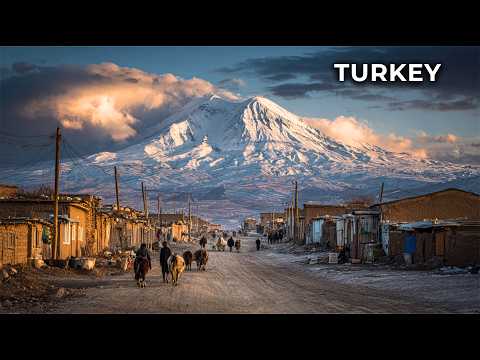
Mount Ararat rises 5,137 m as Turkey's highest peak, a dormant volcano linked to the Noah's Ark legend, near the meeting point of Turkey, Armenia and Iran.
- Ani ▶ 22:06
Ani was once the 'city of a thousand and one churches' and capital of the Armenian kingdom, with a cathedral completed in 1001 AD; today its ruins stand on a windswept plateau near a gorge marking the modern border.
- Sumela Monastery ▶ 24:17
Sumela Monastery clings to a vertical cliff nearly 300 m above a forested valley, founded in the 4th century by Greek Orthodox monks, with chapels and a library carved into the rock.
- Amasya ▶ 25:53
Amasya's rock-cut royal tombs from the 3rd century BC overlook the Yeşilırmak River, and its 19th-century Ottoman wooden houses line the riverbank; several future sultans were educated here.
- Safranbolu ▶ 28:02
Safranbolu is known for over 1,000 well-preserved Ottoman houses built between the 17th and 19th centuries, earning UNESCO World Heritage status, with caravanserais, mosques and artisan workshops in its cobbled streets.
- Hagia Sophia ▶ 30:45
Completed in 537 AD, Hagia Sophia was once the largest cathedral in the world, its dome rising 55 m above the floor.
- Blue Mosque ▶ 31:20
The Blue Mosque displays six minarets and more than 20,000 hand-painted Iznik tiles.
- Basilica Cistern ▶ 31:24
Built in the sixth century to store water for the great palace, the Basilica Cistern's forest of 336 marble columns stretches across a chamber large enough to hold 80,000 cubic meters of water.
- Troy ▶ 32:39
Excavations at Troy revealed at least nine settlement layers dating back more than 4,000 years, with ancient walls still standing several meters high, though whether the Trojan War happened as told is still debated.
- Pergamon ▶ 34:49
Pergamon rivaled Alexandria as a center of knowledge with a library of over 200,000 scrolls, and its acropolis holds a steeply built theater seating around 10,000, plus one of antiquity's most famous medical centers.
- Ephesus ▶ 36:56
Ephesus was one of the largest cities of the Roman Empire, with marble streets grooved by chariot wheels, the Library of Celsus, a 25,000-seat amphitheater, and the Temple of Artemis, one of the seven wonders.
- Çeşme ▶ 39:12
Çeşme on the Aegean coast is known for clear turquoise water and steady winds that attract windsurfers, plus a 16th-century Ottoman castle and thermal springs.
- Pamukkale ▶ 41:12
Pamukkale, meaning 'cotton castle', is formed by calcium-rich thermal waters hardening into bright white travertine terraces stretching about 2.7 km, where visitors can walk barefoot through warm mineral pools.
- Hierapolis ▶ 43:09
Founded in the 2nd century BC above the thermal springs, Hierapolis became a Roman spa city with a colonnaded main street, baths, temples, a 12,000-seat theater, and the sacred Plutonium cave.
- Bodrum ▶ 45:41
Bodrum stands on ancient Halicarnassus, site of the Mausoleum of Mausolus, one of the seven wonders; the Castle of St. Peter built by the Knights of St. John still dominates the harbor.
- Museum of Underwater Archaeology ▶ 46:53
The museum displays shipwreck artifacts dating back over 3,000 years, including cargo from Bronze Age trade routes.
- Ölüdeniz ▶ 47:43
Ölüdeniz lagoon is famous for its intense turquoise water and calm, shallow conditions protected by a natural sandbar, with Babadağ mountain above it considered one of the world's best paragliding sites.
- Lycian rock tombs ▶ 49:16
Lycian rock tombs carved into the cliffs overlook Fethiye, the most famous being the Tomb of Amyntas from the 4th century BC, carved to resemble a small temple.
- Lycian Way ▶ 49:54
The famous Lycian Way hiking trail begins near Fethiye and stretches roughly 540 km along the Mediterranean.
- Patara Beach ▶ 50:37
Patara beach stretches about 18 km, one of Turkey's longest, with shifting dunes and large undeveloped sections protecting nesting loggerhead sea turtles.
- Patara ▶ 51:12
Behind the beach lies ancient Patara, a major Lycian city and Roman port believed to be the birthplace of St. Nicholas, with a Lycian League parliament building, a Roman theater, and one of the world's oldest lighthouses.
- Kaş ▶ 52:44
Kaş is built around a natural harbor with whitewashed houses and bougainvillea, known for underwater visibility exceeding 30 m that makes it a top diving destination, plus a Hellenistic theater overlooking the sea.
- Kaleiçi ▶ 54:34
Antalya's old town, Kaleiçi, preserves narrow cobbled streets and Ottoman-era houses built inside Roman walls.
- Hadrian's Gate ▶ 54:52
Hadrian's Gate was constructed in 130 AD to honor the Roman Emperor's visit, and its marble arches still stand nearly 2,000 years later.
- Düden Waterfalls ▶ 55:16
Just outside the historic center, the Düden waterfalls plunge about 40 m directly into the Mediterranean Sea, one of the rare coastal waterfalls in the region.
- Alanya Castle ▶ 56:52
Alanya's medieval fortress stretches nearly 6 km along stone walls wrapping around the cliffs, expanded in the 13th century under the Seljuk Sultan Alaeddin Kayqubad I, with the 33 m Red Tower guarding the harbor.
- Cleopatra Beach ▶ 58:04
Below the fortress, Cleopatra Beach extends along the western side of the peninsula, with local legend claiming its sand was brought from Egypt as a gift to Cleopatra.
Cities in these videos
Şanlıurfa · Nevşehir · Adıyaman · Mardin · Iğdır · Kars · Trabzon · Amasya · Safranbolu · Istanbul · Çanakkale · Bergama · Selçuk · Çeşme · Pamukkale · Bodrum · Fethiye · Antalya · Kaş · Alanya