 PlaceTube
Ajanta & Ellora: Who Carved 1,200 Temples Into Solid Rock?
Open in PlaceTube Watch on YouTube
Places in this video
- Ajanta Caves ▶ 1:27
The video introduces Ajanta as one of two cave complexes in Maharashtra, carved by hand into basalt cliffs over more than a thousand years. It later describes the thirty caves along the Waghur river gorge, discovered by John Smith in 1819.
- Cave 10, Ajanta ▶ 2:39
The presenter explains that John Smith stumbled onto Cave Ten's carved entrance in 1819, and that it is one of the earliest chaitya prayer halls, where Smith later scratched his name into a mural.
- Cave 9, Ajanta ▶ 3:20
Cave Nine is cited as an early cave whose carvings mimic timber beams and rafters, and whose large arched window served as an engineering solution for light and hauling rubble.
- Cave 1, Ajanta ▶ 9:27
Cave One is named among the caves holding the best-known murals, including the famous portrait of Bodhisattva Padmapani holding a blue lotus.
- Cave 16, Ajanta ▶ 10:18
Inside Cave Sixteen is "The Dying Princess," described as the emotional centerpiece of the complex, depicting Sundari collapsing at the news her husband became a monk.
- Cave 26, Ajanta ▶ 12:01
Cave Twenty Six, one of the largest chaitya halls at Ajanta, holds a roughly seven-meter reclining Buddha entering Nirvana, in one of the last caves completed before the site fell silent.
- Ellora Caves ▶ 15:16
Ellora is introduced as a complex of thirty-four caves cut into basalt over about four centuries, uniquely containing Buddhist, Hindu and Jain caves side by side along more than two kilometers.
- Carpenter's Cave, Ellora ▶ 16:12
The so-called Carpenter's Cave is noted among Ellora's Buddhist caves for its ceiling carved to mimic curved wooden beams, grander than anything at Ajanta.
- Kailasa Temple ▶ 17:34
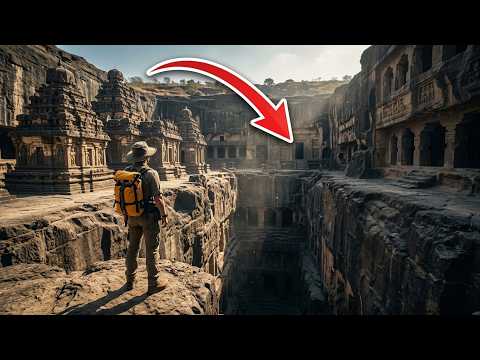
Tucked inside Cave Sixteen, the Kailasa temple is called the largest monolithic rock excavation on Earth, carved top-down from a single block of basalt with elephants at its base and an underground drainage system.
- Jain Caves, Ellora ▶ 23:39
The five Jain caves at the far end of Ellora, carved in the ninth and tenth centuries, are described as quieter and more austere, with dense ornamental columns and statues of the Tirthankaras.