 PlaceTube
Wellington, New Zealand: The Capital That Rose From the Sea (History, Layout, Jobs, Where to Live)
DItto ·
Open in PlaceTube Watch on YouTube
Places in this video
- Lambton Quay ▶ 0:00
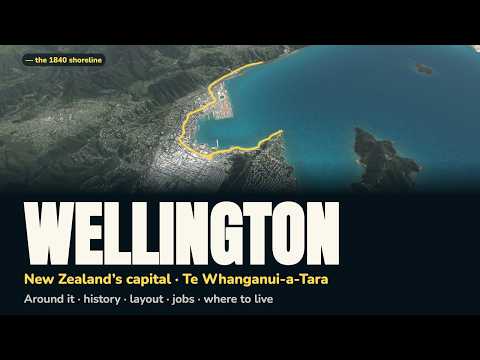
Wellington's busiest shopping street, which in 1840 was a beach with waves breaking where the footpath is today. The presenter ends the video by urging a walk down it while remembering the waves that once broke there.
- Cook Strait ▶ 0:18
The strait separating Wellington at the bottom of the North Island from the South Island, just 22 kilometres at its narrowest.
- Wellington Fault ▶ 0:49
An active fault running along the western edge of the city that moves roughly every 900 years and last did about 300 years ago.
- Wellington Harbour ▶ 1:22
The harbour Māori call Te Whanganui-a-Tara, the great harbour of Tara, where in legend a taniwha called Ngake smashed his way out to the sea.
- Pipitea ▶ 1:40
One of the pā sites built by Te Āti Awa, Ngāti Mutunga and other tribes who settled around the harbour in the 1820s.
- Te Aro ▶ 1:40
A pā site of the 1820s settlers where the city centre is today; later described as having the cheapest apartments in the city, averaging 560,000 dollars.
- Porirua ▶ 1:55
The territory of Ngāti Toa, led by Te Rauparaha, north of Wellington; now one of the region's satellite towns.
- Petone ▶ 2:12
Where the first settler ship, the Aurora, landed in January 1840; today a flat suburb a dozen minutes by train from the city with an old main street by the beach.
- Basin Reserve ▶ 2:28
What was meant to be a shipping basin became the Basin Reserve cricket ground after the 1855 earthquake lifted the coast.
- Government Buildings ▶ 2:44
Finished in 1876, it looks like a stone palace but is made entirely of wood.
- Wellington Cable Car ▶ 3:00
Opened in 1902, the red cable car runs 609 metres up the hill in a few minutes to the Botanic Garden and the university in Kelburn.
- Beehive ▶ 3:00
The executive wing of Parliament, completed in 1981.
- Willis Street ▶ 3:17
Part of the Golden Mile, the strip of the city centre running from Parliament and the railway station along Lambton Quay and Willis Street to Courtenay Place.
- Courtenay Place ▶ 3:17
The end of the Golden Mile, the stretch locals call the city's main spine from Parliament to Courtenay Place.
- Cuba Street ▶ 3:17
The pedestrian heart of cafés and small shops next to the Golden Mile.
- Museum of New Zealand Te Papa Tongarewa ▶ 3:17
The national museum on the waterfront, with over a million visits a year.
- Wellington Botanic Garden ▶ 3:33
Reached by the red cable car at the top of the hill, next to the university in Kelburn.
- Kelburn ▶ 3:33
The hillside suburb at the top of the cable car, home to the Botanic Garden and Victoria University; its houses average 1.32 million dollars, the most expensive in the city.
- Wellington Town Belt ▶ 3:51
A ring of green around the city kept from the 1840 town plan.
- Victoria University of Wellington ▶ 4:21
Up the hill from the centre, it has twenty-one thousand students.
- CentrePort ▶ 4:36
The docks and ferry terminals sit right next to the railway station.
- Miramar Peninsula ▶ 4:36
East over Mt Victoria lies the Rongotai isthmus with the airport and the Miramar Peninsula, film country where Wētā Workshop and Wētā FX are based.
- Wētā Workshop ▶ 4:36
Peter Jackson's effects companies Wētā Workshop and Wētā FX are on the Miramar Peninsula, where the effects for The Lord of the Rings and Avatar were made.
- Thorndon ▶ 5:25
An old wooden-villa suburb up the hill from the city centre.
- Mount Victoria ▶ 5:25
An old wooden-villa suburb up the hill, good for singles, young people and anyone working in town.
- Newtown ▶ 5:43
A southern suburb with the hospital and the zoo, with homes around 830,000 to 1.05 million dollars.
- Island Bay ▶ 5:43
A seaside suburb in the south and east, priced around 830,000 to 1.05 million dollars.
- Miramar ▶ 5:43
A suburb by the sea in the south and east, near Wellington College and Rongotai College.
- Karori ▶ 5:59
A big and green suburb in the western hills, good for families who don't mind a hill.
- Khandallah ▶ 5:59
A northern hills suburb with its own Johnsonville Line trains, ten to twenty minutes into town.
- Ngaio ▶ 5:59
A northern hills suburb with its own Johnsonville Line trains, ten to twenty minutes into town.
- Lower Hutt ▶ 6:31
Further up the valley from Petone, about forty minutes by train at the furthest; the Hutt Valley is called the best value for a first home.
- Upper Hutt ▶ 6:31
The furthest of the Hutt Valley towns, about forty minutes by train from Wellington.
- Wainuiomata ▶ 6:31
Averages under 600,000 dollars, the cheapest of the areas discussed.