 PlaceTube
Ces Animaux RARES des Parcs Nationaux de Croatie...⎮Documentaire⎮AMP
World View - Animaux du monde ·
Open in PlaceTube Watch on YouTube
Places in this video
- Plitvice Lakes National Park ▶ 0:01
The largest of Croatia's eight national parks, famous for its turquoise lakes and waterfalls, a UNESCO World Heritage Site since 1979.
- Great Waterfall ▶ 2:31
The 76-meter-high waterfall where the water-quality researchers begin their sampling; the water is noticeably colder and full of green algae.
- Novakovića Brod ▶ 4:24
A spot upstream where Maya and Adriana compare water quality between the right and left banks, finding more pollution on the left bank.
- Kuterevo Bear Refuge ▶ 8:56
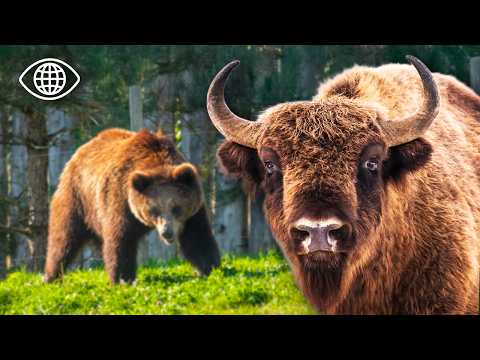
A refuge on the outskirts of Plitvice, run by volunteers since 2001, housing 13 rescued orphan bears; volunteers feed them plums, apples and carrots.
- Falcon Centre ▶ 14:45
A sanctuary for birds of prey established 20 years ago that takes in injured birds from all over Croatia; here an eagle owl's fractured beak is repaired with dental equipment.
- Kuterevo ▶ 18:53
The village whose residents treat the orphaned bears as mascots, bringing apples from their orchards and stale bread from local bakeries.
- Białowieża National Park ▶ 26:16
Created in 1932 and a UNESCO World Heritage Site, it protects 163,000 hectares of Europe's last primeval forest, home to bison, deer, wolves and lynx.
- Museum of Nature and Forest ▶ 26:34
The oldest museum in the Polish national parks, at the entrance to the reserve, offering a guided tour of the forest's biotopes and an exhibition hall.
- Palace Park ▶ 27:20
The former tsar's hunting lodge turned palace, rebuilt as the Forest House between 1999 and 2003; its 47-hectare park was designed by a German landscape architect for a symphony of colors.
- Białowieża Forest strict reserve trail ▶ 33:18
A 5-kilometer loop trail through the strictly protected forest, accessible only with a licensed guide, where dead wood is left to promote biodiversity.
- Białowieża Zoo ▶ 35:55
A small family zoo of over 10 hectares where keepers feed around a hundred animals, including bison, roe deer, wild boar, tarpan horses and zubrons.
- Mammal Research Institute ▶ 40:45
An independent research unit of the Polish Academy of Sciences founded in 1952, studying the forest and its inhabitants and publishing over 1,400 scientific articles.