 PlaceTube
UNSEEN Central Appalachia: Hidden Places No One Talks About
Open in PlaceTube Watch on YouTube
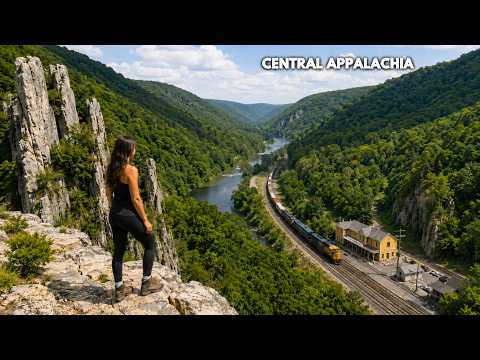
Places in this video
- Thurmond ▶ 0:35
The presenter describes Thurmond, West Virginia, a town that once outshipped Cincinnati and Richmond combined and now has only five residents, with storefronts facing the railroad tracks where a main street should be.
- Helvetia ▶ 0:52
The presenter says Swiss settlers founded Helvetia, where every February the village walks masked through the dark and burns winter in effigy, a tradition brought from home.
- Red River Gorge ▶ 1:48
The presenter explains that the Army Corps of Engineers planned to dam the Red River and flood the gorge, but a hike led by Supreme Court Justice William O. Douglas with 600 people helped stop the dam.
- Gray's Arch ▶ 2:51
The presenter says Gray's Arch is the biggest arch in the gorge, reached from underneath by a trail that drops off the ridge, with 80 feet of sandstone and 50 feet of open air beneath it and no rail on top.
- Blue Heron ▶ 6:51
The presenter describes Blue Heron, a Kentucky coal camp that was abandoned almost overnight and later rebuilt with steel frames marking the vanished buildings and voices of former residents.
- Swallow Falls State Park ▶ 9:06
The presenter says Henry Ford, Thomas Edison, and Harvey Firestone camped under the old-growth hemlock and white pine here, and that Muddy Creek Falls drops 53 feet at the edge of the grove.
- Gary ▶ 12:36
The presenter describes Gary, West Virginia, where a single steel company built 12 towns up one hollow and nearly 15,000 people once lived; fewer than a thousand remain now.
- Dolly Sods Wilderness ▶ 13:08
The presenter says Dolly Sods sits above 4,000 feet with wind-flagged red spruce and bogs holding subarctic plants, and that the army used the plateau as a live-fire range in World War II, leaving live shells behind.
- Kaymoor ▶ 15:03
The presenter describes Kaymoor, a mining town clinging to the wall of the New River Gorge, where workers climbed hundreds of steps home and a steam-powered cable hoist carried coal and workers.
- Lake Shawnee Amusement Park ▶ 15:55
The presenter says the fairground at Lake Shawnee closed for reasons unrelated to money, the rides were never taken down, and the ground is said to be cursed after excavations found a Shawnee village and burials beneath it.
- Paint Bank ▶ 17:13
The presenter explains that Paint Bank, Virginia, takes its name from red clay along Potts Creek where Cherokee parties gathered ochre for body paint and pottery.
- Ohiopyle Falls ▶ 17:44
The presenter says a young George Washington tried to canoe the Youghiogheny but was turned back at Ohiopyle Falls, and that the water below the ledge is now the busiest whitewater run east of the Mississippi.
- Keystone ▶ 21:40
The presenter says Keystone earned a reputation as a lawless mini Vegas with its red-light district, and generations later its bank was shut after more than half a billion dollars went unaccounted for.
- Canaan Valley ▶ 22:42
The presenter describes Canaan Valley burning for a season after loggers left slash that caught fire, then growing back as the highest sizable valley east of the Mississippi with spruce islands and sphagnum bog.
- Fitchburg Furnace ▶ 25:14
The presenter says the twin sandstone stacks of Fitchburg Furnace are all that remain of the largest furnace of its kind, built with no railroad, so the iron went out by flatboat before the furnace shut down within five years.
- Middlesboro ▶ 28:19
The presenter says Middlesboro was laid out inside a meteor crater by a British investor who planned a city of a quarter million with an opera house and golf course, but the money ran out and the city never reached its plans.
- Trans-Allegheny Lunatic Asylum ▶ 29:33
The presenter describes the Trans-Allegheny Lunatic Asylum, the largest building raised to Thomas Kirkbride's staggered-wing design, built of hand-cut blue sandstone and designed for 250 people but housing more than 2,400.
- Chained Rock ▶ 30:45
The presenter says children in Pineville were told the rock above town was chained so it could not fall, and when visitors came to see a chain nobody had hung, the town hauled 100 feet of steam shovel chain up by mule and bolted it to the rock.
- Williams Grove Amusement Park ▶ 32:27
The presenter says Williams Grove was switched off one September and left where it was, with the wooden coaster still up in the trees and paint still on the steel.
- Glen Jean ▶ 33:48
The presenter says Glen Jean began as a wedding present over a thick coal seam, with a solid brick school at its center that kept teaching for decades after the mines closed.
- Falls of Hills Creek ▶ 34:34
The presenter says Hills Creek captured the Cherry River's headwaters and sends the stolen water over three sandstone ledges dropping 25, 45, and 63 feet.
- Jewell Valley ▶ 37:30
The presenter says Jewell Valley was built as a showcase model coal town, but after the mines declined the homes disappeared into vegetation, with one abandoned house carrying the word hell in green paint.
- Elkton ▶ 38:18
The presenter says farms around Elkton were taken by the government for a wartime TNT plant and never returned, leaving more than 100 concrete igloo bunkers among the foundations and cemeteries.
- Big Schloss ▶ 39:07
The presenter describes Big Schloss, a white sandstone outcrop German settlers called a castle, reached by a narrow plank footbridge over a gap, with views across Trout Run Valley into two states.
- Abandoned Pennsylvania Turnpike ▶ 41:39
The presenter says the tunnels were dug for a railroad that never ran, then the turnpike was built over the route and later bypassed, leaving 13 miles of highway and over a mile of unlit tunnel, part of it now a bike trail.
- Twin Arches ▶ 43:03
The presenter says Twin Arches in Tennessee share one roof, with the south arch spanning 135 feet and 70 feet of open air beneath, and the ridge trail running straight across the top with no rail.
- Helvetia Fasnacht ▶ 44:09
The presenter says every February the village of Helvetia walks masked through the dark and burns old man winter in effigy, a tradition that is a real Zurich rite crossed with the last night before Lent.
- Lonaconing Iron Furnace ▶ 48:08
The presenter says the Lonaconing iron furnace proved coal coke and raw coal could replace charcoal, was built from hand-cut sandstone, and ran for barely 16 years.
- Green Bank Observatory ▶ 49:58
The presenter says the National Radio Quiet Zone surrounds a giant radio telescope, making this one of the quietest places in America for radio signals, with strict limits on nearby technology.
- Droop Mountain ▶ 50:39
The presenter describes black water stained amber by tannic acid from spruce and hemlock needles, going over a 57-foot sandstone ledge into a canyon with a 214-step boardwalk descending to a platform in permanent spray.
- Nuttallburg ▶ 54:34
The presenter says Henry Ford took on the Nuttallburg mines to feed his River Rouge plant, and his engineers hung a conveyor down the gorge wall, but railway costs and control defeated him and he sold within a few years.
- Butcher Hollow ▶ 57:24
The presenter says Ted and Clara Webb raised eight children in a newspaper-lined plank house in Butcher Hollow, and their second child was Loretta Lynn, whose song Coal Miner's Daughter describes this ground.
- Coalwood ▶ 59:07
The presenter says George Lafayette Carter built Coalwood from nothing, and after Sputnik six boys from the high school began building rockets and firing them off an old slack dump they named Cape Coalwood.
- Spruce Knob ▶ 1:00:42
The presenter says Spruce Knob is the highest ground in the Allegheny range at 4,863 feet, where every red spruce grows flagged by the wind and snow can fall in June and lie half the year.
- West Virginia State Penitentiary ▶ 1:02:22
The presenter says the new state had no prison, so convicts were sent to lay the stone of a Gothic fortress modeled on Joliet, designed for far fewer inmates than it eventually held.
- Shoaf Coke Ovens ▶ 1:03:30
The presenter says a row of domed stone ovens built by the H.C. Frick Coke Company still runs through second-growth forest, baking coal into coke until clean air laws closed them.
- Seneca Rocks ▶ 1:04:17
The presenter says Seneca Rocks is a fin of Tuscarora quartzite 900 feet above the North Fork, used in World War II as the army's only low-altitude assault climbing school.
- Bramwell ▶ 1:07:50
The presenter says Bramwell once held more millionaires per capita than almost anywhere in America, with as many as 14 living along one bend of the river in turreted stone mansions.
- Johnstown ▶ 1:09:40
The presenter says Johnstown grew where three rivers meet, and when a leaking dam 14 miles above failed, a wall of water destroyed much of the city and killed more than 2,000 people.
Cities in these videos
Thurmond · Helvetia · Stanton · Beckley · Swallow Falls State Park · Gary · Dolly Sods Wilderness · Fayetteville · Lake Shawnee · Paint Bank · Ohiopyle · Keystone · Davis · Fitchburg · Middlesboro · Weston · Pineville · Mechanicsburg · Glen Jean · Hills Creek · Jewell Valley · Elkton · Pembroke · Breezewood · Oneida · Lonaconing · Green Bank · Hillsboro · Nuttallburg · Van Lear · Coalwood · Monterey · Moundsville · Shoaf · Seneca Rocks · Bramwell · Johnstown