 PlaceTube
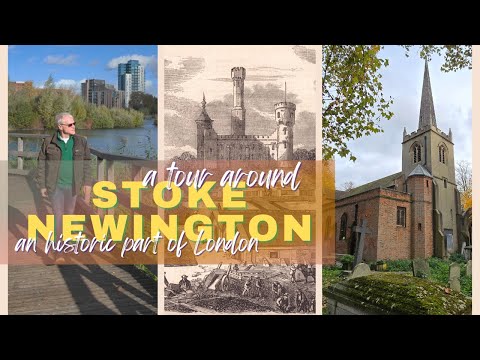
Stoke Newington, an historic part of London
The History of London - Peter Stone ·
Open in PlaceTube Watch on YouTube
Places in this video
- Stoke Newington High Street ▶ 0:53
The ancient eastern boundary road of old Stoke Newington, once part of Roman Ermine Street, now a bustling shopping street with a very different character from Church Street.
- Green Lanes ▶ 1:47
The old north-south road forming Stoke Newington's western boundary, once a drovers' track and now home to Turkish Cypriot shops and restaurants.
- Stoke Newington Church Street ▶ 2:59
The east-west street through the old manor, said to have London's longest street name, with a relaxed atmosphere, independent cafes and boutique shops.
- Stoke Newington Town Hall ▶ 3:47
The former town hall of the old Stoke Newington borough, built on the site of the medieval manor house demolished at the end of the 17th century.
- St Mary's Old Church ▶ 4:29
The old parish church, probably Saxon in origin, rebuilt by William Patten and given a Gothic appearance by Sir Charles Barry; now used for small concerts.
- Newington Green ▶ 5:21
The old hamlet south of Stoke Newington, on the Hackney-Islington boundary, which became a haven for Dissenters after 1660.
- Newington Green Unitarian Church ▶ 6:24
Opened in 1708 on the site of Charles Morton's academy, it is London's oldest non-conformist place of worship still in use, once served by Richard Price.
- Newington Green terrace ▶ 6:32
A group of houses on the west side of Newington Green built in 1658, now the oldest-surviving terrace of houses in London, where Richard Price lived.
- Daniel Defoe plaque, Defoe Road ▶ 7:08
Site of the red-brick house where Daniel Defoe lived, demolished in 1868; a blue plaque on the current building in Defoe Road marks it.
- Abney Park Cemetery ▶ 7:48
One of London's Magnificent Seven cemeteries, with over 200,000 burials including PC William Tyler, the Blitz civilian memorial and the Salvation Army's Booth family.
- Abney Park Chapel ▶ 10:15
The 1842 chapel at the centre of the cemetery, said to be the first non-denominational cemetery chapel in Europe, recently restored and now used for events.
- Stoke Newington Watch House ▶ 11:26
The surviving watch house built 1821-26 on the site of the village pound, later a police station and store for the local fire engine.
- Sisters Place ▶ 12:36
Pleasant houses built in 1715 on the site of a mansion once occupied by Edward de Vere, later inherited by four sisters and named Sisters Place.
- Edgar Allan Poe school site ▶ 12:54
A former family home converted into a school in 1806, where the young Edgar Allan Poe boarded between 1817 and 1820.
- Paradise Row ▶ 13:44
A 1720s terrace of large houses at the western end of Church Street, home to the Quaker Hoare banking family and visited by William Wilberforce.
- Clissold House ▶ 14:36
The large mansion built for Jonathan Hoare, completed in 1793 as Paradise House and later renamed Clissold House after Eliza Crawshay's husband.
- Clissold Park ▶ 15:16
The public park saved by a local campaign led by Joseph Beck and John Runtz, with ponds Beckmere and Runtzmere and a deer herd present since 1890.
- New River ▶ 15:52
The 1613 aqueduct built by Hugh Myddleton to bring water from Hertfordshire springs to London, still supplying the city today.
- West Reservoir ▶ 17:34
One of two reservoirs created by the New River Company in the 1830s, now used for sail-boating and all-year-round open-air swimming.
- Woodberry Wetlands ▶ 17:42
The East Reservoir converted into a nature reserve, officially opened in 2016 by Sir David Attenborough, with a cafe good for coffee and nature-watching.
- The Castle Climbing Centre ▶ 18:15
The castle-like 1856 New River pumping station on Green Lanes, saved from demolition and converted in the 1990s into a climbing centre called The Castle.
- Stoke Newington railway station ▶ 20:12
The original 1872 Great Eastern Railway station, with a forecourt for horse carriages, replaced by a bland 1970s building.
- St Mary's New Church ▶ 21:56
The much larger church designed by Sir George Gilbert Scott, completed in 1858 with a tall spire added in 1890, built opposite the old St Mary's.
- Woodberry Down Estate ▶ 22:39
The 64-acre LCC estate built from 1946 on Zeilenbau principles, hailed as 'the estate of the future', now largely replaced by high-rise buildings.
- John Scott Health Centre ▶ 23:19
Britain's first purpose-built health centre, foundation stone laid by Aneurin Bevan in 1949 and named in 1965 after the LCC's health minister; still part of the NHS.
- The Three Crowns ▶ 25:05
A pub on the corner of the High Street and Church Street, formerly the Cock & Harp coaching inn where James I's party reputedly stopped; current building dates from the late 19th century.
- The Red Lion ▶ 25:28
A pub on Church Street whose name may relate to James I's red lion symbol; first recorded in 1697, with the current building dating from 1924.
- Rochester Castle ▶ 25:59
A High Street pub built by a Rochester builder on land including the old Green Dragon Inn, which had stood there since at least the early 18th century.
- The Coach and Horses ▶ 26:05
A High Street pub that was originally a coaching inn dating back to the early 18th century.
- The Auld Shillelagh ▶ 26:10
The presenter's favourite Stoke Newington pub, an Irish pub on Church Street taken over by Irish owners in 1991, known for its Guinness and live Irish music.