 PlaceTube
Germany’s World Heritage Sites By Drone (2) | A Bird’s-Eye View of Germany — From Bamberg to Cologne
Open in PlaceTube Watch on YouTube
Places in this video
- Lorsch Abbey ▶ 0:03
A prominent center of power in the Middle Ages; only three structures survive, including the 9th-century Aula Regia, one of the few Carolingian-era buildings to survive nearly intact.
- Goslar Old Town ▶ 0:39
A medieval royal seat where Holy Roman emperors held synods, with around 1,500 half-timbered houses crowded into one square kilometer of protected old town.
- Rammelsberg Mine ▶ 1:14
The iron and silver deposits at this mountain, about two kilometers from Goslar, brought the town its wealth; the mine was worked until 1988.
- Bamberg Old Town ▶ 1:52
Declared a World Heritage site in 1993, with over 2,400 protected buildings; built on seven hills, it earned the nickname Franconian Rome.
- Bamberg Cathedral ▶ 2:14
The Cathedral of St. Peter and St. Georg tops one of the hills and houses the famous 13th-century Bamberg Horseman, Germany's first life-size equestrian statue since Roman times.
- Maulbronn Monastery ▶ 3:33
A Cistercian monastery founded in 1147, considered one of the best-preserved medieval monastic complexes north of the Alps, where visitors get a firsthand impression of monks' life.
- Quedlinburg Old Town ▶ 3:59
Its collegiate church, castle hill and old town became World Heritage sites in 1994; over 1,300 original half-timbered houses survive, showing a wide variety of styles.
- Völklingen Ironworks ▶ 4:58
Once Germany's largest ironworks, closed in 1986 and now a World Heritage monument to the Industrial Revolution used for exhibitions, concerts and parties.
- Messel Pit Fossil Site ▶ 5:31
A former open-pit oil-shale mine holding tens of thousands of plant, insect and vertebrate fossils; tours of the outside area are available and a visitors' center exhibits finds.
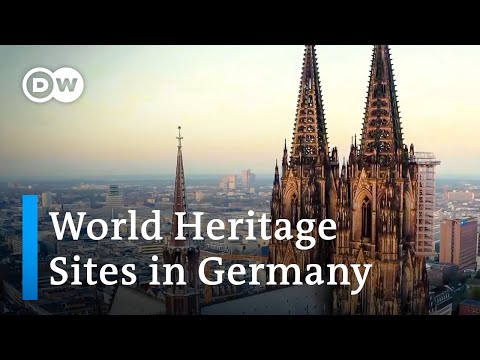
- Cologne Cathedral ▶ 6:09
Probably Germany's most famous church, with Gothic arches and towering steeples dominating the skyline; construction began in 1248 and it was completed in 1880.
- Bauhaus sites in Weimar ▶ 6:52
The Bauhaus's history begins in Weimar, where Walter Gropius merged the arts and crafts school with the Academy of Fine Arts in 1919 to form the Bauhaus.
- Bauhaus Building Dessau ▶ 7:28
In 1925 the Bauhaus moved into this new school building in Dessau, embodying a revolutionary design language of straight lines and right angles.
- Masters' Houses ▶ 8:03
Built for the Bauhaus professors near the school, they are the embodiment of a 20th-century artists' colony.
- Luther Memorials in Eisleben ▶ 8:20
Among the memorial sites in Eisleben are the houses where Martin Luther was born and died, commemorating the reformer's life and work.
- Luther Memorials in Wittenberg ▶ 8:55
Wittenberg holds Melanchthon's house, Luther's home of many years and the Augusteum where he taught, plus the Castle Church where Luther preached for over thirty years.
- Weimar Classical sites ▶ 9:31
A World Cultural Heritage site since 1998, Weimar blossomed in the 18th and 19th centuries into an oasis of German intellectual life drawing Goethe and Schiller; many buildings and parks recall its Golden Age.
- Museum Island ▶ 9:52
The world's largest museum ensemble, with five world-class buildings — the Alte Nationalgalerie, Pergamon Museum, Bode Museum, Neues and Altes Museum — safeguarding treasures from 6,000 years of human history.
- Wartburg Castle ▶ 10:44
No castle played so pivotal a role in German history; famed in the 12th century for its patronage of poets, home to Saint Elisabeth, and where Luther translated the New Testament in the Luther Room.
- Dessau-Wörlitz Garden Realm ▶ 12:03
In the 18th century Duke Leopold III of Anhalt-Dessau created a unique variety of parks, gardens and castles integrated into a cultural landscape laced with streams and woods.
Cities in these videos
Lorsch · Goslar · Bamberg · Maulbronn · Quedlinburg · Völklingen · Messel · Cologne · Weimar · Dessau · Eisleben · Wittenberg · Berlin · Eisenach · Wörlitz