 PlaceTube
Rome, Italy 🇮🇹 – This Is Rome Right Now: OVERCROWDED! | 4K
Roma Walks | Roma Walking Tours ·
Open in PlaceTube Watch on YouTube
Places in this video
- Vicolo della Moretta ▶ 1:10
We start from Vicolo della Moretta, one of the many alleys of the Regola district that connect Via di Monserrato to Via Giulia.
- San Filippo Neri (San Filippino) ▶ 1:24
On nearby Via Giulia, just after the corner with this alley, there's the little church of San Filippo Neri, called San Filippino because of its size. It was founded in 1603 and restored in 1728.
- Via di Monserrato ▶ 2:10
Via di Monserrato is one of the most beautiful streets in Rome.
- Piazza dei Ricci ▶ 3:20
We're in Piazza dei Ricci, dominated by Palazzo Ricci.
- Palazzo Ricci ▶ 3:20
We're in Piazza dei Ricci, dominated by Palazzo Ricci. Look at the sgraffito facade from 1525, the work of Polidoro da Caravaggio and Maturino da Firenze.
- San Tommaso di Canterbury ▶ 4:24
Nearby is the church of San Tommaso di Canterbury, once dedicated to the Santissima Trinità degli Scozzesi, and there was a hospice for English Catholics, the Societas pauperum Anglorum.
- Santa Maria in Monserrato ▶ 5:10
Santa Maria in Monserrato is the national church of Spain in Rome.
- San Giacomo degli Spagnoli ▶ 6:45
Before Monserrato, the Spanish community gathered around San Giacomo degli Spagnoli, in Piazza Navona, built by Bernardo Rossellino for the Jubilee of 1450.
- Santa Caterina della Rota ▶ 7:52
The square is named after the church of Santa Caterina della Rota: according to tradition, the saint was meant to die on a spiked wheel, but it broke.
- San Girolamo della Carità ▶ 8:20
According to tradition, this is where the house of Paula of Rome stood, who hosted Saint Jerome in the fourth century. The church of San Girolamo della Carità was built on this very spot.
- Via Giulia ▶ 11:30
A few steps from here is Via Giulia, commissioned by Pope Julius the Second at the beginning of the sixteenth century.
- Piazza Farnese ▶ 12:20
Piazza Farnese is named after Palazzo Farnese, begun in 1514 by Cardinal Alessandro Farnese, the future Pope Paul the Third, to a design by Antonio da Sangallo the Younger.
- Palazzo Farnese ▶ 12:20
Piazza Farnese is named after Palazzo Farnese, begun in 1514 by Cardinal Alessandro Farnese, the future Pope Paul the Third, to a design by Antonio da Sangallo the Younger. When Sangallo died in 1546, Michelangelo took over.
- Vicolo del Gallo ▶ 13:40
Vicolo del Gallo takes us toward Campo de' Fiori. Here, at numbers 11 to 14, was the Locanda della Vacca, the most famous of the inns in the area.
- Campo de' Fiori ▶ 14:21
Campo de' Fiori, the "field of flowers": the name comes from a flowery meadow with vegetable gardens that occupied the square in the fifteenth century.
- Statue of Giordano Bruno ▶ 14:49
In the middle stands the statue of Giordano Bruno, the philosopher burned alive in this square on February seventeenth, 1600. The monument was unveiled in 1889.
- Via dei Baullari ▶ 15:55
Via dei Baullari was opened and paved in 1517 by Cardinal Alessandro Farnese, the future Pope Paul the Third, to have easy access to his palace in Piazza Farnese.
- Piccola Farnesina ▶ 16:23
The corner building is called Piccola Farnesina because of a mix-up: the fleurs-de-lis of France on the stringcourse were mistaken for those of the Farnese. The facade was rebuilt in 1904.
- Corso Vittorio Emanuele II ▶ 18:10
Corso Vittorio Emanuele the Second was laid out after the unification of Italy to connect the center with Borgo and the Vatican, across a new bridge over the Tiber.
- Museo Barracco ▶ 18:24
Along the Corso, in the Piccola Farnesina, is the Museo Barracco, a collection of ancient Egyptian, Greek and Roman sculpture donated to the city by Giovanni Barracco.
- San Pantaleo ▶ 19:50
This is the church of San Pantaleo, already mentioned at the end of the twelfth century.
- Pasquino ▶ 20:18
Next to the church, at the corner of Palazzo Braschi, is Pasquino, the most famous talking statue in Rome: it was found in the mud in 1501, and anonymous satires were stuck on its base.
- Via della Cuccagna ▶ 21:12
Via della Cuccagna recalls a popular game, the greasy pole, which was held in May in Piazza Navona, near where the Fontana del Moro is today.
- Piazza Navona ▶ 23:20
Piazza Navona is considered the most beautiful Baroque square in Rome. Look at its long shape: it's no accident, because it follows exactly the stadium of the emperor Domitian.
- Stadium of Domitian ▶ 23:34
The Stadium of Domitian was built before 86 AD for Greek athletic games. It was 275 meters long, 106 wide, and could hold about 30,000 spectators.
- Fountain of the Four Rivers ▶ 24:02
The story goes that the Nile, in the Fountain of the Four Rivers, covers his face so he won't see Borromini's church. It's only a legend: the fountain is from 1651, and the facade came later.
- Piazza Madama ▶ 26:50
Piazza Madama is named after the palace that dominates it, today the seat of the Senate of the Republic.
- Palazzo Madama ▶ 26:50
Piazza Madama is named after the palace that dominates it, today the seat of the Senate of the Republic. The first core dates to the fifteenth century, with Bishop Sinulfo di Castell'Ottieri.
- San Luigi dei Francesi ▶ 29:35
San Luigi dei Francesi is the national church of France in Rome. The facade was finished in 1589 by Domenico Fontana, from a design by Giacomo Della Porta. Its fame comes from the Contarelli Chapel: between 1599 and 1602 Caravaggio painted three canvases about Saint Matthew.
- Via Giustiniani ▶ 33:50
Via Giustiniani is named after the Giustiniani family, from Genoa, who came to Rome after losing the island of Chios, conquered by the Turks.
- Palazzo Giustiniani ▶ 34:04
Palazzo Giustiniani stands on the ancient Baths of Nero and today houses the Presidency of the Senate. On December twenty-seventh, 1947, the Constitution of the Italian Republic was signed here.
- Piazza della Rotonda ▶ 35:35
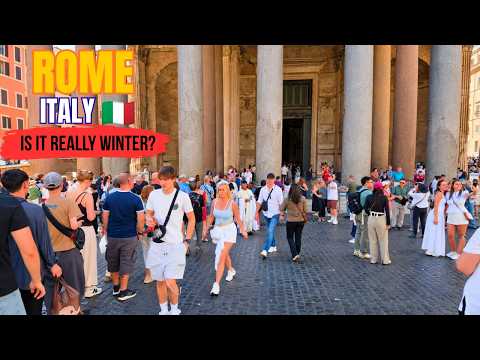
Piazza della Rotonda and the Pantheon: the best-preserved ancient monument in Rome. The square takes its name from the Rotonda, as Romans have always called the Pantheon.
- Pantheon ▶ 35:35
Piazza della Rotonda and the Pantheon: the best-preserved ancient monument in Rome. The inscription on the pediment recalls Marcus Agrippa, who built a temple here between 27 and 25 BC.
- Albergo del Sole ▶ 38:50
Here, at the start of Via del Pantheon, is the Albergo del Sole, one of the oldest hotels in the city: the first records date to 1467, and the entrance was on Via degli Orfani.
- Piazza Capranica ▶ 39:38
Piazza Capranica is named after the palace built in the middle of the fifteenth century for Cardinal Domenico Capranica, who founded the Collegio Capranica here.
- Santa Maria in Aquiro ▶ 41:00
Santa Maria in Aquiro is a very old church: it was built by Pope Anastasius the First between the end of the fourth and the beginning of the fifth century, and restored by Gregory the Third in 731.
- Via in Aquiro ▶ 42:43
Via in Aquiro keeps the name of the church we just saw. We're in the Colonna district, an area that in ancient times was part of the Campus Martius.
- Piazza di Montecitorio ▶ 43:45
Piazza di Montecitorio is dominated by the palace of the same name, home of the Chamber of Deputies. In front there's an Egyptian obelisk, which Augustus dedicated to the Sun and which was put up here in 1792.
- Palazzo Montecitorio ▶ 43:45
Piazza di Montecitorio is dominated by the palace of the same name, home of the Chamber of Deputies. The palace was commissioned from Gian Lorenzo Bernini in 1653 by Pope Innocent the Tenth, but work stopped in 1655. Carlo Fontana completed it starting in 1694.
- Piazza Colonna ▶ 46:15
Piazza Colonna is named after the Column of Marcus Aurelius, put up by the Senate and the Roman People after the emperor's death.
- Column of Marcus Aurelius ▶ 46:15
Piazza Colonna is named after the Column of Marcus Aurelius, put up by the Senate and the Roman People after the emperor's death. The shaft is 29 meters and 60 centimeters high, almost a hundred Roman feet.
- Palazzo Chigi ▶ 46:43
On the north side is Palazzo Chigi, once the Austro-Hungarian embassy and today the seat of the Italian government.
- Galleria Alberto Sordi ▶ 48:00
The Galleria Alberto Sordi is a shopping arcade from the early twentieth century: it was called Galleria Colonna, designed by Dario Carbone, and opened on October twentieth, 1922.
- Via dei Crociferi ▶ 50:10
Via dei Crociferi takes its name from the order of the Crociferi and is tied to the church of Santa Maria in Trivio, which faces the square of the same name.
- Trevi Fountain ▶ 52:10
Here we are at the Trevi Fountain, the most spectacular and the most famous of Rome's fountains. More than a fountain, it's a stage: the water seems to come out of the palace.
- Via del Lavatore ▶ 55:35
Via del Lavatore has a curious name: in the nineteenth century, up against the papal garden of the Quirinale, there was a public wash house that gave the street the name Via del Lavatore del Papa.
- Vicolo Scavolino ▶ 56:34
Vicolo Scavolino is one of the narrowest alleys in Rome. The name comes from the nearby Palazzo dei Cavalieri, of the Carpegna marquises known as "di Scavolino", from the family fief in the Marche.
- Palazzo Carpegna ▶ 56:48
Halfway along, the alley narrows even more: it's the effect of the enlargement of Palazzo Carpegna by Francesco Borromini in the seventeenth century. Today the palazzo houses the Accademia di San Luca.
- Via della Stamperia ▶ 58:08
Via della Stamperia is named after the Stamperia Camerale and the Calcografia. The palazzo was built in 1580 by Cardinal Luigi Cornaro, to a design by Jacopo Del Duca.
- Via del Tritone ▶ 59:20
Via del Tritone is named after Bernini's Triton Fountain, in Piazza Barberini, where it starts. It used to be a narrow, winding street, among gardens and vineyards.
- Via dei Due Macelli ▶ 1:01:20
Via dei Due Macelli had a name that says it all: there were two butcher shops, one belonging to the Duke Mattei. Before that it was called Via Paolina, after Paul the Third Farnese.
- Piazza Mignanelli ▶ 1:05:30
Piazza Mignanelli is named after Palazzo Mignanelli, left almost unfinished until 1887, when it was completed by Andrea Busiri Vici for the Propaganda Fide. In the square there's the Column of the Immaculate Conception, blessed by Pius the Ninth in 1857.
- Column of the Immaculate Conception ▶ 1:05:44
In the square there's the Column of the Immaculate Conception, blessed by Pius the Ninth in 1857. Every December eighth a firefighter climbs a ladder to lay a wreath of flowers at the feet of the Madonna.
- Piazza di Spagna ▶ 1:06:40
Piazza di Spagna: in front of you is the Trinità dei Monti staircase, with 135 steps, and below it the Barcaccia. The name comes from the Palazzo di Spagna, home of the Spanish embassy.
- Trinità dei Monti staircase ▶ 1:06:40
Piazza di Spagna: in front of you is the Trinità dei Monti staircase, with 135 steps, and below it the Barcaccia.
- Barcaccia Fountain ▶ 1:06:40
The Barcaccia is from 1627 to 1629 and is attributed to Pietro Bernini, father of Gian Lorenzo. It looks like a sinking boat: a clever idea to deal with the low water pressure.
- Keats-Shelley House ▶ 1:07:36
For centuries it's been a meeting place for artists and travelers: in the house next to the staircase the English poet John Keats died in 1821, and it's now a museum.