 PlaceTube
Unearthing fantastic stories of Bedford – Saxon Kings, Lost Castle & Bunyan (4K)
Open in PlaceTube Watch on YouTube
Places in this video
- Harpur Square ▶ 0:24
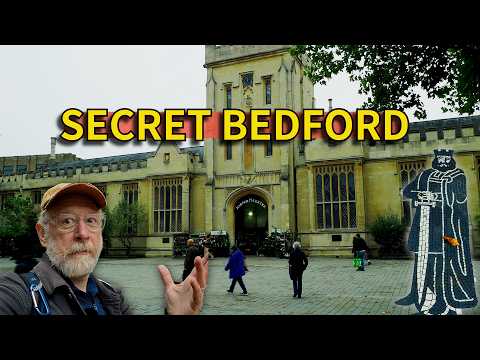
The presenter introduces Harpur Square, named after 16th-century merchant and philanthropist Sir William Harpur, with a Victorian building on one side of the market square.
- Former Bedford Modern School ▶ 0:57
He points out the wonderful stone facade that was once Bedford Modern School, established in 1830.
- The Arcade ▶ 1:47
A wonderful Edwardian arcade designed in 1905, which he compares to the Parisian arcades of Walter Benjamin's Arcades Project.
- Arcadia Sweet Shop ▶ 2:18
A sweet shop trading on this site since the arcade opened in 1905; he buys a mixed bag of cola fizz and strawberry and cream sweets.
- Slide Record Shop ▶ 3:18
The record shop where he finds the Grubby Mitts EP in the window and later buys their new album on vinyl.
- Bedford High Street ▶ 3:52
He emerges onto the high street, noting the public art just off it and the town's strong music and art scene.
- Statue of John Howard ▶ 5:46
He assumes the statue is John Bunyan, but it is actually John Howard (1726–1790), a figure not in his notes.
- St Paul's Square ▶ 6:35
A square of fine historic buildings, including a jettied timber-framed building formerly known as the Falcon, Seven Stars and Ship, symbolizing Bedford's past prosperity.
- Bedford Shire Hall ▶ 7:09
A 1910 Arts and Crafts county court designed by Charles Holden, alongside the French Gothic Shire Hall of 1879–1881.
- Bedford Town Hall ▶ 7:43
A beautiful sandstone building with a statue of Charles Hanka on the front.
- St Paul's Church ▶ 7:59
At the heart of Bedford life since Anglo-Saxon times, said to be the burial place of King Offa of Mercia, and used by the BBC for wartime broadcasts including George Orwell's and news of the D-Day landings.
- The Swan Hotel ▶ 12:24
An impressive 1794 building on the Bedford Heritage list, a former coaching inn said to have hosted Charles Dickens and Glenn Miller, right on the banks of the Great Ouse.
- Bedford Bridge ▶ 13:05
On the bridge he finds a plaque noting that on the third pier stood the stonehouse where John Bunyan was imprisoned in 1675–1676 and wrote the first part of The Pilgrim's Progress.
- River Great Ouse ▶ 13:54
An impressive watercourse that was a dominant feature of the landscape and the reason for the settlement at the ford; Bedford's regatta dates from the 1860s.
- Bedford Castle ▶ 14:35
The remains of the motte-and-bailey castle in Castle Bailey Gardens, demolished after a famous siege in 1224; he climbs the mound and views a model of the castle.
- The Higgins Bedford ▶ 19:08
Housed in the former Higgins and Sons Brewery, the museum has galleries, art spaces and Anglo-Saxon and Iron Age artifacts excavated in Bedfordshire.
- Coffee with Art ▶ 21:08
Recommended by the lady in the arcade, he stops here for lunch — decent coffee and a nice ciabatta.
- Statue of John Bunyan ▶ 22:11
An impressive statue of Bunyan on St Peter's Green, presented to the town by the Duke of Bedford in 1874.
- St Peter's Church ▶ 25:39
A church on the site for over a thousand years, still containing fragments of the original Saxon stonework.
- The Quarry Theatre ▶ 26:12
A fine building with a good programme, including Mark Watson playing soon.
- Lurke Street Car Park ▶ 26:59
The brutalist car park recommended by the sweet shop lady, said to have a giant octopus wrapped around it.
- John Bunyan Museum ▶ 27:36
Built on the site of Bunyan's original meeting house, a mecca for nonconformists, where he buys a copy of The Pilgrim's Progress and takes a selfie with Bunyan.
- Panacea Charitable Trust and Museum ▶ 28:24
Just over the road from the Bunyan Museum, an interesting religious group and museum he skips today.
- Bedford Embankment ▶ 29:33
A beautiful avenue of trees along the Victorian embankment, with a fine 1914–19 war memorial.
- Bedford Suspension Bridge ▶ 30:05
A fantastic old iron suspension bridge dating from 1884, crossing the Great Ouse.
- Mill Meadows Bandstand ▶ 30:28
A lovely bandstand in parkland on an island in the river, installed in 1926.