 PlaceTube
Rome Italy, Here's What Rome Looks Like in August 2026 | Roma Walks
Roma Walks | Roma Walking Tours ·
Open in PlaceTube Watch on YouTube
Places in this video
- Pincio ▶ 1:09
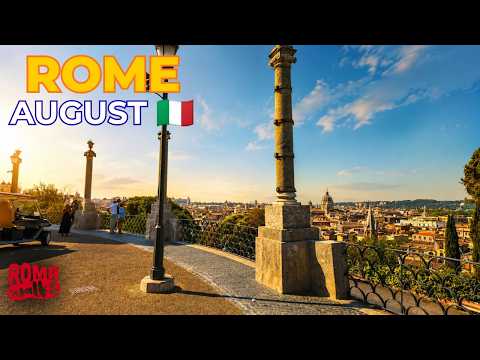
Today we start at the Pincio with a hot coffee in hand, and slowly make our way down toward the heart of Rome.
- Casina dell'Orologio ▶ 1:23
The Casina dell'Orologio on the Pincio takes its name from the famous water clock, one of the most original public clocks in the city.
- Via dell'Obelisco ▶ 1:52
Via dell'Obelisco is named for its closeness to the great Egyptian obelisk we'll soon find in the heart of the Pincio park.
- Pincian Obelisk ▶ 2:30
This Egyptian obelisk is called the Pincian Obelisk, but it would actually be more correct to call it the Obelisk of Antinous.
- Via del Belvedere ▶ 5:15
Via del Belvedere takes us along one of the most scenic stretches of the Pincio, with Rome slowly opening up in front of us.
- Bust of Father Angelo Secchi ▶ 6:10
This bust honors Father Angelo Secchi, a Jesuit and astronomer, one of the first to understand that the Sun is actually a star.
- Terrazza Angelica Kauffmann ▶ 6:50
This viewpoint is named after Angelica Kauffmann, a Swiss painter who made Rome her home in the 1700s.
- Viale della Trinità dei Monti ▶ 10:10
Viale della Trinità dei Monti connects the Pincio to Rome's most famous staircase, running through centuries-old trees and views of the city.
- Villa Medici ▶ 11:55
Villa Medici stands on the site where, in Roman times, the general Lucullus built one of the most beautiful villas in the city.
- Cannonball Fountain ▶ 12:23
The fountain in front of the entrance is known as the Cannonball Fountain.
- Via di San Sebastianello ▶ 13:00
Via di San Sebastianello was opened in the 1500s by the owners of Villa Medici, after they bought a vineyard that had belonged to Quirino Garzoni.
- Church of the Resurrection of Our Lord Jesus Christ ▶ 14:07
This is the Church of the Resurrection of Our Lord Jesus Christ, a small place of worship along our path toward Piazza di Spagna.
- Fontana del Bottino ▶ 15:30
The Fontana del Bottino takes its name from the "bottini," the old underground channels that once carried water to this part of the city.
- Rampa di San Sebastianello ▶ 16:17
The Rampa di San Sebastianello is one of the lesser-known staircases linking the Pincio to Piazza di Spagna, and it's often nearly empty.
- Piazza della Trinità dei Monti ▶ 17:20
We've arrived at Piazza della Trinità dei Monti, one of the most photographed spots in Rome, and it's not hard to see why.
- Trinità dei Monti ▶ 17:44
The church behind us was commissioned by King Louis the Twelfth of France back in 1502, built with stones brought all the way from the French city of Narbonne.
- Sallustian Obelisk ▶ 18:10
In front of the church stands the Sallustian Obelisk, which lay broken on the ground for centuries before finally being raised here in 1789.
- Spanish Steps ▶ 18:37
At its foot opens the Spanish Steps, one hundred and thirty-six steps completed in 1726 and loved by Romans from the very first day.
- Rampa Mignanelli ▶ 20:07
The Rampa Mignanelli connects Piazza Mignanelli to the Trinità dei Monti, following the old terraces of the Horti Luculliani, gardens that are two thousand years old.
- Piazza Mignanelli ▶ 22:55
Piazza Mignanelli takes its name from Palazzo Mignanelli, built at the end of the 1500s for the Gabrielli family.
- Column of the Immaculate Conception ▶ 23:23
The Column of the Immaculate Conception also looks out onto this square, facing the Palazzo di Propaganda Fide, where we'll stop shortly.
- Palazzo di Propaganda Fide ▶ 25:05
The Palazzo di Propaganda Fide bears the mark of two great rivals of Roman Baroque: first Gian Lorenzo Bernini, then Francesco Borromini.
- Via di Propaganda ▶ 25:19
The façade facing Piazza di Spagna is Bernini's, while the one on this street, Via di Propaganda, was built by Borromini in 1646.
- Sant'Andrea delle Fratte ▶ 28:20
This is the basilica of Sant'Andrea delle Fratte, where Angelica Kauffmann rests, the painter I told you about back on the Pincio.
- Via di Sant'Andrea delle Fratte ▶ 33:35
Via di Sant'Andrea delle Fratte takes its name from the basilica we just visited and still has a quiet, intimate feel.
- Via del Bufalo ▶ 35:00
Via del Bufalo probably takes its name from an old building or a sign showing a buffalo, now lost.
- Via del Pozzetto ▶ 36:05
Via del Pozzetto once formed a single street with Via del Bufalo, called Via della Chiavica del Bufalo.
- Piazza di San Silvestro ▶ 37:20
Piazza di San Silvestro stands where the Temple of the Sun once stood, built by the emperor Aurelian in 273 AD.
- Via di San Claudio ▶ 38:35
Via di San Claudio is a short passage connecting Piazza di San Silvestro to Via del Corso, lined with shops and elegant buildings.
- Via del Corso ▶ 39:46
We've now entered Via del Corso, the straight road that has run through the heart of Rome from north to south for two thousand years.
- Piazza del Parlamento ▶ 42:40
In Piazza del Parlamento there once stood a giant sundial, commissioned by the emperor Augustus in 10 BC.
- Via dei Prefetti ▶ 45:40
Via dei Prefetti takes its name from the court of the Urban Prefecture, which was based here in papal times.
- Via della Lupa ▶ 46:50
Via della Lupa probably takes its name from an old sign or an image of the Capitoline Wolf that once stood here.
- Via della Torretta ▶ 48:45
Via della Torretta takes its name from a small medieval tower that once stood in this part of Rome.
- Largo della Fontanella Borghese ▶ 50:00
Largo della Fontanella Borghese takes its name from a small fountain commissioned by the Borghese family right at this spot.
- Palazzo Borghese ▶ 51:00
Romans call Palazzo Borghese "il cembalo," the harpsichord, because of its unusual curved shape that resembles the instrument.