 PlaceTube
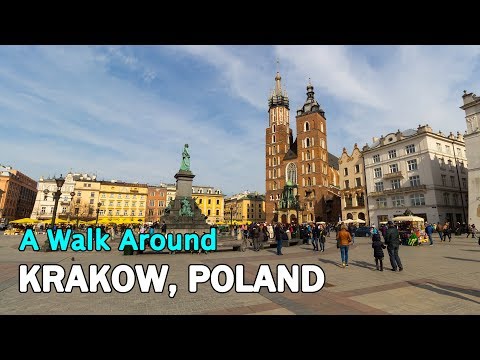
A Walk Around Krakow, Poland (2016)
Open in PlaceTube Watch on YouTube
Places in this video
- Kraków Barbican ▶ 0:00
The presenter starts the free city walking tour at the Barbican, on the outer perimeter of the old city wall, and explains how it was used to stop invaders before they reached the wall itself.
- City Walls of Kraków ▶ 0:50
He points out the gray part of the city wall, original from the 14th century, built to stop the Mongolians who had burned the city three times before.
- Main Market Square ▶ 1:43
He heads into the main market square, noting that the old part of the city is still completely intact because, unlike Warsaw, Kraków saw no major uprising or bombing in World War II.
- St. Mary's Basilica ▶ 2:59
He watches the bugle call from the top of the Market Square church, an old Polish tradition since medieval times that signified the opening and closing of the old city gates.
- Kraków Town Hall Tower ▶ 3:34
On a beautiful warm day in the Market Square he points out the town hall tower, with the Cloth Hall behind it.
- Pope John Paul II's House ▶ 3:50
He shows the building where Pope John Paul II lived in Kraków between 1951 and 1967, in a nice location close to the castle and the cathedral.
- Cloth Hall ▶ 3:50
He passes the Cloth Hall on his way out of the Market Square and later goes inside, describing it as rows of shops and stands like an indoor market.
- Juliusz Słowacki Theatre ▶ 4:23
He identifies the main theater building in Kraków while walking through one of the smaller squares in the old town.
- Rynek Underground ▶ 4:38
He goes down into the underground tunnels beneath the Market Square, where layers of medieval surfaces have been excavated, revealing the original walls of the Cloth Hall.
- Rakowicki Cemetery ▶ 6:38
After leaving the old town he walks a couple of kilometers to the huge cemetery, struck by the incredible gravestones and the many flowers, wreaths and candles on the graves.
- Old Synagogue ▶ 7:37
In the heart of the Jewish quarter he visits the original synagogue, built in the 1400s below street level because it had to be lower than local churches; it now operates as a museum of Jewish culture and customs.
- Oskar Schindler's Enamel Factory ▶ 8:51
He stands at the enamel factory run by Oskar Schindler during World War II, the location of the balcony scene in Schindler's List where people throw their suitcases.
- Ghetto Heroes Square ▶ 9:28
He stands in the former Jewish ghetto, where in 1939 the Nazis forced the city's Jews into a small area south of the river; of 65,000 Jews in 1939 only 3,000 remained by 1945.