 PlaceTube
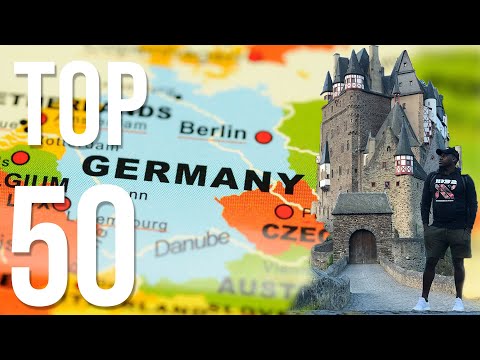
TOP 50 of GERMANYs BEST Places to Go and Things to Do
Open in PlaceTube Watch on YouTube
Places in this video
- East Side Gallery ▶ 1:13
The presenter describes the East Side Gallery as a 1,316-metre stretch of the Berlin Wall near the city centre, now an open-air gallery of 105 paintings by artists from around the world.
- Classic Open Air ▶ 1:29
He calls it the 'Gentleman Market' open-air festival, held every summer in Berlin for a few days with classical concerts, opera, jazz, rock and pop, often under the stars with fireworks.
- Brandenburg Gate ▶ 2:01
The 18th-century neoclassical monument in Berlin, built on the orders of Frederick William II, is described as one of Germany's best-known landmarks and a symbol of freedom and reunification.
- Jewish Museum Berlin ▶ 2:34
Located about 10 minutes from the Brandenburg Gate, it houses the largest documentation of Jewish-German history in Europe, covering some 2,000 years.
- Theresienwiese ▶ 2:51
The open space in Munich that serves as the official ground of Oktoberfest and other festivals, named after Princess Therese of Saxe-Hildburghausen, whose 1810 wedding is commemorated by the festival.
- Bamberg ▶ 3:07
Described as the brightly coloured town by the Regnitz, an attractive destination on the river against the northern foothills of the mountains.
- Lake Constance ▶ 3:24
The lake where Germany, Switzerland and Austria meet, the largest inland waterway in Germany and third largest lake in Central Europe, with well-preserved churches on its islands and prehistoric buildings.
- Baden-Baden ▶ 3:57
A nice little town at the foot of the Black Forest, known for its spas and hot springs and for its open-air theatre productions dating back to 1959.
- Sanssouci Palace ▶ 4:15
The summer palace of Frederick the Great near Berlin in Potsdam, designed from 1745 to 1747; after World War II it became a tourist attraction and Frederick's body was later returned and buried overlooking the gardens.
- Nuremberg Ring Railway ▶ 4:30
A funicular railway in Nuremberg opened in 1888, described as one of the few funiculars in the world with water propulsion.
- Buchenwald Memorial ▶ 4:47
He calls it the 'Saxon housing', a former Nazi concentration camp used mainly for political prisoners from 1936 until the end of the Third Reich, later used as an NKVD camp.
- Black Forest ▶ 5:04
A large forested mountain range in Baden-Württemberg in southwest Germany, filled with dense woods, rolling hills and timber-frame houses.
- Wadden Sea ▶ 5:20
The largest unbroken system of intertidal sand and mud flats in the world, rich in wildlife such as wading birds and porpoises, and a UNESCO World Heritage site.
- Geierlay suspension bridge ▶ 5:35
A rope bridge connecting the towns of Mörsdorf and Sosberg, the largest rope bridge in Germany, around 100 metres above the ground and 360 metres long, opened in 2015 and drawing about 170,000 visitors a year.
- Heide Park ▶ 6:08
The largest amusement park in northern Germany and among the largest in the country, closed from November to mid-March.
- Deutsches Museum ▶ 6:24
The largest museum of science and technology in Germany, with around 28,000 items on display and 1.5 million visitors a year, opened in 1903 and once hosting rock concerts.
- Botanical Garden Frankfurt ▶ 6:41
The botanical garden formerly maintained by Goethe University and since 2012 administered by the city of Frankfurt, a must for plant lovers.
- Pergamon Museum ▶ 6:58
Located on Museum Island in Berlin, it is the most visited museum in Germany with over 5 million visits a year and one of the largest in the country.
- Dresden Frauenkirche ▶ 7:14
A church that began as a missionary church in the 11th century, one of the finest examples of Baroque architecture in Germany, destroyed by bombing in World War II and rebuilt from 1994 over 11 years.
- Hofbräuhaus ▶ 7:46
A beer hall built in 1589 by Duke Maximilian as an extension of the Munich brewery, with the public only admitted in 1828.
- Heidelberg Castle ▶ 8:01
One of Germany's biggest attractions and a fine example of early Renaissance German architecture, existing before 1214 and drawing around a million visitors a year, reached by 315 steps or a shuttle bus.
- Moselle Valley ▶ 8:17
The oldest wine region in Germany, with the Mosel wine route the perfect way to explore vineyards and castles in a region cultivated since Roman times.
- Berlin Zoo ▶ 8:34
A zoo of over 22 acres home to over 2,000 animals, sitting on the outskirts of the city.
- Neuschwanstein Castle ▶ 8:50
One of the world's most renowned fairytale castles, symbolic of Romantic architecture, built as a home for King Ludwig II, who died in 1886; opened to the public shortly after and visited by more than 61 million people since.
- Oktoberfest ▶ 9:22
The world's largest beer festival, normally held for 16 to 28 days from mid-September to the first weekend in October, drawing more than six million people from around the world.
- Berlin Wall ▶ 9:37
The guarded concrete barrier that divided Berlin from 1961 to 1989, built by the GDR on 13 August 1961, opened on 9 November 1989 and demolished from June 1990 to November 1991.
- Europa-Park ▶ 10:10
Rated Germany's number one theme park, located in southwest Germany between Freiburg and Offenburg, open in winter, with themed areas and the Silver Star roller coaster, the second highest in Europe.
- Miniatur Wunderland ▶ 10:44
The biggest model railway in the world, featuring Hamburg's port, the Grand Canyon, the Everglades and Las Vegas, with 1,300 trains, 20,000 metres of track, 500,000 lights and 100,000 moving cars.
- Cologne Cathedral ▶ 11:00
A site of churches since the 4th century, with the cathedral completed in 1880 as the world's tallest building; at 150 metres it has the tallest twin spires and is the second tallest church in Europe, drawing over 6 million visitors a year.
- Karls Erlebnis-Dorf ▶ 11:32
An all-weather, year-round family destination near Rostock on the Baltic coast, with themed attractions, adventure playgrounds, a children's farm, an animal show and a butterfly garden with over 200 tropical butterflies.
- Partnach Gorge ▶ 12:05
A gorge near the south German town of Garmisch, over 80 metres deep in places and 702 metres long.
- Rügen ▶ 12:21
Germany's largest island by area, off the Pomeranian coast in the Baltic Sea, hosting an open-air theatre festival that brings 100,000 visitors annually.
- Sylt ▶ 12:36
Known as the queen of the North Sea, the largest of the North Frisian Islands, famous for hosting the annual windsurfing World Cup.
- Semperoper ▶ 12:53
An opera house and concert hall of the Saxon State Opera and Saxon State Orchestra, also home of the Semperoper ballet.
- Nuremberg Christkindlesmarkt ▶ 13:08
A German Christmas market where you can taste authentic snacks such as mulled wine, roast chestnuts, doughnuts and sugared almonds, open from 25 November to 24 December each year.
- Erfurt ▶ 13:23
The capital and largest city of Thuringia, rich in medieval charm with churches, towers and bridges; Luther called it the city of towers, and its Krämerbrücke has the longest row of inhabited buildings on any bridge in Europe.
- Tropical Islands ▶ 13:56
A tropical theme park in the former airship hangar in Halbe, Brandenburg, the biggest freestanding hall in the world, with a record for the largest indoor waterpark and the fourth largest building by usable volume.
- Zugspitze ▶ 14:12
The highest peak of the Wetterstein mountains and the highest peak in Germany, with three recognised routes to the summit.
- Phantasialand ▶ 14:28
A theme park about 20 kilometres from Cologne attracting around two million visitors a year, home to Taron, the world's fastest multi-launch roller coaster.
- El Dorado Templin ▶ 14:43
A Wild West themed attraction in Templin, Brandenburg, with daily live shows featuring Native American storytelling, dancing, stunt riding, gold panning and horseshoes.
- Hamburg Dungeon ▶ 15:00
One of Hamburg's most popular tourist attractions, with a guided tour lasting around 90 minutes that reveals 600 years of history.
- Rothenburg ob der Tauber ▶ 15:16
A town filled with buildings dating back to the Middle Ages, like a trip back in time with old houses, tucked-away taverns and town squares with fountains.
- The Alps ▶ 15:32
The Alpine region contains over a hundred peaks higher than 13,000 feet, running through Germany, Italy, Austria, France, Liechtenstein, Monaco, Slovenia and Switzerland, with Mont Blanc the highest.
- Dresden ▶ 15:47
The city is famous for three big landmarks — the Zwinger Palace, the Semper Opera House and the Church of Our Lady — plus the Brühl's Terrace gardens with views over the river, the Albertinum Museum and the Green Vault treasure chamber.
- Leipzig Zoo ▶ 16:35
Opened in 1911, it houses 19,000 animals on about 40 acres, is the most biodiverse zoo in Germany and was the world's first geo-zoo.
- Steinhuder Meer ▶ 16:51
The largest shallow lake in Germany with an average depth of about 1.5 metres, located 30 kilometres northwest of Hanover in a glacial landscape, good for windsurfing, angling and hiking.
- Autostadt ▶ 17:07
As the name indicates, the place for cars and car lovers from all over the world.
- Baden-Baden ▶ 17:24
A spa town in Baden-Württemberg on the northwestern edge of the Black Forest, where the Romans established the spas as far back as 69 AD; today there are over 29 natural springs at 46 to 67 degrees Celsius.
Cities in these videos
Berlin · Munich · Bamberg · Konstanz · Baden-Baden · Potsdam · Nuremberg · Weimar · Freiburg im Breisgau · Cuxhaven · Mörsdorf · Soltau · Frankfurt · Dresden · Heidelberg · Trier · Schwangau · Rust · Hamburg · Cologne · Rövershagen · Garmisch-Partenkirchen · Rügen · Sylt · Erfurt · Halbe · Brühl · Templin · Rothenburg ob der Tauber · Leipzig · Hanover · Stuttgart