 PlaceTube
Catania, Sicily Walking Tour - With Captions!
Open in PlaceTube Watch on YouTube
Places in this video
- Piazza del Duomo ▶ 2:10
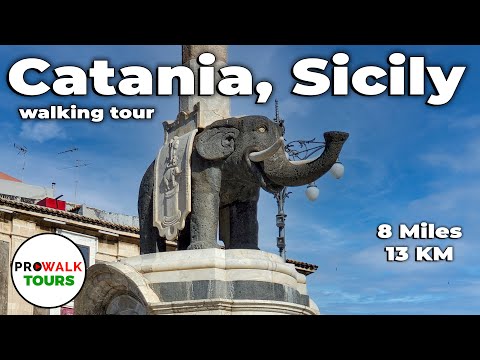
The main square of Catania, dominated by the Elephant Fountain, the symbol of the city.
- Elephant Fountain ▶ 2:10
A lava-stone elephant atop a Baroque fountain, called 'Liotru' by locals, symbolizing prosperity, wisdom and longevity.
- Palace of the Elephants (City Hall) ▶ 3:08
The City Hall, rebuilt in late Baroque style after the 1693 earthquake, representing secular power facing the Palace of the Clerics.
- Palace of the Clerics ▶ 3:42
The religious-power counterpart facing City Hall, a typical medieval disposition of the two institutions facing each other.
- Amenano Fountain ▶ 3:42
A Neoclassical fountain marking the entry to the fish market, also called 'Acqua o' Linzolu' for its sheet-like cascade, fed by the underground Amenano river.
- Catania Fish Market ▶ 5:05
A sensory market with the 'vuciata' cries of fishermen, divided into fresh fish, frozen fish and other goods; big tuna and swordfish are the most common large fish.
- Piazza Alonzo di Benedetto ▶ 7:30
Where fishermen set up stalls with their blue tanks.
- Piazza Pardo ▶ 8:02
Around the corner, fishmongers with red tents sell here, and traditional Sicilian restaurants line the square.
- Carl V Gate ▶ 10:21
The only surviving medieval door of Catania, from the old walled city that had more than 10 gates.
- Via Etnea ▶ 14:39
The main street of Catania, named after Mount Etna, ideally connecting the historic center to the volcano.
- Porta Uzeda ▶ 23:12
A gate opening into the ancient city walls, built shortly after the 1693 earthquake, connecting the seminary with the Archbishop's Palace and the Cathedral.
- Catania Cathedral (St. Agata Cathedral) ▶ 24:09
The Cathedral dates to 1094, rebuilt with a late Baroque facade featuring St. Agata; it holds the tombs of Bellini and Bishop Dusmet and medieval Norman apses.
- Via Vittorio Emanuele II ▶ 26:41
Along with parallel Via Garibaldi, it houses shops for souvenirs and typical Sicilian products like wine, food and handicrafts.
- Church of St. Martino dei Bianchi ▶ 27:17
A late Baroque church by Stefano Ittar with a typical concave prospect.
- Monument to Giuseppe Benedetto Dusmet ▶ 29:01
A monument to the beloved bishop who shared everything with the poor and is buried in the Cathedral.
- St. Francis Church ▶ 29:23
The first church of Via Crociferi, the 'church street' of Catania, with beautiful Baroque facades in white Syracuse limestone.
- Via Crociferi ▶ 29:23
Known as the church street of Catania, lined with Baroque facades and used as a film set by directors like Zeffirelli.
- Arch of St. Benedict ▶ 30:23
An arch connecting the church with the convent of cloistered Benedictine nuns, rumored to have been built in one night in 1704.
- MACS (Sicilian Contemporary Art Museum) ▶ 30:23
The Sicilian Contemporary art museum on Via San Francesco.
- St. Francis Borgia Church ▶ 31:22
A now deconsecrated church that hosts temporary exhibitions.
- Church of St. Benedict ▶ 31:50
A single-nave church with the monumental 'angels' staircase' and frescoes by Giovanni Tuccari; cloistered nuns sing at mass here.
- Nevski trattoria ▶ 32:14
A popular, easygoing, family-run trattoria since 1986, one of the nightlife spots near the Alessi stairs.
- St. Julian Church ▶ 33:22
Annexed to a former Benedictine convent now housing the CGIL trade union; it was a set for Zeffirelli's film 'Sparrow'.
- St. Camillo ai Crociferi ▶ 36:03
The last Baroque church of Via Crociferi, with its annexed convent, which gives the street its name.
- Villa Cerami Arch ▶ 37:10
The uphill arch marking the entrance to an 18th-century noble villa, now hosting the Law faculty of the University of Catania.
- Via Penninello ▶ 39:29
A venue of Catania nightlife.
- Via Manzoni ▶ 40:39
An old street of haberdashery (sewing items), even today.
- Church of St. Agata at the Prison ▶ 41:09
Has a medieval Norman portal; tradition says St. Agata was imprisoned here after her martyrdom.
- Roman Amphitheater of Catania ▶ 42:06
Among the biggest in the Roman empire, made of black lava stone and white limestone; only a tenth remains, the rest buried under 18th-century palaces.
- Church of San Biagio ▶ 43:00
Also known as St. Agata at the Furnace, it hosts the sarcophagus where she was buried.
- Piazza Stesicoro ▶ 46:41
The third square of Via Etnea, with the monument to opera composer Vincenzo Bellini.
- Let's BnB ▶ 46:59
Where the presenter stayed during his visit, on the second floor; he highly recommends it.
- 'A Fera o' Luni Market ▶ 48:15
The big open market of Catania selling clothes, food, plants and more, open daily except Sunday until early afternoon; one of the oldest markets in the city.
- Via Pacini ▶ 1:01:57
Very beautiful at night with many pubs and restaurants; its upper part is a nightlife venue crossing Via Etnea.
- Church of SS. Annunziata al Carmine ▶ 1:02:15
A church with a long history from Norman times, rebuilt in 1880, earning the title of sanctuary and minor Basilica.
- Corso Umberto I ▶ 1:07:42
A street for nightlife with Liberty and eclectic buildings from the early 20th century.
- Vicolo Santa Filomena ▶ 1:09:42
One of the main venues of the movida (nightlife) of Catania.
- Savia Bar ▶ 1:10:55
Popular for arancini and all the typical tavola calda street food.
- Villa Bellini ▶ 1:14:02
The green lung of the city, over 7 hectares, inaugurated in 1883, with Mediterranean and exotic plants, a Promenade of the Illustrious Men and a Moorish Kiosk of Music.
- Kiosk of Music ▶ 1:30:40
A Moorish-style kiosk of wrought iron and glass in Villa Bellini where opera concerts were once held in summer.
- Largo Paisiello Fountain ▶ 1:39:35
An area that once held the Arena Giardino open-air cinema and skating rink; now a spot for the local hip hop and skate scene.
- La Rinascente ▶ 1:42:39
A shopping center built on the ruins of Palazzo Spitaleri, mined during WWII; Roman necropolis remains were found beneath it.
- Corso Sicilia ▶ 1:45:10
A modern large road built in the 1950s connecting the center to the train station, which split the San Berillo district.
- San Berillo District ▶ 1:45:10
An iconic neighborhood of Catania, symbol of art and decay, split by the building of Corso Sicilia.
- Via Montesano ▶ 1:46:41
Along with Via San Michele, offers pubs, cocktail bars and art studios such as Razmataz, Cucina dei Colori, Mixology and Tabaré.
- Basilica della Collegiata (Santa Maria dell'Elemosina) ▶ 1:49:26
A beautiful concave-prospect church by Stefano Ittar, once a royal chapel, with bright frescoes by Giuseppe Sciuti inside.
- Piazza Università ▶ 1:50:09
Features the main buildings of the University of Catania, established in 1434, the first university in Sicily; also home to Ligama's colorful elephant and bronze lamp posts.
- University of Catania ▶ 1:50:09
Established in 1434, the first university in Sicily, with 17 faculties and branches in Syracuse and Ragusa.
- Badia of St. Agata ▶ 1:59:18
Vaccarini's masterpiece with a wavy white-stone Baroque facade; its dome walkway offers views of Catania and Etna.
- Ancient Greek-Roman Theater of Catania ▶ 2:03:11
Entered from Via Vittorio Emanuele II 266; a Greek theater from the 5th century BC later enlarged by the Romans, with a cavea that held up to 7000 spectators and an antiquarium.
- Odeon of Catania ▶ 2:12:20
A smaller theater behind the main one, used for poetry readings, music and private events, holding 1500 spectators.
- Piazza Asmundo ▶ 2:37:01
A silent area at the back of St. Benedict church, near the old upper Judeca Jewish neighborhood.
- Piazza Mazzini ▶ 2:41:51
Its columns probably come from the Greek-Roman theater of Catania.
- Via Transito ▶ 2:45:09
A street named after death, where the registry office stood opposite coffin shops.
- Ursino Castle ▶ 2:47:10
A medieval castle completed in 1250 by Frederick II, now the civic museum with three archaeological collections; once a prison and distanced from the sea by the 1669 lava flow.
- Via Plebiscito ▶ 2:57:05
The first ring road of the old city, famous for trattorias and butcheries selling horse meat.
- Via Belfiore Market ▶ 3:01:59
A local market on Via Plebiscito also famous for trattorias and butcheries selling horse meat, including Leone butcher.
- Porta Ferdinandea (Porta Garibaldi) ▶ 3:06:24
A triumphal Baroque arch called 'u Futtino' by locals, built in the 18th century to celebrate the Bourbon wedding, decorated with the elephant and phoenix.
- La Casa delle Crispelle ▶ 3:13:52
A must-see spot at Via Plebiscito and Via Vittorio Emanuele II, open in the afternoon, serving fried crispelle with anchovies, ricotta or rice and honey.
- Former Convent of Santissima Trinità ▶ 3:18:26
A former cloistered convent and annexed church, now hosting a high school.
- Monastery of San Nicolò l'Arena ▶ 3:20:20
The second biggest Benedictine monastery complex in Europe after Mafra, rich with Roman ruins including a thermal bath and ancient roads.
- Church of St. Nicola ▶ 3:22:14
The biggest church in Sicily, yet unaccomplished, as the monks ran out of resources after the lava flow and earthquake.
- Terme della Rotonda ▶ 3:24:55
A Roman bath complex whose dome was later turned into a church by the Byzantines; the circular room was the caldarium.
- Quattro Canti ▶ 3:31:08
The Four Corners intersection, whose Baroque buildings were among the first rebuilt after the earthquake and WWII bombings.
- Manganelli Palace ▶ 3:33:01
A noble palace with a famous two-level hanging Italian garden connected by a staircase.
- Teatro Massimo Bellini ▶ 3:34:54
The opera theater named after Bellini, inaugurated in 1890 with 'La Norma', seating 1500 with one of the best acoustics in the world.
- Fountain of the Dolphins ▶ 3:36:04
A fountain by Baroque architect Giovanni Battista Vaccarini near the opera theater.
- Piazza dei Martiri ▶ 3:41:51
Its column, probably from the Roman amphitheater, is topped by St. Agata smashing a hydra symbolizing the plague.
- Civita District ▶ 3:42:52
The first medieval core of the city.
- House of Giovanni Battista Vaccarini ▶ 3:43:24
The classic-Baroque house of the architect to whom Catania owes many palaces, churches, fountains and squares.
- Piazza Cutelli ▶ 3:44:48
Home to the Convitto Cutelli and the Fountain of the Seashells, which replaced an older fountain honoring King Vittorio Emanuele II.
- Convitto Cutelli ▶ 3:45:36
A former boarding school opened at the end of the 18th century for young noblemen studying law, today a prestigious European high school.
- Bonajuto Palace ▶ 3:46:50
A jewel in a narrow alley with a 6th-century Byzantine church that became the family's private chapel, with Caravaggio-style angel murals.
- Palazzo della Cultura ▶ 3:48:00
A former cloistered convent and church of St. Placido, now a cultural center embedding the old Platamone palace structures.
- Church of St. Placido ▶ 3:48:53
A late Baroque church by Stefano Ittar with a typical concave prospect; possibly the site of the ancient temple of Bacchus.
- Gardens of the Cathedral ▶ 3:51:53
The gardens beside the Cathedral, shown at the end of the tour.