 PlaceTube
Walking London's Hidden Legendary City | Prehistoric Mounds of London Walk (4K)
Open in PlaceTube Watch on YouTube
Places in this video
- Tothill Street ▶ 1:01
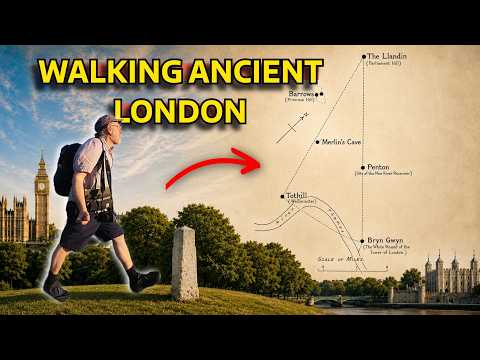
The presenter starts his walk at Tothill, the western boundary and first of the four mounds, noting the name is recorded in Tothill Street and Tothill Fields on old maps.
- Tower of London ▶ 1:19
The White Mount, known to most as the Tower of London, is the second mound; Gordon sees it as an ancient island site where the head of Bran the Blessed was buried beneath the White Tower to protect Britain.
- Palace of Westminster ▶ 2:05
The Houses of Parliament are cited as one of the institutions of power gathered on the ancient site of Tothill, needing no explanation.
- Westminster Hall ▶ 2:05
He points out Westminster Hall behind him, where the first General Assembly of the United Nations met in 1946, as evidence of power clustering around ancient significant sites.
- Westminster Abbey ▶ 2:16
He describes the abbey as an incredibly important site in Christian Britain, standing on the marshy Thorney Island where the River Tyburn met the Thames.
- Thorney Island ▶ 2:23
The whole Westminster area was built on Thorney Island, a marshy island where the Tyburn broke into rivulets, and history records it as a raised area giving some credence to Gordon's theory.
- UK Supreme Court ▶ 4:00
Alongside the Houses of Parliament, he notes the UK Supreme Court as another institution of decision-making and settling of disputes on this ancient court site.
- Victoria Embankment Gardens ▶ 5:52
The route follows the embankment through a series of delightful gardens, including a lily pond presented in 1915 by Alfred Buxton, chairman of the London County Council.
- Savoy ▶ 7:39
He passes through the Savoy, site of John of Gaunt's palace destroyed in the Peasants' Revolt, and mentions a supposed Roman bathhouse that was likely an ancient spring.
- Middle Temple ▶ 8:37
Behind the Waitrose band he points out the Inns of Court, the Middle and Inner Temple, built on land originally owned by the Knights Templar.
- Inner Temple ▶ 8:51
He names the Inner Temple among the Inns of Court on Templar land, linking Gordon's mythology to ideas of the Holy Land and the Middle East.
- Ludgate Hill ▶ 9:51
He crosses the top of Ludgate Hill, the highest natural point in the City of London, which Gordon considers one of the most important hills in London's mythology, linked to King Lud.
- St Dunstan-in-the-West ▶ 10:51
The statues of King Lud and his sons stand in the porch of this church on Fleet Street, moved here when Ludgate was taken down.
- St Paul's Cathedral ▶ 11:12
He describes St Paul's as a site of ancient worship, likely a Roman temple and early Christian church built over a pagan shrine, with records of a stag's head carried up Ludgate Hill in the 16th century.
- London Stone ▶ 12:48
On the way down Cannon Street he checks in on the London Stone, officially a possible Roman milestone, which Gordon claimed was a coronation stone of the ancient kings of England.
- Billingsgate Roman Bathhouse ▶ 14:18
He passes the Billingsgate Roman Bathhouse with its map of Londinium, unable to resist an opening into the underworld.
- Barbican ▶ 18:12
The route heads up to the northern edge of the city, the Barbican, before continuing to the Penton Mound at Islington.
- Lombard Street ▶ 18:27
He always seems to go down Lombard Street, recalling a procession here for the Knollys Rose Ceremony from the church at the Tower to Mansion House.
- St Peter upon Cornhill ▶ 18:52
The church claims a site of worship since around AD 160, as the altar of the Roman basilica was found nearby, and Gordon would claim it was pre-Roman worship too.
- Cornhill ▶ 18:52
Looking back up Cornhill, one of the twin hills of the City, towards St Peter's Cornhill, which claims a church on the site since around AD 160.
- Royal Exchange ▶ 19:35
He cuts behind the Royal Exchange because its grand columns invoke the ancient world.
- Bank of England ▶ 19:41
He cuts round the back of the Bank of England, joking about the vaults of gold on the hills of London.
- Guildhall ▶ 20:06
Passing across Guildhall Yard, a site of antiquity with the Roman arena nearby, he notes the carved statues of Gog and Magog within the Guildhall.
- Gresham Street ▶ 20:48
The walk continues up Gresham Street, looking delightful on this midsummer's evening.
- St John Street ▶ 21:38
St John's Street is one of the ancient medieval streets linking Islington to the city and its monastic communities, passing close to the Penton Mound.
- Aldersgate Street ▶ 21:42
He goes up Aldersgate Street, an ancient street, before turning into St John's Street, another of London's ancient thoroughfares.
- Islington Museum ▶ 22:40
He mentions passing the Islington Museum, where you can see the Joe Orton defaced library books in a glass case.
- Spa Green Gardens ▶ 22:59
Turning into Lloyd's Row, once the site of the famous Islington Spa, commemorated in the Spa Green Estate and Spa Green Gardens at the foot of the Penton Mound.
- Merlin Street ▶ 23:50
He walks Merlin Street, where the original Merlin's Cave Tavern stood, an 18th-century tea garden linked to the Spa Fields riots.
- Charles Rowan House ▶ 24:28
Formerly police dwellings, this was the last site of the Merlin's Cave Tavern when it became a punk and prog rock club, at the base of the Penton Mound.
- Penton Mound ▶ 25:14
The third and most unlikely mound, the head of the sacred hill in Islington, where Gordon says Merlin dwelt in a cave and a stone circle hosted Druidic ceremonies; today it is the New River Head upper reservoir.
- New River Head ▶ 26:01
The New River aqueduct, built in the 1610s, carried fresh drinking water to the New River Head and pumped it into the city; its upper reservoir sits on the Penton Mound.
- Penton Street ▶ 28:03
He notes Penton Street is named after the developer Henry Penton, undercutting Gordon's etymology of Pen-Ton as the head of the sacred mound.
- Chapel Market Tavern ▶ 28:33
He planned to take his hydration break at the Chapel Market Tavern but spent too long chatting by Merlin's Cave, so had to go further.
- Copenhagen Street ▶ 28:41
He goes down Copenhagen Street to connect with York Way, passing a mural telling the story of the Tolpuddle Martyrs who marched through from Copenhagen Fields.
- York Way ▶ 28:44
York Way, originally Maiden Lane, is a ceremonial way according to Gordon, the processional route solstice pilgrims and druids would have walked to Parliament Hill.
- Brecknock Road ▶ 33:08
York Way becomes Brecknock Road, with a great view down into the valley of the Fleet running through Kentish Town.
- Boston Arms ▶ 33:50
He calls the Boston Arms a majestic building very fitting for a ceremonial way, but decides stopping for a hydration break now would be a mistake.
- Lord Palmerston ▶ 34:13
He vaguely remembered the Lord Palmerston on Chetwynd Road, which sounds vaguely Welsh, before cracking on with his can.
- Bull and Last ▶ 35:10
The Bull and Last is another pub that could act as a pilgrim's rest, being so close to Parliament Hill.
- Hampstead Heath ▶ 35:19
He reaches the foot of Hampstead Heath, checking the map before heading for the Stone of Free Speech.
- Parliament Hill ▶ 35:48
The fourth and final holy hill, and in some eyes the most significant, where Gordon calls it the largest and loftiest of the four prehistoric gorsedd seats, an amphitheatre of wooded hills between Hampstead and Highgate.
- Stone of Free Speech ▶ 36:03
Near the summit of Parliament Hill, the stone is said to carry rights of free speech from antiquity; Tony Benn read from the banned Spycatcher here so journalists could report freely.