 PlaceTube
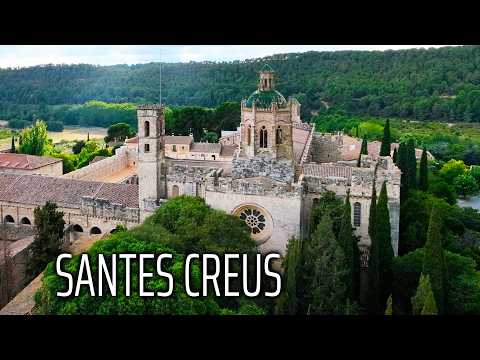
Santes Creus Monastery 🇪🇸 | A Journey into Medieval Catalonia
Open in PlaceTube Watch on YouTube
Places in this video
- Santes Creus Monastery ▶ 0:00
The presenter introduces the Cistercian monastery of Santes Creus, founded in the 12th century and one of the most important Cistercian monasteries in Spain, a place of faith, silence and power for centuries.
- Abbot's Palace (Town Hall) ▶ 0:20
The former Abbot's Palace now houses the town hall (ajuntament); after the monastery was dissolved it became the seat of local government in 1857, giving a former religious power center a secular role.
- Monastery Church Facade ▶ 0:59
The presenter stands before the imposing facade of the monastery church and the entrance to the historic complex, behind which lie centuries of faith, power and history.
- Hexagonal Wash Pavilion ▶ 1:14
In the cloister stands a hexagonal wash pavilion from the late 12th or early 13th century, older than the surrounding Gothic cloister, with a circular fountain of white marble where the monks washed their hands before meals.
- Rear Cloister ▶ 1:33
The rear cloister was built in the second half of the 14th century under Abbot Guillem Ferrer, its simpler pointed arches connecting different parts of the monastery.
- Kitchen and Refectory ▶ 1:50
The kitchen and refectory are where the monks ate in silence while religious texts were read aloud; a serving hatch passed food from the kitchen into the dining hall, and the refectory was remodeled in 1733.
- Abbot's Palace ▶ 2:09
The Abbot's Palace served as the abbot's residence and administrative center, reflecting the considerable secular power the abbot held alongside his religious duties.
- 12th-Century Chapel ▶ 2:14
This small 12th-century chapel was probably the first place the monks held religious services, until the main church opened in 1211; it later served the monastery's infirmary.
- Clock Tower (Torre de les Hores) ▶ 2:44
On the way to the cemetery and church stands the historic clock tower built in 1575, whose clock and bells helped regulate the monks' daily routine.
- Monastery Cemetery ▶ 2:54
At the cemetery the presenter finds a single stone cross, reflecting the Cistercian ideal of equality, since no individual monk's grave was meant to stand out.
- Rose Window ▶ 3:03
The large rose window of the monastery church dates from 1193, measures 6.3 m in diameter, retains much of its original medieval glazing and is one of the oldest surviving examples of Cistercian stained glass.
- Monastery Church Interior ▶ 3:22
Inside the church the presenter is struck by the tall, largely unadorned interior; construction began in 1174 and continued until the late 13th century, reflecting Cistercian ideals.
- Baroque High Altar ▶ 3:42
In the choir stands a striking contrast: the magnificent Baroque high altar by Josep Tremul, created in 1647.
- Royal Tombs ▶ 3:48
Near the high altar are the royal tombs of Peter the Great, James II and his wife Blanche of Anjou, making Santes Creus the final resting place of Catalan rulers.
- Monks' Dormitory ▶ 3:58
The former dormitory, begun in 1191 and completed in 1225, is about 46 m long and spanned by 11 pointed transverse arches without supporting columns; the monks slept here together on straw mattresses, and a staircase led directly to the church for night prayers.
- Chapter House ▶ 4:40
In the chapter house the monks gathered daily to hear a chapter of the Rule of Saint Benedict; the abbot led the assembly, decisions were made and new abbots elected, under an impressive ribbed ceiling supported by four freestanding columns.