 PlaceTube
Some of the places to see in Ansbach
Open in PlaceTube Watch on YouTube
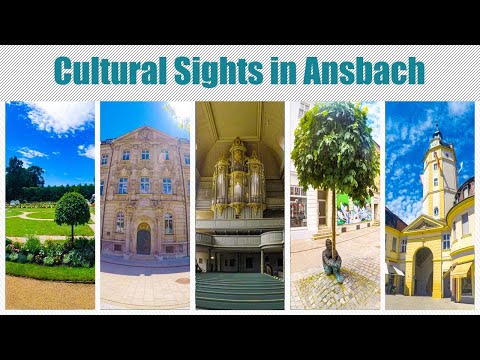
Places in this video
- Ansbach Residence ▶ 3:28
The former government seat of the Margraves of Brandenburg-Ansbach, now the administrative seat of Middle Franconia; its great hall and orangery host the Bach Week festival.
- Behringershof ▶ 3:51
A former 16th-century monastery courtyard next to St. Gumbertus church, now used as the church's rectory, with two Renaissance stair towers worth seeing.
- St. Gumbertus ▶ 4:11
A Protestant parish church on the site of the 8th-century Benedictine monastery, with a three-tower facade and a royal burial vault holding 25 sarcophagi of the Ansbach margraves.
- Ansbach Town Hall ▶ 5:10
Built in 1531 and expanded in the 1620s, this four-story gable-roofed building now serves as the tourist information center.
- St. Johannis ▶ 5:33
The bourgeois parish church built uniformly in the 15th century as a three-aisle pseudo-basilica, begun in 1420 and consecrated in 1458.
- Margrave Museum ▶ 6:13
Houses the history of the city in a complex of buildings from the 14th to 18th centuries, including a walkable section of the city wall and a Kaspar Hauser department.
- Ansbach Synagogue ▶ 7:01
Built in 1744-46 to plans by Leopoldo Retti, desecrated by the Nazis in 1938 and repurposed since 1964 as a museum space.
- Herrieder Gate ▶ 7:18
A late Gothic gate with a substructure expanded by Georg Andreas Buckler in 1684-85 and a top by Johann David Steingruber in 1750-51; the Ansbach coat of arms is on its north side.
- Ansbach City Library ▶ 7:42
Housed in the former margraves' granary, it holds more than 45,000 media across three floors, most of them barrier-free.
- St. Ludwig ▶ 8:04
The first Catholic parish church in Ansbach, built in the 19th century with a grant from King Ludwig I in 1829.
- Orangery ▶ 8:32
Built in the early 18th century on French models by Carl Friedrich von Zocha, modeled on Versailles, and rebuilt after World War II bombing using old plans.
- Hofgarten ▶ 9:01
A French Baroque courtyard garden near the Residence centered on the castle-like Orangery, with a rose and herb garden and southern plants like lemon, olive and pistachio trees in summer.
- Ansbach City Cemetery ▶ 9:50
Originating from a 1461 pilgrimage chapel, it became the cemetery after a 1521 plague epidemic and holds graves of figures like Kaspar Hauser and poet Johann Peter Uz.