 PlaceTube
Graz Vacation Travel Video Guide
Open in PlaceTube Watch on YouTube
Places in this video
- Schlossberg ▶ 0:52
The mountain rising 123 m above the city, reached by a rack railway up its steep 60% gradient; once a ritual site for Romans and Celts, now crossed by paths and pavilions.
- Schlossberg Clock Tower ▶ 2:38
The clock tower on the Schlossberg summit, Graz's main landmark, dating to the 13th century and given its characteristic design in 1569.
- Hauptplatz ▶ 4:21
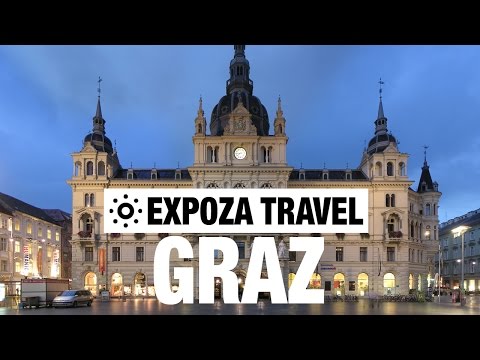
The main square dominated by the historic City Hall, long a popular meeting place, once full of market stalls and a site of public punishment.
- Erzherzog Johann Fountain ▶ 4:54
The fountain in the center of the main square, surrounded by old houses and colorful facades.
- Franciscan Monastery and Church ▶ 5:30
A monastery and church in one of the oldest districts, first built in 1257 and enlarged in 1515, with plain furnishings and modern windows added after WWII destruction.
- Landhaus ▶ 7:17
The city's most famous example of Italian Renaissance design, with a courtyard of arcades on three levels by master builder Domenico dell'Allio.
- Landeszeughaus ▶ 8:28
The historic armory near the Landhaus, guarded by figures of Mars and Minerva, holding nearly 32,000 exhibits and the world's largest collection of historic weaponry.
- Burg zu Graz ▶ 10:43
The former Habsburg residence, whose tower contains a unique double spiral Gothic staircase of shining sandstone.
- Schloss Eggenberg ▶ 11:16
A castle built outside the city walls in 1438, now the seat of Styria's provincial government, with numerous building styles and an adjoining park.
- Minoriten Monastery ▶ 11:54
A monastery on the right bank of the river, home to the Maria Hilf pilgrimage site and since 1978 maintained by Slovenian monks; its dormitory now houses the Diocesan Museum.
- Diocesan Museum Graz ▶ 12:44
Located in the former monks' dormitory of the Minorite monastery, exhibiting sacred treasures, figures of saints, church furnishings and old paintings from Styrian parishes.
- Murinsel ▶ 13:52
The floating island in the River Mur created by New York artist Vito Acconci for the 2003 Cultural Capital year, containing an amphitheater seating 300 and a cafe.
- Joanneum Museum ▶ 14:39
Donated in 1811 by Archduke Johann along with his personal collections, housed in the splendid Landesmuseum with 16 exhibition areas, ancient stone reliefs, minerals and prehistoric animal replicas.
- Graz Cathedral ▶ 16:38
The Gothic cathedral built by Emperor Friedrich III in 1438 as a church for the city's inhabitants and the Royal Court, located next to the castle.
- Jesuit Church ▶ 17:07
An impressive Jesuit church at the center of the Counter-Reformation since 1573, later Styria's main Bishop's Church, with a late Baroque altar, imposing pulpit and Rococo organ.
- Mausoleum of Ferdinand II ▶ 18:21
An imposing Mannerist monument next to the cathedral, ordered by Archduke Ferdinand II, who chose his hometown of Graz as his final resting place.
- Botanical Garden of the University of Graz ▶ 18:37
The university botanical garden, graced since 1995 by a futuristic glasshouse whose cylinders hold warm, cold, temperate and succulent houses letting in 98% of sunlight.
- Basilica of Maria Trost ▶ 20:22
A Baroque basilica on a hill to the northeast, reached by 215 steps, home to a miraculous Gothic Madonna and frescoes by Philipp Carl Laubmann; Franciscans have maintained it since 1846.
- Schloss Eggenberg ▶ 22:26
Built in 1623 by Hans Ulrich von Eggenberg as a symbol of power, with four towers for the seasons, 12 gates for the months and 365 windows for the days; Austria's largest and most splendid castle, modeled on the Escorial.