 PlaceTube
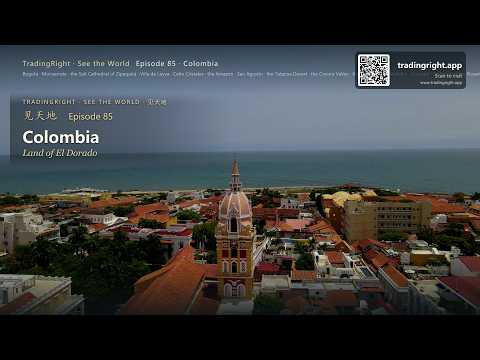
Colombia: Land of El Dorado | See the World Ep 85
Open in PlaceTube Watch on YouTube
Places in this video
- Bogotá ▶ 0:47
The capital comes into view on a high Andean plateau, one of the highest large cities in the world, and the journey begins here.
- La Candelaria ▶ 4:33
The old quarter's cobbled lanes climb between colourful colonial houses with wooden balconies, their walls covered in street art.
- Plaza de Bolívar ▶ 4:42
The square is framed by the cathedral, the Capitol and the city hall, as flocks of pigeons rise and settle.
- Gold Museum ▶ 4:50
Nearby, the Gold Museum holds tens of thousands of pre-Columbian gold pieces, among them the famous Muisca raft.
- Monserrate ▶ 5:01
The guardian mountain of Bogotá rises east of the old town; visitors ride the cable car or funicular up, while pilgrims climb the stone steps to the seventeenth-century white church with the Fallen Christ.
- Zipaquirá Salt Cathedral ▶ 5:33
About fifty kilometres north of Bogotá, miners carved a cathedral out of rock salt about 180 metres underground, completed in 1995, with blue and violet light glowing on the salt walls.
- Villa de Leyva ▶ 6:11
A colonial town founded in 1572 that still looks much as it did centuries ago, with whitewashed houses, red tiles and bougainvillea spilling over the walls.
- Plaza Mayor ▶ 6:21
Its cobbled square covers about 14,000 square metres, one of the largest squares in South America.
- Caño Cristales ▶ 6:57
The legendary river of colours in the Serranía de la Macarena, where from about June to November a water plant turns bright red, earning it the name river of five colours.
- Leticia ▶ 7:24
Colombia's southernmost town on the banks of the Amazon, where Colombia, Brazil and Peru meet.
- Puerto Nariño ▶ 7:46
Upstream, a car-free Indigenous village where forest peoples such as the Ticuna keep their age-old ways of life.
- San Agustín Archaeological Park ▶ 7:54
Hundreds of stone statues of gods, animals and fanged figures stand scattered over the green hills, carved roughly between the first and eighth centuries; the park became a World Heritage Site in 1995.
- Tatacoa Desert ▶ 8:35
About 330 square kilometres of dry land in Huila, strictly a tropical dry forest where rain has carved deep gullies and spires; the Cuzco area glows ochre red while Los Hoyos is a grey maze.
- Cocora Valley ▶ 9:11
Slender wax palms stand tall on misty slopes; the Quindío wax palm is Colombia's national tree, reaching up to sixty metres, with trails through pastures and cloud forest.
- Salento ▶ 9:35
At the mouth of the valley the little town is painted in bright colours, and old Willys jeeps carry visitors between town and valley.
- Coffee Cultural Landscape of Colombia ▶ 9:50
North lies the Coffee Axis around Caldas, a World Heritage Site since 2011, where Arabica coffee covers steep slopes shaded by banana plants and bamboo, picked by hand with two harvests a year.
- Medellín ▶ 10:21
The capital of Antioquia, mild all year round and known as the City of Eternal Spring, with a metro linked to cable cars climbing the steep slopes.
- Comuna 13 ▶ 10:36
Once a hard place to live, it now has outdoor escalators and walls of murals telling its story, a symbol of the city's renewal.
- Plaza Botero ▶ 10:46
In the centre, the plaza displays twenty-three plump, rounded bronze sculptures by the artist Fernando Botero.
- Rock of Guatapé ▶ 11:02
About eighty kilometres east of Medellín a giant granite rock rises from a land of lakes, about two hundred metres high, with more than six hundred steps zigzagging up a crack in its face.
- Guatapé ▶ 11:19
At the foot of the rock, the town is full of colour, every house decorated with painted reliefs along its walls that tell of the owners' lives.
- Cartagena ▶ 11:30
The Caribbean port founded in 1533, once one of the most important Spanish harbours in the Americas, with about eleven kilometres of walls built to keep out pirates; the old town became a World Heritage Site in 1984.
- Castillo San Felipe de Barajas ▶ 11:52
On a hill outside the walls, one of the largest fortresses Spain built in the Americas, a maze of tunnels and batteries.
- Rosario Islands ▶ 12:16
About an hour by boat southwest of Cartagena, more than twenty little islands form a national natural park, one of the most important marine reserves on Colombia's Caribbean coast, with clear water, corals and tropical fish.
- Playa Blanca ▶ 12:39
On nearby Barú, palms sway over the white sand of Playa Blanca, and at sunset fishing boats head home across a golden sea.
- Santa Marta ▶ 12:50
East along the coast lies Santa Marta, founded in 1525, the oldest surviving city in Colombia.
- Tayrona National Park ▶ 12:58
Rainforest runs right down to the sea, and giant boulders lie scattered on golden sand; a walk through the jungle leads to Cabo San Juan.
- Cabo San Juan ▶ 13:07
A thatched hut on a rocky knoll looks over two crescent bays in Tayrona National Park.
- Ciudad Perdida ▶ 13:20
The Lost City of the Tairona, called Teyuna by Indigenous people, was built around the year 800, centuries before Machu Picchu; more than 1,200 stone steps climb to mossy circular terraces, reached on a four or five day trek.
Cities in these videos
Bogotá · Zipaquirá · Villa de Leyva · La Macarena · Leticia · Puerto Nariño · San Agustín · Villavieja · Salento · Manizales · Medellín · Guatapé · Cartagena · Barú · Santa Marta