 PlaceTube
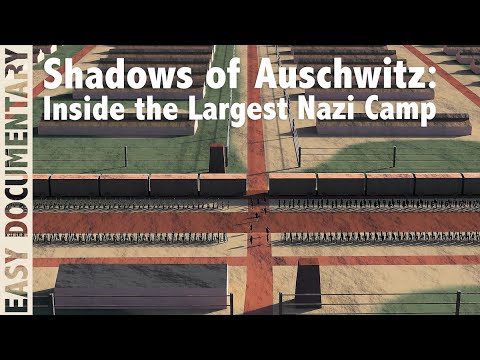
Shadows of Auschwitz: Inside the Largest Nazi Death Camp - Full Documentary
Open in PlaceTube Watch on YouTube
Places in this video
- Auschwitz I ▶ 8:39
The main camp, built in May 1940 on the site of former Polish military barracks, with 28 prisoner blocks behind a double barbed-wire fence.
- Block 11 (Death Block) ▶ 15:16
The sinister 'death block' at the tip of the camp, a prison within the prison with 28 cramped cells, torture chambers and Gestapo court sessions.
- Execution Yard of Block 11 ▶ 17:29
The courtyard where thousands of men, women and children were shot in the back of the head, and where the first Zyklon B gassings were tested in the basement of Block 11.
- Crematorium I ▶ 19:14
A new gas chamber created in the old ammunition depot of the barracks, equipped with a crematorium that could burn over 400 bodies a day.
- Auschwitz II-Birkenau ▶ 20:20
The largest concentration camp and most important extermination center, built over the razed village of Brzezinka, enclosed by 16 km of electrified barbed wire.
- Judenrampe ▶ 25:07
The first station platform built in spring 1942, 1 km from Auschwitz I and 600 m from Birkenau's entrance, where half a million people arrived in two years.
- Birkenau Ramp (Bahnhofsrampe) ▶ 25:33
The second platform, built in May 1944, led inside the camp to the gates of the gas chambers; 430,000 Hungarian Jews landed here in just six weeks.
- Freight Car Memorial ▶ 26:51
A preserved cattle car, a vestige of the deportation period, kept in tribute to the victims who were transported in such conditions.
- Yad Vashem ▶ 29:56
The Holocaust History Museum in Jerusalem where the Auschwitz Album, an exceptional collection of 197 photos, is carefully preserved.
- Crematorium IV ▶ 32:40
One of the crematoria north of the camp, reached by the camp road, where those deemed unfit for work were marched to be gassed.
- Crematorium V ▶ 32:40
The crematorium more than a kilometer away, near the small birch woods where the Sonderkommando photographs were taken.
- Bunker 1 ▶ 33:46
One of two sealed farmhouses from the dismantled Polish village, nicknamed bunkers by the SS, where the first gassings at Birkenau took place.
- Bunker 2 ▶ 34:18
The second gas chamber of 1942, whose foundations show a building of about 120 square meters divided into four airtight rooms; 150,000 to 200,000 people were murdered in the two bunkers.
- Crematorium III ▶ 35:39
One of the twin crematoria at the end of the ramp, with an undressing room, a fictitious shower room and Zyklon B hatches; Marcel Nadjari's manuscript was buried near it.
- Crematorium II ▶ 35:56
The ruins of gas chamber and crematorium number two, with an underground gas chamber holding over 2,000 people and five furnaces that officially burned 1,400 corpses a day.
- Auschwitz-Birkenau State Museum ▶ 42:38
The museum preserving the sites and collections, including tons of abandoned belongings kept behind the huge windows of block 4.
- Central Sauna ▶ 44:20
The building where deportees not sent straight to the gas chambers were undressed, shaved, tattooed and given disinfected prisoner uniforms.
- Canada Barracks ▶ 46:01
The group of barracks opposite the central sauna where the personal effects of murdered people were sorted before being shipped to Germany.
- Auschwitz III-Monowitz ▶ 47:55
The largest subcamp, 8 km east of Birkenau, attached to the Buna factory, where at least 15,000 people were detained in 1944.
- Buna Werke ▶ 48:12
The largest chemical plant in Europe, covering over 350 hectares, built by IG Farben to produce synthetic rubber and aircraft fuel; part of it still remains and produces fuel today.
- IG Farben Settlement ▶ 49:54
A vast urban planning project for Aryan settlers less than a kilometer from the factory, with houses now inhabited by Polish families where 7,000 German settlers once lived.