 PlaceTube
Corinth: Roman Capital of Greece
Open in PlaceTube Watch on YouTube
Places in this video
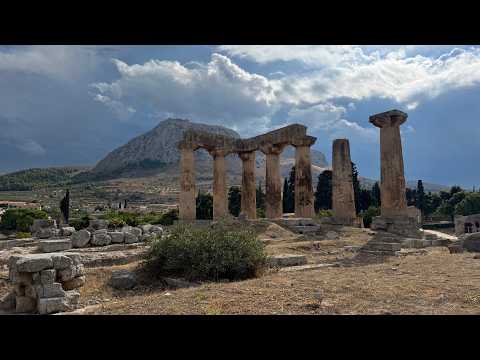
- Temple of Apollo ▶ 0:51
The oldest and most prominent building in the city center, built around the mid-6th century BC with monolithic poros limestone columns coated in stucco; the surviving columns belonged to the back facade.
- Roman Forum of Corinth ▶ 1:42
The forum is divided into upper and lower terraces by a row of shops, with small temples alternating with shops on the west side of the upper terrace.
- Lechaion Road ▶ 1:59
The road led down to one of Corinth's harbors and was the Cardo Maximus, the main north-south street of the Roman city, paved with limestone under Vespasian and lined with colonnades.
- South Stoa ▶ 2:15
The enormous two-story South Stoa dominated the back of the forum's upper terrace, originally with 33 shops and restaurants on its ground floor; the bouleuterion and the procurator's office were at its end.
- Julian Basilica ▶ 2:57
An all-purpose public building on the lower terrace, decorated with statues of the imperial family.
- Bema of Corinth ▶ 3:06
An imposing marble rostra 10 feet above the lower terrace, almost certainly the speaker's platform where the proconsul judged cases and where Gallio likely refused to try St. Paul; a Byzantine church was later built over the site.
- Fountain of Peirene ▶ 3:56
A famous fountain on the right side of the Lechaion Road, monumentalized under the Romans in the 2nd century with a two-story marble facade and shady alcoves; myth says it rose where Pegasus stamped his hoof.
- Odeon of Corinth ▶ 5:03
Used for musical and rhetorical performances with about 3,000 seats, remodeled by Herodes Atticus and later converted into a Roman-style arena after a 3rd-century fire.
- Theater of Corinth ▶ 5:34
Built in the classical period and reconstructed by the Romans with an elaborate three-story stage building; its lowest seats were cut away to make it a venue for beast hunts and gladiatorial matches, later sealed for aquatic spectacles.