 PlaceTube
BELGRADE Travel Guide 2026 🇷🇸 | Best Things to Do, See & Know
Open in PlaceTube Watch on YouTube
Places in this video
- Belgrade Fortress ▶ 0:40
The presenter starts the tour at Belgrade Fortress, the birthplace of the city, describing its Roman-era fortifications, the military museum with outdoor tanks, the Roman well, and the ramparts.
- Kalemegdan Park ▶ 0:40
Described as the city's favorite park surrounding the fortress, a massive open-air museum where you walk through ancient gates and stone ramparts.
- Victor Monument ▶ 1:31
Called the highlight of the fortress, erected after World War I, with a terrace offering the most famous panoramic view in Belgrade, especially at sunset.
- Knez Mihailova Street ▶ 1:52
Belgrade's vibrant pedestrian boulevard lined with 19th-century neoclassical buildings, boutiques, bookshops and street performers, prime for people watching and coffee.
- Republic Square ▶ 2:13
Belgrade's main meeting point, dominated by the monument to Prince Mihailo and surrounded by the National Museum and National Theater; also the central hub for night buses.
- National Museum of Serbia ▶ 2:13
Mentioned as one of the two major cultural landmarks surrounding Republic Square.
- National Theatre in Belgrade ▶ 2:13
Named alongside the National Museum as one of the major cultural landmarks on Republic Square.
- Skadarlija ▶ 2:29
Belgrade's old bohemian quarter, a small cobbled street that was a favorite gathering place for writers, poets and musicians, with historic 19th-century taverns serving traditional food and live music.
- Terazije ▶ 3:44
Marks the beginning of Belgrade's monumental city center, home to the historic Hotel Moskva and a 19th-century fountain that is a meeting point for sticker collectors.
- Hotel Moskva ▶ 3:44
Opened in 1908 and one of the most recognizable buildings in the city; its cafe is famous for the Moskva Schnit cake.
- National Assembly of Serbia ▶ 4:22
An imposing building completed in 1936, a short distance from Terazije, with the old and new palaces standing across the avenue.
- Old Palace ▶ 4:22
Built for Serbia's royal dynasty in the late 19th century, today serving as Belgrade City Hall.
- New Palace ▶ 4:22
Across the avenue from the old palace, now the official residence of the president of Serbia.
- St. Mark's Church ▶ 4:38
One of Belgrade's largest Orthodox churches, completed shortly before WWII, recognizable by its distinctive striped stone exterior, standing beside Tasmajdan Park.
- Tasmajdan Park ▶ 4:59
One of the most popular green spaces in central Belgrade, next to St. Mark's Church, forming part of the most interesting stretch of the city center.
- Temple of Saint Sava ▶ 5:14
Belgrade's most recognizable religious landmark on the Vracar plateau, one of the largest Orthodox churches in the world, with golden mosaics inside and a richly decorated crypt; free to enter.
- Nikola Tesla Museum ▶ 6:38
A small but extraordinary museum holding Tesla's belongings, documents and working models, plus the urn with his ashes; the guided tour includes live Tesla coil demonstrations.
- Zemun ▶ 7:33
A former Austro-Hungarian border town across the Danube, now part of Belgrade, with pastel houses, baroque churches and cobblestone alleys; its old town and Danube promenade are popular for evening walks.
- Gardos ▶ 8:27
A historic neighborhood above Zemun's old town with steep cobbled streets and old houses, home to the Millennium Tower.
- Millennium Tower ▶ 8:27
Built by Hungary in 1896 to mark 1,000 years since the Hungarian conquest; climbing to its viewing platform gives one of the finest vantage points in the region.
- New Belgrade ▶ 9:17
A post-WWII socialist planned district of residential blocks, wide boulevards and green spaces, renowned for modernist and brutalist architecture, now also a business district.
- Western City Gate ▶ 9:54
Also known as the Genex Tower, a 35-story concrete skyscraper with two unequal towers joined by a bridge topped with a rotating restaurant, once a symbol of the future.
- Museum of Yugoslavia ▶ 10:35
Chronicles the rise and collapse of the former Yugoslav state with artifacts and state gifts, centered on the House of Flowers, Tito's final resting place, set in landscaped parklands.
- House of Flowers ▶ 10:52
A winter garden pavilion at the center of the Museum of Yugoslavia complex serving as the final resting place of Josip Broz Tito.
- Belgrade Waterfront ▶ 11:08
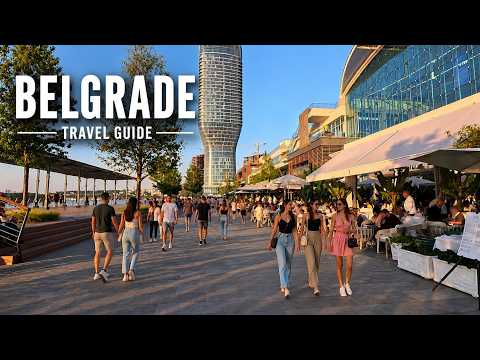
The newest part of the city center, a controversial redevelopment along the Sava with modern towers, restaurants and a long promenade, home to Kula Belgrade and the Galerija mall.
- Kula Belgrade ▶ 11:59
The main landmark of Belgrade Waterfront and the tallest building in Serbia.
- Galerija ▶ 11:59
One of the largest shopping malls in the region, located near Kula Belgrade in the waterfront district.
- Beton Hala ▶ 11:59
A former riverside warehouse complex beneath Belgrade Fortress transformed into a popular area for restaurants, bars and nightlife.
- Ada Ciganlija ▶ 12:35
An island on the Sava turned into a peninsula and recreational lake, known as Belgrade's sea, with an 8 km pebbled beach, cafes, sports fields and shaded paths.
- Savamala ▶ 15:02
Mentioned as a popular area for bars and clubs along with the riverfront when discussing Belgrade's nightlife.
- Cetinjska Street ▶ 15:21
A street near Skadarlija known for a more alternative nightlife atmosphere.