 PlaceTube
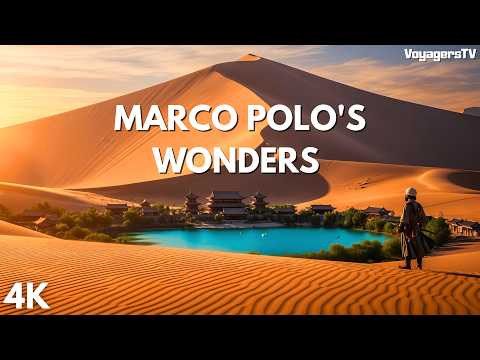
Marco Polo's Silk Road Today | What Survived 750 Years?
Open in PlaceTube Watch on YouTube
Places in this video
- St. Mark's Basilica ▶ 1:55
The presenter explains that every surface of St. Mark's Basilica tells the story of Venice's connection to the East, with Byzantine mosaics and marble columns borrowed from ancient temples.
- Rialto ▶ 2:26
The Rialto is described as the place where Eastern goods like spices, silks, frankincense and precious stones first touched European soil, making Venetian merchants wealthy.
- Acre ▶ 4:08
Marco's first destination, Acre in 1271, is presented as Christianity's last major foothold in the Holy Land, with massive fortress walls meeting the Mediterranean.
- Jerusalem ▶ 5:24
The Polos traveled inland to Jerusalem as merchants with papal credentials, into a city where three faiths converged on ancient stones.
- Dome of the Rock ▶ 5:41
The Dome of the Rock is listed alongside the Church of the Holy Sepulchre and the Western Wall as sacred ground shared uneasily by three faiths.
- Church of the Holy Sepulchre ▶ 5:41
The Church of the Holy Sepulchre is named as one of the sacred sites marking territory and claiming divine connection in Jerusalem.
- Western Wall ▶ 5:46
The Western Wall is mentioned as one of the ancient stones where Christians, Muslims and Jews converged in 1271.
- Naqsh-e Jahan Square ▶ 7:24
Marco Polo called Isfahan one of the most beautiful cities in the world, and the presenter describes Naqsh-e Jahan Square stretching five hundred meters with perfect symmetry, designed as a mirror of heaven on Earth.
- Sheikh Lotfollah Mosque ▶ 7:58
The Sheikh Lotfollah Mosque is described with its turquoise tiles in kaleidoscope patterns and domes that seem to float, though it was built after Marco passed through.
- Persian gardens of Isfahan ▶ 8:32
The presenter explains that Persian gardens follow a design older than Islam, with four rivers flowing from a central point, and that Marco wrote extensively about these gardens and water systems.
- Bridges of Isfahan ▶ 8:49
The bridges of Isfahan are described as more than crossings, meeting places where East and West traded goods, ideas and stories, reflected in the Zayandeh River.
- Kashgar Sunday Market ▶ 13:30
The presenter says Kashgar's Sunday Market has operated in essentially the same form for over two thousand years, with Uyghur merchants selling carpets, spices and jade.
- Flaming Mountains ▶ 13:59
The Flaming Mountains are described as red sandstone cliffs that glow like embers at sunset, with Chinese legends about the Monkey King battling demons.
- Bezeklik Thousand Buddha Caves ▶ 14:22
Hidden in canyon walls, Buddhist monks carved sanctuaries filled with murals depicting the Silk Road's spiritual journey, where travelers prayed before entering the desert.
- Mogao Caves ▶ 15:36
The Mogao Caves are described as 492 caves carved into cliff faces holding a thousand years of Buddhist art, where Marco almost certainly stopped on his way into China.
- Singing Sand Dunes ▶ 16:24
Local legends claim these dunes echo with the voices of lost travelers, and the presenter describes a low hum pulsing across the desert at sunset.
- Crescent Lake ▶ 16:48
Crescent Lake is described as a spring-fed lake surviving in the middle of massive sand dunes, which Marco mentioned as proof that beauty finds a way even in harshness.
- Shangdu (Xanadu) ruins ▶ 17:41
The presenter says Xanadu was real, with the ruins of Shangdu still marking Inner Mongolia's grasslands, and archaeologists found it exactly where Marco said it would be.
- Forbidden City ▶ 20:43
The Forbidden City is said to sit on the foundations of Kublai Khan's palace, with nine thousand rooms and courtyards designed to manifest imperial power.
- Temple of Heaven ▶ 21:11
The Temple of Heaven reveals cosmic geometry, circular heaven meeting square Earth, where emperors performed rituals to maintain harmony between celestial and terrestrial realms.
- Beijing hutongs ▶ 21:39
The presenter explains that medieval street patterns survive in Beijing's hutongs, narrow alleyways following the same grid system Khan's planners established.
- Lijiang Old Town ▶ 23:31
Lijiang is said to preserve what Marco witnessed, with stone streets polished smooth, water channels through the town center, and Naxi architecture blending Chinese, Tibetan and local traditions.
- Tiger Leaping Gorge ▶ 23:48
Tiger Leaping Gorge is described as cutting three thousand meters deep, one of Earth's deepest canyons, with a legend of a tiger leaping across the river at its narrowest point.
- Honghe Hani Rice Terraces ▶ 24:31
The rice terraces of Yunnan are described as steps carved into mountains over a thousand years ago, each terrace a small miracle of water management studied by Khan's administrators.
- West Lake ▶ 26:10
Marco called Hangzhou the finest and most splendid city in the world, and the presenter describes West Lake with causeways, islands and pagodas achieving perfect balance between nature and civilization.
- Longjing tea hills ▶ 26:56
The hills surrounding Hangzhou produce some of China's finest tea, and the presenter says Marco witnessed Longjing tea culture at its height, as ceremony and philosophy.
- Leifeng Pagoda ▶ 27:23
The pagodas of Hangzhou are described as marking the city's history in vertical increments, built to anchor spiritual energy, and as earthquake-resistant marvels with flexible wooden joints.
- Grand Canal ▶ 27:41
The Grand Canal connects Hangzhou to Beijing over seventeen hundred kilometers, the longest canal system ever constructed, which Marco traveled repeatedly and which reminded him of Venice.
Cities in these videos
Venice · Acre · Jerusalem · Isfahan · Kashgar · Turpan · Dunhuang · Xilingol · Beijing · Lijiang · Yuanyang · Hangzhou