 PlaceTube
Walking Through 2,000 Years of History in Évora, Portugal
Open in PlaceTube Watch on YouTube
Places in this video
- Convento do Salvador ▶ 1:27
The presenter points out this former 16th-century convent as the walk begins through Évora's old town.
- Porta de Alconchel ▶ 2:18
Described as one of the main entrances to medieval Évora, forming part of the city's extensive defensive walls.
- Évora Historic Centre ▶ 2:58
Called the 'Museum City' for its rich monuments, the historic centre was designated a UNESCO World Heritage Site in 1986.
- Convento de São Francisco ▶ 5:20
A former convent founded in 1452, established beside Évora's former Jewish quarter which began on the right-hand side of this street.
- Évora ▶ 6:36
The presenter explains that Évora lies in the Alentejo region of southern Portugal, about 140 km east of Lisbon, with roughly 40,000 inhabitants.
- Paço de São Miguel ▶ 8:25
A palace dating back to the 16th century that the walk passes by in the old town.
- Praça do Giraldo ▶ 10:03
Évora's main square and the historic heart of the city, where the presenter pauses during the walk.
- Church of Santo Antão ▶ 10:48
A 16th-century church standing on Praça do Giraldo, noted as the walk continues through the square.
- Palácio de Dom Manuel ▶ 19:59
Once a magnificent royal residence where Portuguese monarchs stayed; only this section survives of the 15th-century palace.
- Ruínas Fingidas ▶ 23:45
The 'False Ruins' are a 19th-century picturesque composition built from genuine fragments of demolished buildings.
- Statue of Vasco da Gama ▶ 26:49
A statue of the navigator who pioneered the sea route from Europe to India in 1498, seen near the palace gardens.
- Church of St. Francis ▶ 28:25
Originally 13th-century but rebuilt between the late 15th and early 16th centuries, with an impressive single nave covered by a vast Gothic vault.
- Chapel of Bones ▶ 39:35
Famous chapel whose walls and pillars are covered with the bones of an estimated 5,000 people, built by Franciscan monks in the 17th century; the presenter describes its inscription and mummified remains.
- University of Évora ▶ 1:12:31
Founded in 1559 and entrusted to the Jesuits, it strengthened the city's reputation as a center of education before closing in 1759.
- Porta de Moura ▶ 1:15:32
Once one of the main entrances to medieval Évora, dating back to at least 1286, though the original gate no longer survives.
- Évora Cathedral ▶ 1:16:48
Officially the Basilica of Our Lady of the Assumption, begun in 1186 and the largest medieval cathedral in Portugal; the presenter tours the altar, upper choir, rooftop terrace and Gothic cloister.
- Roman Temple of Évora ▶ 1:43:35
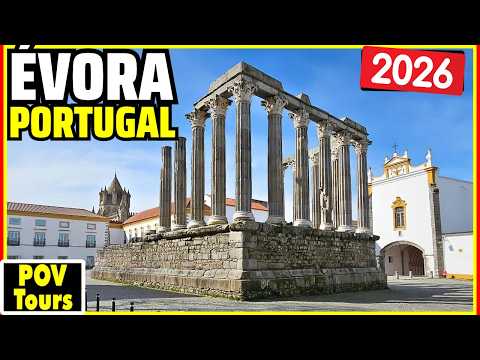
Known as the Temple of Diana, this 1st-century AD granite temple with Corinthian columns is one of Portugal's most striking Roman remains.
- Duques de Cadaval Palace ▶ 1:50:08
A 14th-century palace built over the ruins of a former Moorish castle, next to the Roman temple.
- Roman Arch of Évora ▶ 1:51:26
Dating to the late 2nd or 3rd century AD, it once formed one of the gates of Ebora Liberalitas Julia.
- Évora City Hall ▶ 1:53:53
The City Hall stands above Roman public baths from the 2nd and 3rd centuries AD, discovered in 1987, with a heated bathing room and furnace area.
- Porta Nova ▶ 1:56:06
One of the medieval entrances to Évora, dating back at least to the 14th century as the town expanded beyond its Roman center.
- Água de Prata Aqueduct ▶ 1:58:35
A 16th-century aqueduct stretching about 18 km that brought water to Évora, with houses built into the spaces between its stone arches.
- Porta de Aviz ▶ 2:14:30
One of the oldest surviving gates in Évora's medieval walls, first documented in 1381, incorporating a small chapel.