 PlaceTube
Pompeii 1-day Tour - What to see in Italy's Roman ruins - Mini-documentary
Deanna Allison (DeannaInAustria) ·
Open in PlaceTube Watch on YouTube
Places in this video
- Pompeii ▶ 0:10
The presenter introduces Pompeii as an ancient Roman city near Naples that was buried under volcanic ash in the eruption of Mount Vesuvius in 79 AD.
- Mount Vesuvius ▶ 0:10
The volcano whose eruption in 79 AD buried Pompeii; the city lies about 10 km from it.
- Marina Gate ▶ 0:29
One of the seven entrance gates in the city walls; entering through it brings you quickly to the Forum.
- Forum ▶ 0:46
The centre of the city's daily life, containing the main places of citizen worship and the public buildings for administration, justice, business and markets.
- Forum Granary ▶ 1:01
Now used to store more than 9000 artefacts found in Pompeii, including casts of victims, marble tables, statues, terracotta crockery and amphorae.
- Mensa Ponderaria ▶ 1:38
A replica of the public weights and measures table, used to check the accuracy of merchants' measures in the forum.
- Large Theatre ▶ 3:04
Built around the middle of the 2nd century BC using the natural slope of the hill for the auditorium, where Greek-Roman comedies and tragedies were performed.
- Quadriporticus ▶ 3:41
A large quadrangle behind the Large Theatre used as a foyer for spectators, later converted into a gladiator barracks after the 62 AD earthquake.
- Odeon (Small Theatre) ▶ 3:56
The Small Theatre dating to 79 BC, used for mime, music and singing.
- Amphitheatre ▶ 3:56
The oldest surviving Roman amphitheatre, built after 70 BC, seating around 20,000 for gladiatorial games; site of a famous AD 59 riot.
- Stabian Baths ▶ 4:45
A well-preserved bath complex with a large palaestra courtyard and separate areas for men and women.
- Forum Baths ▶ 4:45
One of Pompeii's well-preserved bath houses, mentioned alongside the Stabian Baths as a centre for bathing and socialising.
- Fullery of Stephanus ▶ 5:44
A house converted into a laundry, with baths in the atrium and garden, where slaves trod fabrics soaked in urine to clean badly stained items.
- House of Menander ▶ 6:02
A large house with a peristyle courtyard, home to relatives of Empress Poppea Sabina, named after a painting of the Athenian playwright; it has a private bath suite and lararia.
- House of the Orchard ▶ 6:58
A small but elegant home with a square atrium and impluvium, decorated with garden scenes, bird life and Egyptian-motif plaques.
- House of Paquius Proculus ▶ 7:16
A relatively small house with an atrium covered in mosaic panels of animals, including a comic scene of pygmies fishing on the Nile, and a garden with a marble fountain.
- House of Marcus Lucretius ▶ 7:53
A house with a raised garden, a stepped marble fountain feeding a circular pool, and a tablinum with a fine mosaic floor.
- Garden of the Fugitives ▶ 8:09
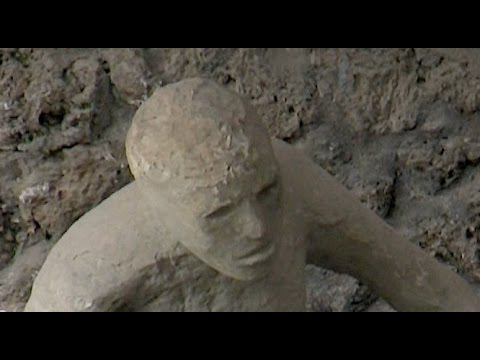
A former vineyard where victims of the eruption were found; their casts are displayed in a glass case near the back wall.