 PlaceTube
[4K]🇫🇷 Versailles: World's Most Luxurious Palace Full Walking Tour 👑
Open in PlaceTube Watch on YouTube
Places in this video
- Equestrian Statue of Louis XIV ▶ 2:23
The presenter opens the tour at the equestrian statue of Louis XIV that greets visitors at the entrance of Versailles, calling it a grand monument representing the absolute power of the Sun King.
- Palace of Versailles ▶ 2:55
The presenter introduces the Palace of Versailles as one of the world's most magnificent royal residences, originally a hunting lodge for Louis XIII and transformed by Louis XIV into the political and cultural center of France.
- Grille d'Honneur ▶ 3:58
The golden ceremonial gate of Versailles is described as symbolizing the power and grandeur of the French monarchy.
- Cour d'Honneur ▶ 4:32
The grand forecourt where nobles and ambassadors once arrived to witness the glory of Louis XIV's palace.
- Cour Royale ▶ 7:25
The presenter explains that this courtyard was where dignitaries and noble guests first arrived, sitting between the Cour d'Honneur and the Marble Court.
- Marble Court ▶ 8:27
Described as the very heart of the palace, built on the site of Louis XIII's hunting lodge, with black-and-white marble tiles and the oldest façade at Versailles.
- Lower Gallery of the Pavillon Central ▶ 9:49
A long, intimate corridor beneath the Sun King's private chambers that once served as a passage for royal guests connecting the Marble Court to the king's apartments.
- Madame Victoire's Apartments ▶ 11:03
The presenter visits the chambers of Princess Victoire, daughter of Louis XV, where grand public rooms connected to the princesses' bedchambers used for receptions and ceremonies.
- Hoquetons Salon ▶ 13:49
A historically fascinating room originally used by palace guards known for their distinctive hoqueton tunics, later serving royal family members like Madame Victoire and Madame Adélaïde.
- King's State Apartments ▶ 15:50
A series of lavish ceremonial rooms built under Louis XIV for official functions, receptions and banquets, decorated in Italian Baroque style and named after Roman gods.
- Royal Chapel of Versailles ▶ 17:08
Completed in the late 17th century under Louis XIV, the chapel served as the royal space for religious ceremonies and official events, designed in French Baroque style with ornate ceilings and gilded decorations.
- Hercules Salon ▶ 22:26
One of the grandest rooms in the King's State Apartments, used for official ceremonies and royal banquets, with a ceiling featuring 'The Apotheosis of Hercules.'
- Venus Salon ▶ 24:04
The first room of the King's State Apartments, dedicated to the goddess of love and beauty, adorned with marble, gilded decorations and ceiling paintings of Venus.
- Hall of Mirrors ▶ 26:49
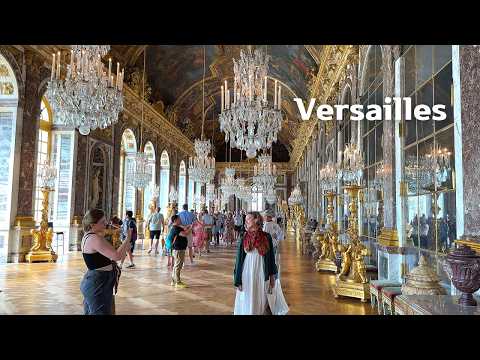
The presenter marvels at the Hall of Mirrors, where seventeen mirrors face seventeen windows, with gilded decorations and ceiling paintings celebrating Louis XIV's victories and the glory of France.
- King's Chamber ▶ 30:57
The Sun King's personal bedroom and ceremonial space where court rituals and official audiences took place, featuring grand Baroque decoration and a central royal bed.
- Queen's Chamber ▶ 31:35
The residence of queens including Marie Antoinette, used for important court rituals, births, receptions and the queen's official breakfasts.
- Coronation Room ▶ 33:00
Originally a chapel built in 1682, transformed by Louis-Philippe in 1833 to honor Napoleon, displaying works commemorating Napoleon and his empire.
- Gardens of Versailles ▶ 34:07
The presenter strolls through the Gardens of Versailles, designed by André Le Nôtre, covering nearly 800 hectares and considered one of the finest examples of French formal garden style.
- The Orangery ▶ 37:14
Designed by Jules Hardouin-Mansart and completed between 1684 and 1686, built to protect orange trees and exotic plants during winter, showcasing the king's wealth and taste.
- Bacchus Fountain ▶ 43:23
Created around 1670 and dedicated to Bacchus, the Roman god of wine and festivity, surrounded by satyrs and nymphs and symbolizing abundance and joy.
- Latona Fountain ▶ 49:41
The fountain depicts the goddess Latona protecting her children while punishing insolent peasants, symbolizing the authority of Louis XIV, with the Latona Parterre stretching around it.
- Grove of the Girandole ▶ 58:53
Created in the late 17th century and named after the firework-like effect of its central fountain.
- Saturn Fountain ▶ 1:00:25
Created by François Girardon in the early 1670s, depicting Saturn, the god of time and seasons, surrounded by allegories of the year.
- Grand Canal ▶ 1:03:36
Stretching 1.6 km across the western end of the gardens, completed in the late 1660s and originally used for royal boating parties, symbolizing the absolute power of Louis XIV.
- Grand Trianon ▶ 1:06:21
Built between 1670 and 1687 by Jules Hardouin-Mansart as a private retreat for Louis XIV, blending architecture with nature, with the Mirror Room, Empress's Bedchamber and pink marble Peristyle.
- Cotelle Gallery ▶ 1:09:15
Decorated with paintings by Jean Cotelle the Younger depicting the fountains and groves of Versailles, offering the royal family a place to stroll and admire art.
- Amphitheater of the Gardens of Versailles ▶ 1:15:36
An outdoor space designed for concerts, performances and court events, showing how the 17th-century French formal garden combined nature, art and royal spectacle.
- French Pavilion ▶ 1:16:30
A small pavilion with trelliswork and gardens that served as a summer retreat for the royal court.
- Petit Trianon ▶ 1:18:20
The presenter visits the Petit Trianon, a summer dining room where Louis XV and Madame de Pompadour enjoyed fresh produce, later favored by Marie Antoinette as a private sanctuary.
- Temple of Love ▶ 1:24:15
Built in 1778 at Marie Antoinette's request, this elegant rotunda by Richard Mique features twelve Corinthian columns surrounding a statue of Cupid carving his bow.
- Queen's Hamlet ▶ 1:25:18
Built between 1783 and 1786 for Marie Antoinette, a picturesque village with cottages, a mill, a dairy and a working farm around a tranquil lake, where the queen could escape court formality.
- Little Train of Versailles ▶ 1:29:55
On the way back the presenter takes the little train, noting that Versailles is too much to cover in one day and recommending a two-day itinerary.