 PlaceTube
The Pu-erh tea mountains of Xishuangbanna: map overview
Open in PlaceTube Watch on YouTube
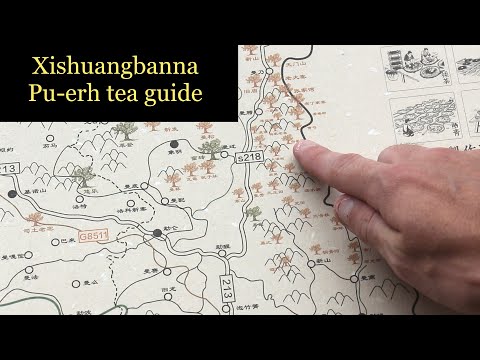
Places in this video
- Mekong River ▶ 0:46
The Mekong (Lancang Jiang) splits Xishuangbanna in half and marks the border with Myanmar and Laos, dividing eastern and western Xishuangbanna.
- Jinghong ▶ 1:03
Jinghong is the main city of Xishuangbanna, sitting on the Mekong at about 800 meters altitude, and has grown from a remote rural place into a city with skyscrapers.
- Yiwu ▶ 1:37
One of the six famous tea mountains east of the Mekong; the town is in the south while the tea gardens lie to the northeast, and it is by far the largest producing mountain of the six.
- Xiangming ▶ 2:09
A small town from which you can access four of the famous tea mountains, including Yibang and Mansa; the presenter found it mostly rubber plantations when he visited ten years ago.
- Yibang ▶ 2:56
Yibang, especially the village of Mansong in its north, is famous for imperial tribute tea, now extremely expensive and very low yield, and is distinctive for its pure small-leaf varietal.
- Mansong ▶ 2:56
Mansong, in the north of Yibang, is famous for producing imperial tribute tea, now extremely expensive with very low yield.
- Youle Mountain ▶ 4:01
Youle Shan, about an hour from Jinghong, is populated by the Jinuo minority; only two villages, Situ Laozhai by the main road to Laos and Longpa further north, produce decent tea.
- Situ Laozhai ▶ 4:31
A very accessible village by the side of the main road going south to Laos, one of two villages on Youle Mountain producing a decent amount of good tea.
- Longpa ▶ 4:47
A village further north in the hills around Youle Shan, the other of the two tea-producing villages there.
- Mengla ▶ 6:39
Between Yiwu town and Mengla there are many tea gardens on the eastern side, with terroirs detailed very precisely across the mountains.
- Guafengzhai ▶ 8:33
One of two valleys across the border in Laos, with many villages making very interesting tea in remote forests, similar in setting to eastern Yiwu.
- Menghai ▶ 11:17
About an hour and a half west of Jinghong, Menghai is the capital of Pu-erh, home to all the big business and thousands of factories, and a convenient base for visiting the western tea mountains.
- Mengsong ▶ 12:26
North of Menghai at fairly low altitude, Mengsong is known for teas with a high-pitched fragrance and a special kind of bitterness; Baotang and Naka are its most famous villages.
- Baotang ▶ 13:15
One of the two most famous villages in Mengsong, known for the area's distinctive fragrance and bitterness.
- Naka ▶ 13:30
One of the presenter's favorite villages, in Mengsong, with both high-pitched fragrance and strong but fast bitterness.
- Nannuo Mountain ▶ 14:54
A very tiny mountain close to Menghai with lots of ancient gardens, a well-balanced but less typical tea, and a great view toward Jinghong; Banpo Laozhai is its most famous tea village.
- Banpo Laozhai ▶ 15:13
The most famous tea village on Nannuo Mountain, with a great view toward Jinghong and lots of ancient gardens.
- Galanghu ▶ 15:45
A small town by a small lake at the top of Nannuo Mountain, a good base for going further south.
- Pasha Mountain ▶ 16:03
A very famous mountain in the Menghai area with a taste fairly close to Ban Zhang; the presenter hasn't visited yet but plans to.
- Mengzhe ▶ 17:24
A town on the road toward Bada with a nice pagoda, good for tourism, on the road that goes to Chiang Mai.
- Bada Mountain ▶ 17:39
In the west, Bada has a huge plantation of conventional, low-quality tea, plus villages like Hesong and Zhanglang with a decent amount of ancient gardens.
- Manmei ▶ 17:55
A famous area that used to be a tourist hotspot for one of the oldest and biggest tea trees in Xishuangbanna, until the tree fell around 2012.
- Jingmai Mountain ▶ 18:27
Jingmai Mountain is in Pu'er county, not Xishuangbanna, but very close by; it's the presenter's base and favorite mountain, and may have belonged to Xishuangbanna 20-30 years ago.
- Mengku ▶ 19:17
A large plain with lots of rice fields, huge and very beautiful, with amazing barbecue and great local meat and produce.
- Hekai ▶ 19:50
Up a small windy road with bad conditions, Hekai has two villages, Manong and Manmai, with vast, beautiful tea gardens that could be mistaken for Jingmai.
- Manmai ▶ 20:07
One of the two villages at the start of Hekai, with beautiful, vast tea gardens and mostly gushu rather than young plantations.
- Banpan ▶ 20:39
A village included in Hekai, far from Manmai along a long windy road, at about 1,600 meters and closer in character to Lao Banzhang.
- Lao Banzhang ▶ 21:13
At a peak of about 1,800 meters, Lao Banzhang is considered one of the best teas around, with great fragrance, mouthfeel and depth; it seemed very touristy and required a ticket to enter.
- Xin Banzhang ▶ 22:34
Further along the road, Xin Banzhang has fewer ancient gardens and mostly plantations, but they are pricey because the soil gives excellent tea.
- Baka Noy ▶ 23:07
A lesser-known village right after Xin Banzhang, with Banzhang character in the taste and better price-to-value than Lao Banzhang.
- La Mana ▶ 23:37
One of the presenter's favorite places, at low altitude (1,200 m) yet producing great tea with the heaviest sweetness, though less balanced than Lao Banzhang.
- Bulangshan ▶ 24:43
A small town with lots and lots of villages, mostly plantation tea, and one of the two largest producing areas in Menghai, giving heavy sweetness and bitterness to blends.
- Zhangjia ▶ 25:16
A notable area with three villages at the border with Myanmar, an absolutely beautiful landscape with a deep valley and tea gardens on all the slopes.
- Xiding ▶ 27:10
Mentioned as having some cheap tea, like Bada, and tea almost everywhere if you go a bit into the countryside.
Cities in these videos
Xishuangbanna · Jinghong · Yiwu · Xiangming · Yibang · Mengla · Menghai · Pu'er