 PlaceTube
Is This The Most Beautiful City in England? | Newcastle 4K Walk
Open in PlaceTube Watch on YouTube
Places in this video
- Newcastle Central Station ▶ 0:00
The walk begins at the magnificent Central Station, opened by Queen Victoria in 1850 and designed by John Dobson, with its pioneering curved iron roof.
- Grainger Street ▶ 0:32
The presenter walks up Grainger Street, the heart of Grainger Town, praising its uniform golden sandstone facades, listed buildings and gentle curve designed to create unfolding vistas.
- Grainger Market ▶ 2:56
The entrance of Grainger Market is pointed out; opened in 1835, it was once the largest covered market in Europe, though the tour does not go inside.
- Bigg Market ▶ 4:00
The junction with Bigg Market is noted as an area with a centuries-old nightlife reputation, named after the barley once sold there in medieval times.
- Grey's Monument ▶ 7:12
The 135-foot column dedicated to Charles Grey, 2nd Earl Grey, is the city's most famous landmark; the presenter notes the missing thumb, the 164 steps to the top and the Monument Metro station beneath.
- Grey Street ▶ 8:48
Grey Street, voted the finest street in Britain by BBC Radio 4 listeners, is praised for its perfect curve descending to the river and its uniform classical buildings.
- Northumberland Street ▶ 10:56
The presenter walks the busy shopping artery of the North East, once part of the Great North Road, noting its mix of Victorian, Art Deco and modern architecture.
- Fenwick ▶ 11:28
The flagship department store founded in 1882 is pointed out, famous for its Christmas window displays and family-owned history.
- Haymarket ▶ 13:04
The Haymarket area marks the transition from the retail district to the civic and academic zone, historically where hay and fodder were sold at the edge of town.
- Church of St Thomas the Martyr ▶ 14:56
The presenter admires this Gothic Revival church by John Dobson at Barras Bridge, noting its delicate open-lantern tower and its role as a progressive community hub.
- Civic Centre ▶ 16:32
The 1968 modernist headquarters of Newcastle City Council is explored, with its carillon tower topped by seahorses and the bronze 'River God Tyne' sculpture in the gardens.
- Great North Museum: Hancock ▶ 18:56
The museum is seen in the distance and later passed; the presenter describes it as a hub of natural history housing everything from Roman artifacts to T-Rex skeletons.
- Newcastle University ▶ 19:44
The walk enters the campus at the Armstrong Building and its Arches, exploring the quadrangle, the red-brick heritage and the story of Lord Armstrong's influence.
- The Response War Memorial ▶ 26:08
The presenter examines this bronze monument by Sir William Goscombe John honoring the Northumberland Fusiliers, capturing the march of the Pals Battalions and the sorrow of those left behind.
- Theatre Royal ▶ 36:33
At the top of Grey Street stands the Theatre Royal, opened in 1837 with a Greek Revival portico of Corinthian columns, home of the Royal Shakespeare Company in the region.
- High Bridge ▶ 39:13
The tour turns onto this cobbled street, once crossing the buried Lort Burn, now known for independent record and vintage shops and the Stand Comedy Club.
- Old George Inn ▶ 40:01
The 16th-century pub on High Bridge is noted for the legend that King Charles I drank here while held prisoner in Newcastle during the Civil War.
- Central Arcade ▶ 41:21
The entrance to the Central Arcade on Grey Street is pointed out as a hidden gem with stunning tile work inside.
- Dean Street ▶ 42:57
The walk descends Dean Street, once a ravine with the Lort Burn, now a chic address; the presenter points out the Vampire Rabbit carving and Milburn House.
- Side ▶ 45:21
The presenter walks down 'Side', the ancient main road to the river, noting the bust of Admiral Lord Collingwood born in a house here.
- Tyne Bridge ▶ 46:25
Standing in its shadow, the presenter describes the 1928 steel arch by Mott, Hay and Anderson, its green paint, granite pylons and the Great North Run crossing.
- High Level Bridge ▶ 48:01
Robert Stephenson's 1849 double-decker bridge is pointed out as the first in the world to combine road and rail, opened by a terrified Queen Victoria.
- Swing Bridge ▶ 48:33
Lord Armstrong's 1876 red and white Swing Bridge is noted for pivoting open to let ships pass, replacing the old Roman and medieval bridges on that spot.
- Quayside ▶ 48:49
The presenter walks the promenade of the former busy port, now a leisure destination, noting the merchant buildings, flood markers and the Sunday Quayside market.
- Bessie Surtees House ▶ 49:21
The rare Jacobean timber-framed house on Sandhill is where Bessie Surtees famously climbed out of a window in 1772 to elope with John Scott, later Lord Chancellor.
- The Glasshouse International Centre for Music ▶ 51:45
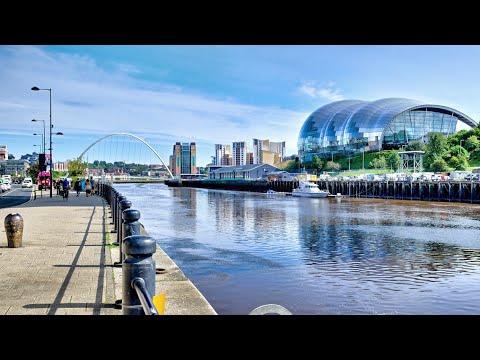
The presenter admires the shiny curved building known locally as The Sage, a Norman Foster-designed music venue opened in 2004 with three halls inside a stainless steel shell.
- Gateshead Millennium Bridge ▶ 55:45
The world's first tilting bridge, opened in 2001, is crossed on foot; the presenter explains how it tilts 40 degrees like a blinking eye to let ships pass.
- Baltic Centre for Contemporary Art ▶ 59:13
The tour ends at the former Baltic Flour Mill turned free contemporary art gallery, noting its industrial brickwork, the Level 4 viewing platform and the nesting kittiwakes.