 PlaceTube
🇮🇹 La Spezia, Italy Walking Tour 4K Afternoon to Evening Walk | Old Town & Marina
Open in PlaceTube Watch on YouTube
Places in this video
- La Spezia Centrale railway station ▶ 2:20
The walk begins at La Spezia Centrale, opened in 1887, described as the main gateway to the Cinque Terre region.
- Via Fiume ▶ 9:00
Via Fiume is an important route from the station to the historic center, lined with early 20th-century tenements with decorative balconies.
- Le Vele (Dialogue Fountain) ▶ 11:20
A white marble sculpture by Viliano Tarabella depicting ship sails spread in the wind, made from Carrara marble.
- Via del Prione ▶ 11:50
The oldest commercial route and today the main pedestrian street, closed to cars, with boutiques, ice cream parlors and bookstores.
- Ethnographic Museum (Museo Etnografico) ▶ 12:50
The municipal Ethnographic Museum and a gallery operate along the pedestrian street, holding artifacts documenting the region's past.
- Piazza Sant'Agostino ▶ 21:10
A spacious square that is the historic heart of the old district, where a 14th-century Augustinian monastery once stood; local restaurants serve fresh fish and seafood.
- Viale Mazzini ▶ 23:30
An elegant palm-lined boulevard along green gardens, named after Giuseppe Mazzini, forming a walking axis near the port.
- Banchina Thaon di Revel ▶ 25:20
A modern pedestrian waterfront promenade named after the WWI navy admiral, offering views of the Gulf of Poets and luxury yachts.
- Mirabello Port ▶ 25:45
A marina built on an artificially raised pier, offering berths for several hundred vessels with a basin depth allowing drafts up to 8 meters.
- Ponte Thaon di Revel ▶ 30:40
A 150-meter pedestrian footbridge opened in July 2013, with a movable central span and a panorama of the naval port from its highest point.
- Naval Technical Museum ▶ 31:55
The Naval Technical Museum collects vessel models, historic compasses and torpedoes, documenting underwater technology since 1860.
- Giardini Pubblici ▶ 32:40
Public gardens established in the second half of the 19th century, with century-old plane trees, an equestrian statue of Garibaldi and an Art Nouveau music pavilion.
- Via Domenico Chiodo ▶ 34:55
A street characterized by monumental neoclassical arcades sheltering pedestrians, with cafes, bookstores and antique shops beneath them.
- Centro Storico ▶ 36:00
The old town preserves its medieval layout with narrow caruggi alleys and trompe-l'oeil painted facades.
- Santa Maria Assunta ▶ 37:00
The city's oldest parish church, begun in the 13th century, destroyed in WWII bombings and rebuilt; it holds a terracotta from Andrea della Robbia's workshop.
- Museo Civico Amedeo Lia ▶ 37:45
Housed in a former 15th-century Franciscan monastery, the museum displays art from antiquity to the 18th century, including works by Titian and Tintoretto.
- San Giorgio hill ▶ 45:30
The route climbs toward the castle hill, where a funicular connects the lower streets with the castle and stone houses line narrow alleys.
- City elevator (Via del Prione - Via XX Settembre) ▶ 56:00
A free automated glass elevator connects Via del Prione with Via XX Settembre, overcoming an 18-meter level difference.
- Cathedral of Christ the King ▶ 57:00
A modern circular cathedral designed by Adalberto Libera in 1956 and completed in 1975, with a dome supported by 12 pillars symbolizing the apostles.
- Natural History Museum (Giacomo Doria) ▶ 59:00
The municipal natural history museum named after Giacomo Doria holds paleontological exhibits, minerals, fossilized plants and insects.
- Via XX Settembre ▶ 1:00:00
A street commemorating the 1870 capture of Rome, with a tree-lined square and views of old tenement roofs and the commercial port.
- Funicolare di San Giorgio ▶ 1:02:00
A 125-meter inclined funicular connecting Via XX Settembre with the castle, overcoming a 40-meter elevation difference in under 90 seconds.
- Castello San Giorgio ▶ 1:02:30
A 13th-century medieval stronghold first erected in 1252 by Niccolò Fieschi, rebuilt after its destruction by Genoa, now housing the Ubaldo Formentini Civic Archaeological Museum with statue stele.
- Scalinata San Giorgio ▶ 1:04:15
A monumental 19th-century staircase with neo-Renaissance elements connecting the castle directly with the old town, lined with cast-iron balustrades and lanterns.
- Palazzo delle Poste ▶ 1:11:30
The post office building in front of Verdi square, designed in 1933 by Angiolo Mazzoni, with a 38-meter tower and futuristic wall mosaics inside.
- Piazza Giuseppe Verdi ▶ 1:12:30
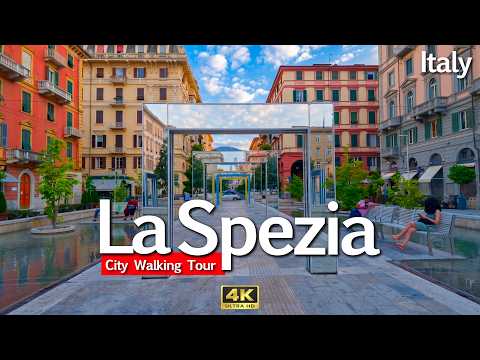
The city's main public square, modernized in 2017 with a colorful installation of geometric gates by Daniel Buren, illuminated by LED at night.
- Via D'Azeglio ▶ 1:15:30
A street named after Massimo d'Azeglio, with traditional Ligurian osterie in the side streets serving homemade seafood cuisine.
- Piazza Bastione ▶ 1:17:15
A square on the site of a former Genoese bastion demolished in the late 19th century, now a center of evening youth gatherings with cafes and a modern water installation.
- Via Biassa ▶ 1:22:00
A street named after the historical Ligurian Biassa family, leading toward the former fish market.
- Piazza Cavour market ▶ 1:22:45
The city market hall operating daily from 7 AM, selling fresh fish, vegetables and fruits under a steel roof from the first half of the 20th century.
- Teatro Civico ▶ 1:24:45
The main municipal drama theater, opened in 1846 and rebuilt in the 1930s in Art Deco style, with a 900-seat auditorium decorated with zodiac motifs.
- Via Roma ▶ 1:27:30
Via Roma marks the border between the medieval core and the 19th-century blocks, where the streets double in width.
- Piazza Garibaldi ▶ 1:30:00
A key pedestrian and road hub near the station, created in the late 19th century, known for its illuminated Belle Époque carousel and a marble fountain by Viliano Tarabella.