 PlaceTube
Alcobaça, Portugal: The Final Scene of the Most Tragic Love Story! [4K]
Open in PlaceTube Watch on YouTube
Places in this video
- Rua Judite Neves Vasco ▶ 1:45
The presenter walks down this street while explaining that Alcobaça is pronounced 'alkubasa' in Portuguese.
- Alcobaça Court ▶ 2:08
He points out the local courthouse building as he passes through town.
- Alcobaça Town Hall (Palacete do Pena) ▶ 2:41
This late 19th-century mansion built by Francisco Pena is now the town hall; the presenter recounts how Pena made his fortune in Brazil and the property passed to the municipality.
- Rua Dr. José Nascimento e Sousa ▶ 6:03
The presenter walks this street while noting the region's rich history and nearby monuments like Batalha.
- Garden of Love ▶ 7:41
He visits this garden, teasing that the reason for its name will become clear at the end of the video (the Pedro and Inês story).
- Nossa Senhora da Conceição Church ▶ 10:16
Built in 1648 on the foundations of a 1152 church that gathered the first monks of Alcobaça while the monastery was under construction.
- Rua Araújo Guimarães ▶ 16:58
Walking here, he explains that in 1153 Afonso Henriques donated the lands of Alcobaça to the Cistercians, starting the monastery.
- Praça da República ▶ 17:37
The presenter crosses this central square in the old town.
- Rua 16 de Outubro ▶ 18:03
He walks this street while noting that monastery construction concluded in 1222 and the main cloister followed decades later.
- Igreja da Misericórdia ▶ 19:46
A church built in 1520, pointed out on Rua do Castelo on the way up to the castle ruins.
- Alcobaça Castle ▶ 20:34
He climbs to the castle ruins, tracing its Visigothic origins, Moorish conquest, rebuilding by the Cistercians, damage by earthquakes, use as a prison, and eventual demolition in the 19th century.
- Avenida Maria de Oliveira ▶ 24:54
The presenter walks down this avenue on his way back toward the monastery.
- Avenida João de Deus ▶ 25:51
Walking here, he discusses the monks' influence on Portuguese culture, including the first authoritative History of Portugal and a public school opened in 1269.
- Rua Frei António Brandão ▶ 27:31
A street mixing recently renovated buildings with ones still awaiting renovation or rebuilding.
- Alcobaça Monastery ▶ 29:22
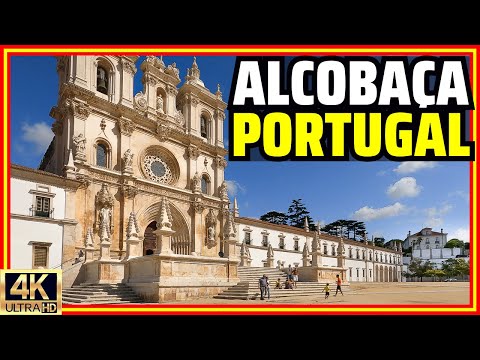
The centerpiece of the visit: Portugal's first Gothic buildings, a UNESCO World Heritage Site, with a Baroque façade added in 1725 and a far more impressive interior.
- Praça 25 de Abril ▶ 30:13
A square with a memorial to Manuel Vieira de Natividade, the archaeologist and historian born in Alcobaça.
- Praça D. Afonso Henriques ▶ 33:31
The square in front of the monastery, where the presenter shows the façade of the Dormitory.
- Claustro da Hospedaria ▶ 39:00
The 'Inn Cloister' inside the monastery; nearby he recounts how Napoleonic troops pillaged the monastery in 1810, including its famous library.
- Cloister of King Dinis (Cloister of Silence) ▶ 41:08
The oldest cloister, first built between 1178 and 1240 and replaced after 1311; talking was forbidden here, hence the name Cloister of Silence.
- Refectory ▶ 41:43
The monks ate here in silence while one monk read Bible passages from the pulpit; a narrow 32cm opening in the wall was used to hand meals to the poor.
- Monastery Kitchen ▶ 46:00
Famous for its enormous chimney supported by eight iron columns, with water diverted from the Alcoa river through a canal under the floor.
- Monks' Room ▶ 47:58
Originally accommodation for novices, later a work and living room; a nearby compartment may have served as the monastery prison.
- Dormitory ▶ 49:38
The monks slept here together and fully clothed, separated only by movable partitions; only the abbot had his own room.
- Cloister of the Novices (Cloister of the Cardinal) ▶ 56:10
The presenter passes through this cloister while telling the story of Pedro and Inês de Castro.
- Chapter Room ▶ 56:26
The most important room after the church, where monks gathered daily to hear a chapter of the Rule of Saint Benedict; abbots were buried beneath its floor.
- Tomb of King Pedro I ▶ 1:01:36
Pedro's final resting place, supported by lions with angels around the recumbent king, placed opposite Inês's tomb so they face each other at the Last Judgment.
- Tomb of Inês de Castro ▶ 1:03:36
Inês's tomb, supported by half-men half-beasts with angels, faces Pedro's; the pair are among Portugal's finest Gothic sculptures, inscribed 'Até o fim do mundo'.
- Royal Pantheon Tombs ▶ 1:06:43
The monastery served as the second royal pantheon, with tombs of Queen Urraca of Castile, Queen Beatriz of Castile, and Kings Afonso II and Afonso III.
- Room of Kings ▶ 1:08:59
A room with statues of Portuguese kings and blue-white tile panels telling the monastery's history, including Afonso Henriques crowned by Pope Alexander III and Bernard of Clairvaux.