 PlaceTube
Gloucester: England's most underrated historic city?
Open in PlaceTube Watch on YouTube
Places in this video
- Gloucester railway station ▶ 0:21
The presenter starts his walk here, noting it has the longest unbroken train platform in the UK at 602 metres, built to hold two high-speed trains.
- Gloucester bus station ▶ 0:54
He points out the bus station as he walks down from the railway station toward the city centre.
- The Forum ▶ 1:54
A newly regenerated area near the bus station with an office block and the boutique Hotel Indigo, with stones commemorating Gloucester's Roman history as Glevum.
- Hotel Indigo Gloucester ▶ 2:03
He notes this boutique hotel on the left as part of the new Forum development.
- King's Square ▶ 5:27
Formed in 1928 after houses were demolished, this square has the cathedral towering over it and hosts events and a Christmas market.
- University of Gloucestershire ▶ 5:40
He points out the building on King's Square that was formerly a Debenhams department store, now part of the University of Gloucestershire.
- The Regal (Wetherspoon) ▶ 5:56
A Wetherspoon pub that used to be the Regal cinema, where the Beatles played in the early 1960s.
- Gloucester Post Office ▶ 6:52
An original 1933 post office building, not one tucked inside a shop, which he says is rare nowadays.
- New Inn ▶ 9:04
A Grade I listed 1450 medieval courtyard inn, the most complete surviving example in England, said to be Gloucester's most haunted pub; Lady Jane Grey was proclaimed queen here.
- Site of the first Bank of England branch outside London ▶ 11:35
He notes this as the site of the first Bank of England branch opened outside London, on 19 July 1826.
- The Cross ▶ 12:26
The historic centre of medieval Gloucester where the four gate streets converge.
- Southgate Street ▶ 12:40
One of the four gate streets, with some surviving Tudor buildings though many were demolished in the 1960s.
- Crypt School ▶ 14:31
He points out this building, a school founded in 1539, and notes George Whitefield was born at the nearby Bell Inn in 1714.
- Greyfriars ▶ 16:35
The old friary built around 1231, closed in 1538 during Henry VIII's dissolution of the monasteries.
- Eastgate Street ▶ 18:53
One of the four gate streets and the main pedestrianised shopping area, with a glass-covered section of Roman city remains.
- St Michael's Tower ▶ 21:22
The only remaining part of St Michael's Church, a 14th-century medieval tower left standing after the Victorian church was demolished in 1956.
- Westgate Street ▶ 22:35
He walks down this gate street past the site of a 12th-century merchant's house and inn, and later the County Council offices.
- Fountain Inn ▶ 24:46
A 16th-century coaching inn with origins dating back to 1216, currently not open.
- The Beatrix Potter Shop and Museum ▶ 26:14
A shop and museum dedicated to Beatrix Potter, linked to her book The Tailor of Gloucester.
- Gloucester Cathedral ▶ 26:43
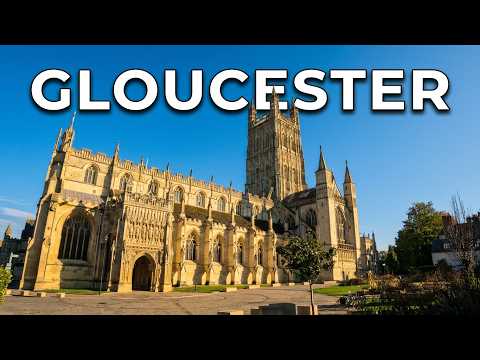
The jewel in the city's crown, built by the Normans from 1100 on the site of an abbey dating to 679; he tours the exterior and interior.
- Gloucestershire and South Africa Yeomanry War Memorial ▶ 29:12
A monument outside the cathedral to local soldiers killed in First World War battles such as Sinai, Gallipoli and Palestine.
- St Mary's Gate ▶ 31:10
A 13th-century gate forming the entrance to St Peter's Abbey precinct.
- Bishop Hooper statue ▶ 31:44
A statue to John Hooper, Bishop of Gloucester, martyred in 1555 for his Protestant faith near this execution spot.
- St Nicholas Church ▶ 44:09
He points out St Nicholas Church at the bottom end of Westgate Street, along with the Folk Museum.
- Gloucester Folk Museum ▶ 44:09
Mentioned near St Nicholas Church at the bottom of Westgate Street, possibly in Bishop Hooper's lodging building.
- Gloucester Docks ▶ 44:50
Now known as Gloucester Quays, the docks have been transformed over 20 years, keeping old warehouses converted into offices and flats, with barges and tall ship events.
- Soldiers of Gloucestershire Museum ▶ 46:06
A museum at the docks covering the county's military history.
- Sharpness and Gloucester Canal ▶ 47:31
Built in 1793 to let larger ships reach the inland docks, joining the River Severn further down.
- Gloucester Quays ▶ 49:00
A designer outlet shopping centre at the docks, which he says was done well but perhaps to the detriment of the city centre.