 PlaceTube
How America's Capital Became Its Most Dangerous City: Washington, D.C.
Open in PlaceTube Watch on YouTube
Places in this video
- The Strip (Morton and Orleans Place NE) ▶ 0:20
The open-air drug market known as The Strip, where Rayful Edmond's crew once moved 30 transactions a minute, operated a mile from the Capitol; the presenter notes it is quiet and gentrified now.
- United States Capitol ▶ 2:58
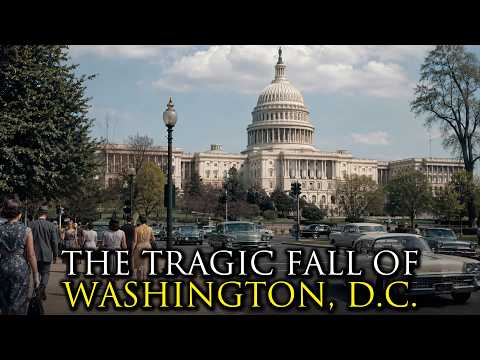
L'Enfant placed Congress on the highest hill, Jenkins Hill, giving the people's legislature the best real estate; the dome is a recurring image throughout the video.
- White House ▶ 2:58
L'Enfant's plan radiated grand avenues from the Capitol and the President's House; the British burned the White House during the War of 1812.
- National Mall ▶ 3:15
L'Enfant proposed a sweeping mall stretching from the seat of Congress to the river; early on, cows grazed on the mall and a railroad station stood on it.
- Library of Congress ▶ 4:57
The presenter notes the British burned the Capitol, the White House and the Library of Congress with all its books during the War of 1812.
- Constitution Avenue ▶ 6:51
Boss Shepherd's crews covered the stinking Washington Canal, which ran along what is now Constitution Avenue.
- Shaw ▶ 10:14
Black families settled in neighborhoods like Shaw and LeDroit Park; the 7th Street corridor in Shaw was hit especially hard by the 1968 riots.
- LeDroit Park ▶ 10:14
Named alongside Shaw as one of the neighborhoods where black families settled during the Great Migration.
- U Street ▶ 10:16
By the 1920s U Street was the center of African-American cultural life, called Black Broadway, with more than 300 black-owned businesses; it later filled with wine bars and luxury apartments.
- Howard Theatre ▶ 10:34
Opened in 1910, predating Harlem's Apollo by more than two decades, it was one of the first major theaters built for black audiences; it reopened in 2012 after a $29 million renovation.
- Lincoln Theatre ▶ 10:47
The Lincoln Theatre followed in 1922 and is a performing arts venue again today.
- Crystal Caverns ▶ 10:51
A jazz club tucked in the basement of a drugstore at 2001 11th Street that hosted Duke Ellington, Miles Davis, John Coltrane and Billie Holiday.
- Industrial Bank ▶ 11:22
Founded in 1934 by nine black businessmen, it provided loans to families and entrepreneurs who couldn't borrow from white-owned institutions.
- Whitelaw Hotel ▶ 11:34
Built in 1919 at 13th and T by John Whitelaw Lewis, it offered black travelers accommodation segregation denied them; Duke Ellington stayed three nights in May 1935.
- Howard University ▶ 12:31
The great HBCU founded in 1867 sat at the neighborhood's northern edge, feeding a professional class into the surrounding blocks.
- 14th and U Streets ▶ 14:37
The heart of Black Broadway became the epicenter of the 1968 riots after King's assassination; today a Lululemon, SoulCycle and CVS occupy the ground where the People's Drug Store stood.
- H Street Northeast ▶ 17:02
Named among the corridors that burned in 1968 and did not recover for 30 years.
- Ben's Chili Bowl ▶ 33:38
The legendary half-smoke joint at 1213 U Street survived the riots because the community protected it; it now shares the block with a boutique hotel.
- Congress Heights ▶ 34:38
One of the overwhelmingly black, poor and disproportionately violent neighborhoods east of the Anacostia where crime migrated after gentrification.
- Barry Farm ▶ 34:42
Named with Congress Heights and Anacostia as neighborhoods where the murder rate still exceeds the national average and public housing bears decades of disinvestment.
- Anacostia ▶ 34:42
The presenter says Anacostia proper remains overwhelmingly black and poor, with a murder rate far above the national average.