 PlaceTube
Inside America's Grandest Jazz Age Summer Palace | Touring Castle Hill on the Crane Estate | NO AI
Open in PlaceTube Watch on YouTube
Places in this video
- Castle Hill ▶ 0:00
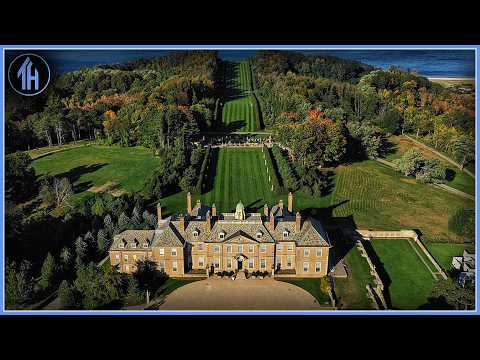
The presenter introduces Castle Hill as one of America's last great Jazz Age summer palaces, a 56,000-square-foot estate with endless gardens and rooms salvaged from English country houses.
- The Great House ▶ 2:37
The presenter describes the English Stuart-style manor David Adler designed for the Cranes, completed in 1928, with its Holland brick facade, slate hip roof, cupola and ten tall chimneys.
- Grand Allée ▶ 4:07
The presenter calls the Grand Allée the estate's most breathtaking feature: a 160-foot-wide ribbon of lawn running half a mile from the hilltop down to a bluff above the ocean, lined with spruce, pine and cedar.
- The Casino ▶ 4:35
The presenter explains that this 'casino' means a little house in the Italian sense, the estate's outdoor entertainment complex, tucked into the hillside below the sight lines from the house.
- Hedge Maze site ▶ 4:44
The presenter notes a hedge maze with gravel paths was planted in 1920 on a site recommended by the Olmsted Brothers, later dismantled, and the lawn where it stood is now open and green.
- Italian Garden ▶ 5:06
The presenter describes the formal Italian Garden, Florence's favorite, a sunken oasis of perennial beds with two octagonal tea houses joined by a pergola and a columned balcony above a fountain and pool.
- Rose Garden ▶ 5:25
The presenter describes the circular Rose Garden framed by a pergola-covered walk, designed by Arthur Shurcliff with plantings chosen by rosarian Harriett Risley Foote, where hardy roses still bloom in late summer.
- Gallery ▶ 6:53
The presenter tours the Gallery, a 63-foot-long room with 16-foot ceilings holding twin fireplaces, one topped by a clock and the other by a wind indicator wired to a master gauge.
- Rotunda ▶ 7:16
The presenter shows the circular Rotunda with its parquet starburst floor and walls and domed ceiling painted by Chicago artist Abram Poole.
- Drawing Room ▶ 7:33
The presenter describes the grandest room in the house, roughly 48 by 26 feet, restored with paneled walls and curtains, meant for entertaining guests before dinner rather than as a ballroom.
- Library ▶ 8:09
The presenter highlights the Library's centerpiece: paneling and carved woodwork bought in 1922 from a demolished English house in Hertfordshire, including an overmantel carved by Grinling Gibbons.
- Dining Room ▶ 8:24
The presenter shows the Dining Room with soft green paneled walls assembled from salvage from an eighteenth-century London townhouse, a tray ceiling with dentil molding, and a bay window looking down the allée.
- Butler's Serving Pantry ▶ 9:12
The presenter tours the two-story butler's serving pantry with china cabinets, a dumbwaiter and a multi-level lazy Susan for passing hot food through to a heated metal table.
- Grand Staircase ▶ 9:39
The presenter climbs the richly carved grand staircase with delicate balusters, noting the decorative motifs leading the eye up to the second floor hall.
- Mr. Crane's Bedroom ▶ 10:08
The presenter shows Mr. Crane's wood-paneled bedroom above the drawing room, with jib doors concealing a hidden bookcase and a dressing-room door, and his showpiece black-and-white marble bathroom.
- Mrs. Crane's Suite ▶ 10:32
The presenter notes Mrs. Crane's bedroom faces inland, paneled in pickled pine, with a green paneled dressing room and a green marble bathroom considered the prettiest on the estate.
- The Blue Room ▶ 10:51
The presenter mentions the Blue Room, a guest room hung in restful blue.
- The Chinese Room ▶ 10:51
The presenter describes the Chinese Room, once papered in hand-painted Chinese wallpaper that was sold at auction and later replaced.
- Cupola roof deck ▶ 11:01
The presenter notes a popular tour climbs a hidden spiral staircase through the attic and out onto the roof at the base of the cupola, where the whole estate spreads out below.
- The Oak Room ▶ 11:01
The presenter calls the Oak Room a darker, more masculine guest space paneled in late seventeenth-century wood.
- Crane Beach ▶ 11:58
The presenter explains that in 1945 the family gave 1,000 acres of beach and dunes, most of what is now the beloved public Crane Beach, to The Trustees of Reservations.
- Crane Wildlife Refuge ▶ 12:08
The presenter mentions that a quarter century later Florence's daughter-in-law added the 680-acre Crane Wildlife Refuge to the estate's holdings.