 PlaceTube
Barcelona, Spain ☀️ Ciutadella Park to Sagrada Familia | 4K Walking Tour
Open in PlaceTube Watch on YouTube
Places in this video
- Parc de la Ciutadella ▶ 2:00
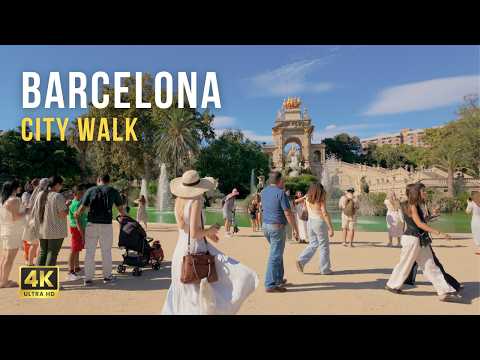
The walk begins in Ciutadella Park, Barcelona's largest green space, a favorite spot for locals to relax, play music and exercise. The presenter explains it stands on the site of a former fortress built by Philip V after the 1714 siege.
- Cascada del Parc de la Ciutadella ▶ 5:20
The park's grand fountain was inspired by Rome's Trevi Fountain, with two massive crab claws forming stairways to a central podium where Venus rises from a clam shell.
- Parc de la Ciutadella bandstand ▶ 6:10
The presenter shows the park's beautiful bandstand, often filled with music, dance and outdoor activities, where locals practice boxing, dance or exercise on sunny days.
- Mammoth statue, Parc de la Ciutadella ▶ 7:44
This life-sized mammoth was built in 1907 using early armored concrete, meant to be part of a full 'stone zoo' that ended with the death of geologist Norbert Font i Saqué. It is a beloved symbol of the park.
- Parc de la Ciutadella lake ▶ 8:30
The park's main pond is a peaceful oasis surrounded by greenery and wildlife, where birds nest on the islands and visitors can rent rowboats to explore the water.
- Palau del Parlament de Catalunya ▶ 10:51
Built between 1717 and 1727 as a military arsenal for the Ciutadella fortress, it became a royal palace for the 1889 Universal Exposition and has been the seat of the Parliament of Catalonia since 1932.
- Arc de Triomf ▶ 29:00
The grand gateway connecting Eixample with Ciutadella Park was built by Josep Vilaseca for the 1888 World Fair in reddish brick Neo-Mudéjar style, decorated with friezes of agriculture, trade, arts and sciences.
- Passeig de Lluís Companys ▶ 29:37
This avenue opening from the Arc de Triomf is a lively pedestrian area popular with locals and visitors, used for marathons, fairs and Chinese New Year celebrations.
- Tetuan Square ▶ 29:55
Walking to Tetuan Square, the presenter notes this area is known as Barcelona's Chinatown, full of shops, restaurants and bubble tea, great for Asian cuisine and groceries.
- Eixample ▶ 38:46
The presenter explains Eixample, Barcelona's famous district of wide streets and geometric blocks designed in 1859 by Ildefons Cerdà, with chamfered corners and its Modernist architecture and superblocks.
- Casa Antònia Burés ▶ 43:57
Built between 1903 and 1906 by Juli Batllevell for a textile industrialist's family, its façade features stone balconies, vegetal motifs and two tribunes resting on stone trees, with an ornate elevator inside.
- Plaça d'Urquinaona ▶ 53:24
A bustling square in central Barcelona connecting Eixample with the old city, named after Bishop José María de Urquinaona, where you also find Teatre Borràs hosting local plays and cultural events.
- Via Laietana ▶ 56:50
One of Barcelona's main arteries connecting the old city to the port, where the walk continues toward the Palau de la Música Catalana.
- Palau de la Música Catalana ▶ 58:48
Hidden in the street, this magnificent concert hall built in the early 20th century hosts concerts, choirs and cultural events year-round, famous for its stained glass and intricate Catalan architecture.
- Gothic Quarter ▶ 1:02:07
Barcelona's old town, where the streets are narrow and winding, contrasting with the organized Eixample grid.
- Els Quatre Gats ▶ 1:04:12
A historic café in the Gothic Quarter opened in 1897, a hub for artists, writers and modernist thinkers including Picasso, still retaining its vintage décor and bohemian atmosphere.
- Avinguda del Portal de l'Àngel ▶ 1:06:10
One of Barcelona's busiest streets, crowded all day with shoppers drawn by the many shops and boutiques lining the avenue, giving a lively, energetic city-center atmosphere.
- Teatre Tívoli ▶ 1:12:50
Located on Carrer de Casp in central Barcelona, it is one of the city's largest theaters, hosting opera, musicals and Catalan plays.
- Palace Hotel Barcelona ▶ 1:19:26
A historic luxury hotel in the heart of the city, opened in 1919, which has hosted royalty, celebrities and important events, with an elegant façade and grand interiors.
- Les Cases Cerdà ▶ 1:25:44
A historic architectural ensemble at the corner of Consell de Cent and Roger de Llúria, built in 1863 following the original Cerdà Plan, with ceramic railings and sgraffito decorations; only three of the original four houses survive.
- Carrer del Consell de Cent ▶ 1:27:21
One of Eixample's long, straight streets, recently remodeled under the Superilla plan with wider sidewalks, green areas and calmer traffic to prioritize pedestrians and cyclists.
- Passeig de Sant Joan ▶ 1:37:29
The walk ends back at Passeig de Sant Joan near the Arc de Triomf; this avenue is loved by locals, full of restaurants, bars, ice cream shops, comic shops and unique gift stores.
- Sagrada Família ▶ 1:52:02
The final destination is Gaudí's most iconic masterpiece, under construction since 1882 and still unfinished; the presenter describes the Nativity and Passion façades, the planned 18 towers, the colorful stained glass and its UNESCO World Heritage status.